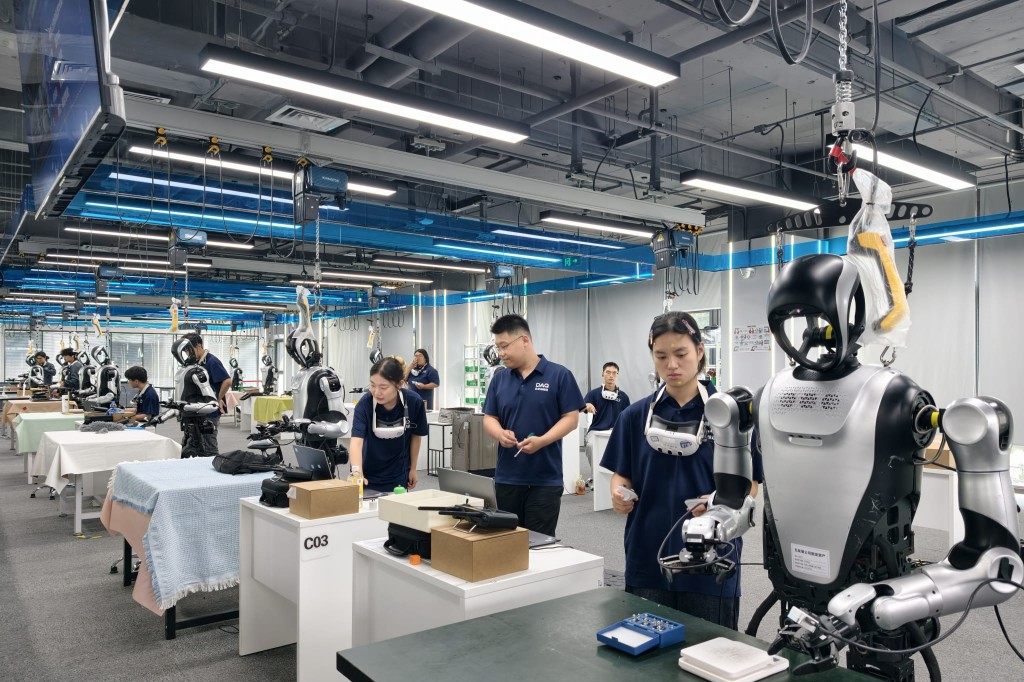
China is seeing a rapid expansion of embodied artificial intelligence training facilities, where robots are learning skills ranging from picking up screws and sorting parcels to folding clothes, cooking and assisting with elderly care.
At the country’s largest humanoid robot training center in Beijing’s Shijingshan district, simulated environments covering manufacturing, smart homes, elderly care and 5G applications allow robots to train for tasks ranging from sports and household companionship to factory production and logistics.
Each robot is paired with a dedicated trainer who uses teleoperation equipment to guide its movements while recording operational data such as joint rotation angles and grip force.
Zhu Kai, general manager of the center, said training a robot in even one basic skill requires thousands of sets of data.
While motion control and physical coordination have become increasingly mature, he said competition in the industry is shifting toward more advanced capabilities, including cognitive decision-making, environmental perception and semantic understanding.
China shipped 23,000 humanoid robots in the first half of this year, but fewer than 5 percent are capable of performing practical tasks on factory production lines, largely because of a shortage of high-quality real-world training data, Zhu said.
By the end of last year, at least 30 data-collection facilities had been established in major cities including Beijing, Tianjin, Shanghai and Guangzhou, as well as Zhengzhou, Wuxi and Jinan.
To help address the global shortage of embodied AI training data, a new cross-embodiment data-collection model is also gaining traction in China.
Companies have begun recruiting “Universal Manipulation Interface data collectors” through social media platforms, offering around 20 yuan (HK$22) an hour or 200 yuan a day.
The work does not require an actual robot to be present. Instead, collectors wear sensors and recording equipment provided by data companies while performing tasks in real-world settings such as factories, supermarkets and homes.
By repeatedly carrying out everyday actions such as tightening screws, picking fruit and vegetables or folding clothes, workers generate movement data that can be processed and used to train embodied AI models.