The rapidly growing need for artificial intelligence computing power is fundamentally altering the geographical layout of data centers in mainland China.
According to financial media outlet Yicai, the city of Ulanqab in Inner Mongolia has emerged as a prime destination for tech heavyweights, including Alibaba, Apple, Huawei, ByteDance, and Kuaishou.
These multinational companies are drawn to the region's low electricity costs, a climate that naturally aids in cooling servers, and minimal network latency.
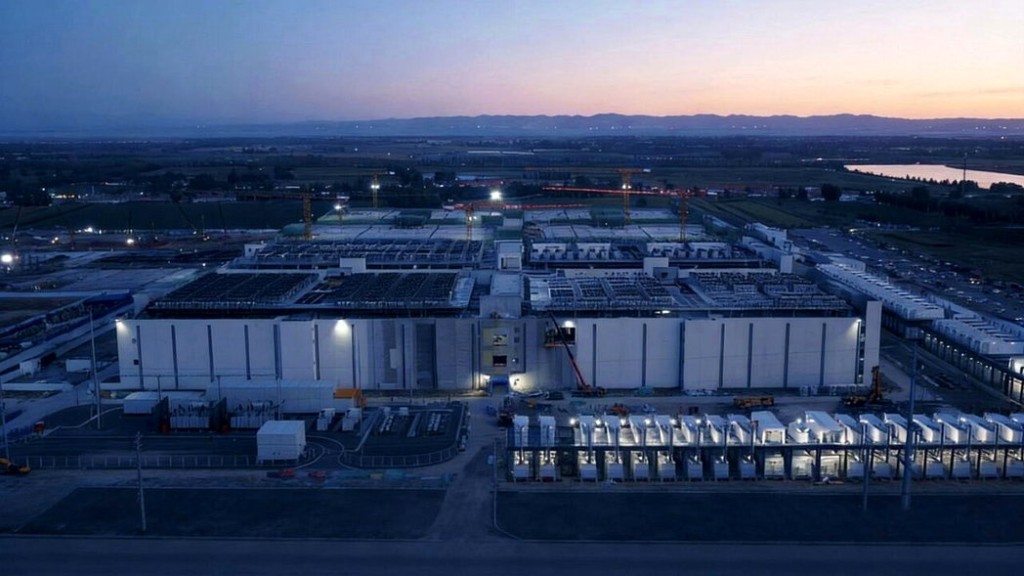
Driving through the Chahar High-Tech Zone in Ulanqab, observers can spot more than thirty data centers belonging to various enterprises, with numerous industrial parks still actively under construction.
The core advantage of this location lies in its highly affordable power supply. Wang Zhaoyang, general manager of Alibaba's data center operations, explained that the local electricity rate is highly competitive, while the annual average temperature stays around a chilly four degrees Celsius.
Furthermore, being situated just 350 kilometers from Beijing, the area offers a brief round-trip network delay of roughly four milliseconds.
Wang noted that the strategic selection of Ulanqab is driven by a complex interplay of market demands, cost efficiency, and technological requirements.
Shifting priorities from cloud computing to AI
The logic behind data center placement has evolved significantly in recent years.
During the peak of the cloud computing era, digital services such as e-commerce, online payments, and gaming required extremely fast response times.
Being physically close to consumer markets was a top priority, which previously made neighboring cities like Zhangjiakou highly desirable for tech firms.
However, the dawn of the AI era has brought a massive surge in the need for training large language models.
The average power consumption per server cabinet has skyrocketed from a fraction of what it was in standard cloud data centers to an immense load in AI-specific facilities, making electricity supply a major production bottleneck.
Additionally, because intensive AI model training and certain reasoning tasks are much more forgiving of slight cross-regional network delays, cities like Ulanqab are now considered geographically close enough to serve major tech hubs effectively.
A broader geographical relocation trend across the country
This evolution is driving a distinct geographical shift in China's technological infrastructure. Wang pointed out that the data center industry is currently expanding westward to focus on heavy AI training while simultaneously establishing localized facilities eastward for reasoning tasks that require more immediate outputs.
Initially, massive computing clusters featuring thousands of processors were densely concentrated in major eastern economic hubs, such as the Beijing-Tianjin-Hebei region, the Yangtze River Delta, and the Greater Bay Area.
Today, the most extensive computing networks have largely relocated to the western and less populated regions of the country, with industry experts anticipating that even larger facilities will continue to move further west in the future.















![Mu Xinyue (C) of team China celebrates with her teammates after the 1v4 asymmetrical survival game [Identity V - Asian Games Version] final of Esports between team China and team Japan at the 20th Asian Games Aichi-Nagoya 2026 in Tokoname of Aichi Prefecture, Japan, Sept. 30, 2026. (Xinhua/Wang Fei)](https://image.hkstandard.com.hk/f/1024p0/0x0/100/none/2419e193e5dca7d4943445f5dc5616b2/2026-10/e.jpg)