
Read More
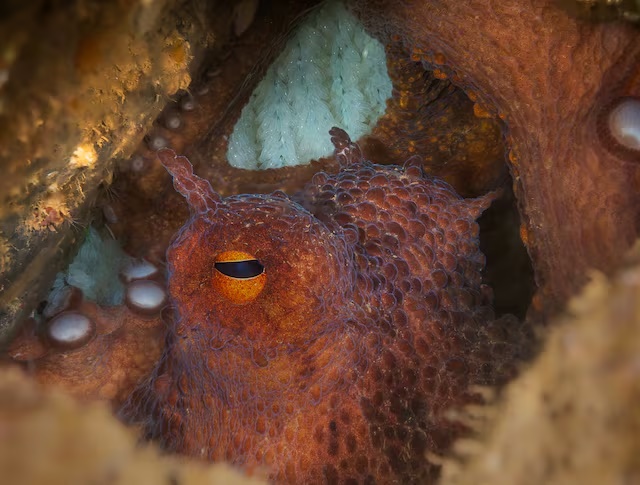
Octopuses are famous for slipping through seemingly impossible gaps. Scientists have now mapped how they do it, finding that these marine invertebrates organize their eight arms and soft bodies into a sequence that changes when the opening gets tighter — a strategy that could offer lessons for robots designed to enter confined spaces.
ADVERTISEMENT
SCROLL TO CONTINUE WITH CONTENT
Unlike humans and other animals with rigid skeletons, octopuses have extremely flexible bodies built around what scientists call a muscular hydrostat, a system of muscles that provides both support and movement without bones.
Their eight dexterous arms can bend and elongate, while their central mantle can change shape. The animal's circulatory system is also suited to contortions: major blood vessels have muscular pumping systems that help keep blood moving locally even when part of the body is constricted.
"In nature, octopuses have the ability to move through spaces smaller than their bodies, a capability called squeezing behavior," said Wenci Xin, a researcher at the National University of Singapore's Soft Robotics Lab and one of the authors of the study published in the Journal of Experimental Biology. "We explored whether there is a general pattern in how these animals perform this behavior that could be applied to robots in the future."
The researchers made videos of three sub-adult common octopuses squeezing through an adjustable opening. They discerned two main strategies: a three-step process employed by the octopuses when the opening was wider than the distance between the animal's eyes, and a four-step process used when it was narrower.
"At the beginning, we expected the animals to use the same strategy. ... We were surprised when we found that the strategy changed," Xin said.
In the three-step maneuver, an octopus first probed the opening with one arm, moved several more arms through, then used the inserted arms against the partition to pull the remaining arms, head and mantle through. With a tighter opening, the octopus added a step, pulling the remaining arms through before squeezing its head and mantle through separately.
It is not clear what determines the narrowest gap an octopus can squeeze through. The animal's beak, which functions as its jaws and is its only rigid body part, has long been considered the limiting factor, but Xin said the experiments suggest it may instead be the size of the arms near the body.
'THE TACTILE SENSE'
For an octopus, squeezing into tight spaces can provide an escape route and access to prey that other marine creatures cannot easily reach.
"The idea is that the octopuses use the tactile sense on the arms to investigate the opening," said Michael Kuba, a biologist at the University of Naples Federico II and co-author of the study.
Different octopus species may not tackle tight spaces in the same way. The common octopus is a generalist predator in coastal waters, particularly around rocky shores, where there are many holes to squeeze through, Kuba said. Species living on sandy seabeds or those with very different body shapes and arm lengths might use different strategies to negotiate openings, Kuba added.
The researchers hope that understanding how octopuses solve this problem could help engineers design more versatile robots for navigating similarly confined spaces.
Search-and-rescue robots designed to move through debris are often long and slender because they need a small cross-section to navigate narrow gaps, Xin said. An octopus-inspired robot potentially could carry more equipment, with flexible arms equipped with different sensors, tools or communication devices, Xin added.
Building one presents an engineering challenge: its arms would need to be soft enough to squeeze through narrow openings, but strong and dexterous enough to bend, twist and stretch while pulling the rest of the body through, Xin said. Conventional actuators needed to control such complex movements typically add rigid components, making the robot stiffer.
For Kuba, the study also highlights how much remains to be learned about the animals themselves.
"Humans feel attracted to octopuses as the soft intelligence in the ocean," Kuba said. "But we know very little about how the octopus lives its daily life."
Reuters