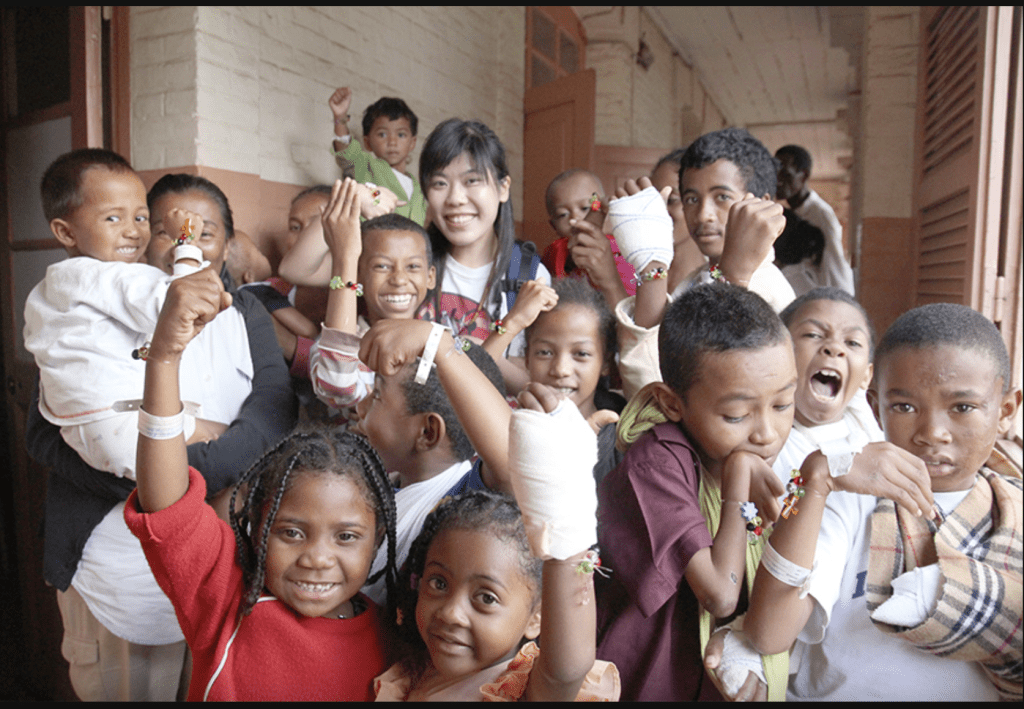
For the past decade, a nurse from the Intensive Care Unit (ICU) of Queen Elizabeth Hospital has made an annual journey to Madagascar to provide humanitarian aid. In a country severely lacking medical resources, she uses games and music as a substitute for anesthesia to comfort young patients during wound care. Despite the harsh conditions, she has never wavered, stating, "I may not be able to change the world, but I can help one person at a time."
10 Years of Rescue Work: Using Play in Place of Anesthesia
According to an article in the Hospital Authority's publication HASLink, advanced practice nurse Jasmine Mak Po-ching from the ICU at Queen Elizabeth Hospital has, since 2014, traveled over 8,600 kilometers and flown more than 18 hours each year from Hong Kong to Madagascar with a charitable organization. Her mission: to provide wound care for children in need. In recognition of her years of dedication to humanitarian work, she was recently awarded the Hong Kong Red Cross's "Hong Kong Humanity Award 2024."
Mak recalls her first trip: "When I first went to Madagascar, the gap from Hong Kong was immense. The local people struggle to find enough food for three meals a day. Children would scavenge in polluted rivers and search for food on garbage dumps." Yet, this difficult reality only strengthened her resolve. "I felt even more strongly that I needed to continue this work. This place needs me," she says.
Madagascar suffers from a severe shortage of basic medical equipment. Relying on her years of experience at Queen Elizabeth Hospital, Mak has learned to adapt quickly to emergencies. "In Madagascar, we've experienced power outages during surgery and suddenly realized we didn't have enough clean water, forcing us to immediately fetch bottled water from our accommodation to the operating room." With a lack of precision instruments, she relies on clinical experience to assess patients, paying extra close attention to the children. When treating wounds, she uses music and games instead of anesthesia to distract her young patients from the pain.
With Skill and Love: Modifying Shoes for Remote Patients – "Help One Person at a Time"
In Madagascar, most families cannot afford medical care. Many children end up with severe disabilities simply because burns or minor wounds were not properly treated. These children with disabilities often face discrimination in their communities, leaving them isolated at home, unable to attend school or make friends. To address this, Mak organizes activity classes, teaching children arts and crafts and drawing. Through play therapy, they gradually let down their guard and open their hearts.
"At first, the children were very afraid of how others saw them. They would come to drawing class wearing long sleeves to hide their physical disabilities," she explains. "But in the activity class, they found people who accept them for who they are. It gives them friends to share their childhood with."
Furthermore, many children from remote villages must travel a full day by car to return home after surgery. To prevent wound infections on the long journey, Mak uses supplies brought from Hong Kong along with local materials to personally modify their shoes, ensuring they can travel home safely.
A Decade of Service: "Love and Companionship Matter Most"
Having served in Madagascar for over 10 years, Mak admits her perspective has shifted. "In the past, I thought I needed to work hard to use my professional nursing skills here. But now I've realized that love and companionship are even more important." She has also learned to refer families in need to local long-term support groups, helping them find opportunities for self-sufficiency.
Years of humanitarian work have taught her humility and gratitude, inspired by the local people who endure difficult lives yet remain optimistic. Mak concludes, "I may not be able to change the whole world, but I can help one person at a time. Helping others knows no distance. Anyone willing to reach out a hand can let their light shine on those around them."