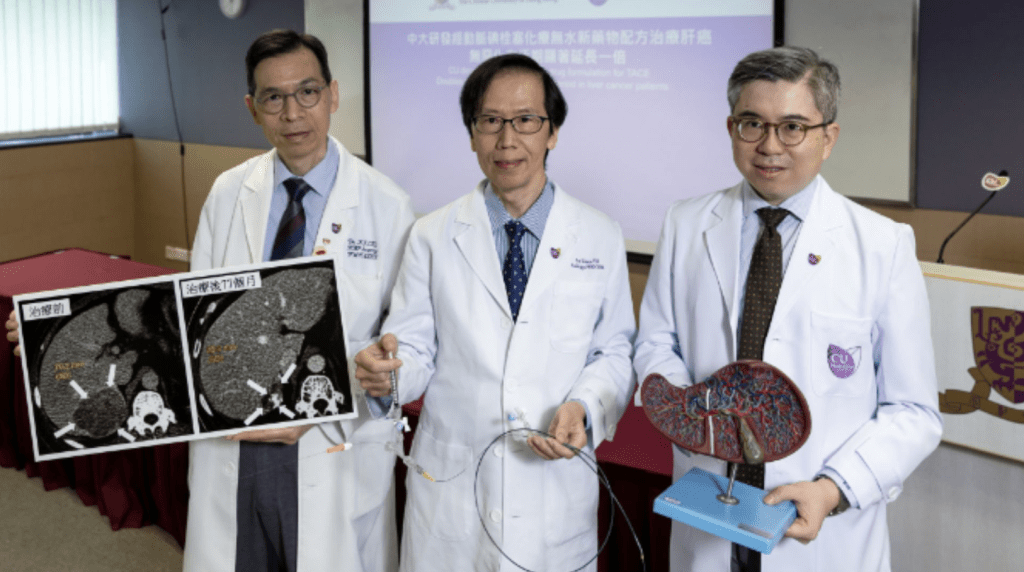
The Department of Imaging and Interventional Radiology at the Faculty of Medicine, The Chinese University of Hong Kong (CU Medicine), has developed a new drug formulation (aTACE) based on conventional transarterial chemoembolization (cTACE) for intermediate-stage hepatocellular carcinoma (HCC). This new formulation combines anhydrous cisplatin with lipiodol and has achieved breakthrough results in clinical trials.
Liver Cancer Ranks Third Among Cancer Killers in Hong Kong
Liver cancer ranks third among cancer killers and fifth among the top ten most common cancers in Hong Kong. According to the latest data from the Hospital Authority, there were 1,700 new cases of liver cancer in 2023 alone, with HCC accounting for the majority (over 1,400 cases). However, nearly half of the patients are diagnosed at intermediate to advanced stages, making surgical tumor removal impossible.
Conventional transarterial chemoembolization (cTACE) involves delivering a mixture of lipiodol and the water-soluble chemotherapeutic drug cisplatin via a catheter directly into the blood vessels supplying the liver tumor. Microspheres are then used to block these vessels, cutting off the tumor's blood supply and causing cancer cell death. Currently, although three types of transarterial therapies are commonly used for HCC, the complete tumor response rate on imaging is less than 30% for all of them, including:
- cTACE therapy
- Drug-eluting bead (DEB) chemoembolization
- Radioembolization
The CU Medicine team's new transarterial chemoembolization formulation (aTACE) uses "anhydrous" (water-free) cisplatin. The key advantage is that the anhydrous drug dissolves slowly in the bloodstream and is not rapidly diluted. This allows it to maintain a high concentration within the tumor for a prolonged period, continuously releasing its therapeutic effect. This effectively addresses the drawback of conventional cTACE, where the water-soluble cisplatin formulation is easily washed away by blood flow.
Significant Efficacy with New Formulation: 90% of Patients Achieve Complete Tumor Response on Imaging
From 2016 to 2023, CU Medicine's multidisciplinary team conducted a prospective, multicenter randomized clinical trial. The study enrolled 77 patients with HCC, aged 49 to 86, who were randomly assigned to receive either cTACE or aTACE. Patients received treatment cycles every two months, for a total of two to three cycles over six months. The results showed:
- The aTACE new formulation was significantly superior to conventional cTACE across all efficacy indicators. The complete tumor response rate on imaging reached 90%, nearly double that of conventional therapy.
- The three-year progression-free survival rate was two times higher. The median overall survival exceeded 53.3 months, significantly extended by 17.3 months compared to conventional therapy.
- Follow-up at 30 days after the first treatment cycle also showed that the new therapy had fewer side effects than conventional therapy. Although there was a higher incidence of elevated ALT liver enzymes, most patients' liver function abnormalities returned to normal within two weeks, with the remainder recovering within 30 days.
- aTACE had a lower risk of severe side effects such as liver abscess and liver failure following treatment.
Dr. Lee Kit-fai, Clinical Associate Professor (Honorary) in Hepatobiliary and Pancreatic Surgery, Department of Surgery, CU Medicine, stated: "The study results are encouraging. The three currently commonly used transarterial therapies for treating HCC have similar clinical outcomes, with no significant differences in overall survival. The emergence of aTACE provides physicians with an ideal treatment option when managing patients with intermediate-stage liver cancer."
Professor Simon Yu Chun-ho, Clinical Professor (Honorary) in the Department of Imaging and Interventional Radiology, CU Medicine, stated: "Since the introduction of conventional chemoembolization 39 years ago, the global medical community has been working to improve the clinical efficacy of transarterial therapy for intermediate-stage HCC, but significant breakthroughs have been lacking for many years. After seven years of dedicated work, the CU Medicine team has successfully demonstrated that aTACE is significantly superior to conventional therapy across multiple treatment efficacy indicators. This marks a significant step toward developing a more ideal treatment regimen for patients with intermediate-stage HCC. I sincerely thank all the patients and colleagues who participated in this research."
Professor Stephen Chan Lam, Ip's Family Trust Professor in Cinical Oncology and Professor in the Department of Oncology, CU Medicine, stated: "aTACE not only breaks through the existing efficacy level of transarterial therapies but also highlights CU Medicine's capabilities in medical research. The team believes that conducting larger clinical trials on the clinical efficacy of aTACE will help expand the use of aTACE, benefiting more patients."