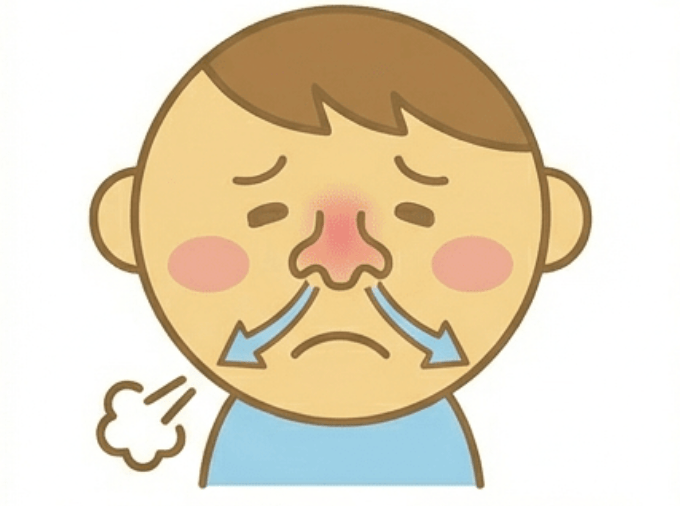
Many people experience nasal congestion specifically when lying down to sleep, even though they have no other ailments and breathe fine during the day. An online tip suggests that if one nostril is blocked, clamping a fist under the opposite armpit for about 20 seconds can clear the stuffy nose. Experts analyze that there is indeed a basis for this method, but what deserves more attention is: why are modern people particularly prone to nasal congestion at night?
Physician specializing in genetics and eugenics, Dr. Cheung Ka-ming, recently analyzed the principle and mechanism behind the "fist under armpit for 20 seconds to clear a stuffy nose" trick on his personal page. Cheung explains that when pressure stimulates the armpit, it affects the body's autonomic nerve balance, slightly increasing sympathetic nervous system activity. Once the sympathetic nerve is activated, blood vessels constrict. The nasal turbinates inside the nasal cavity, which were engorged with blood, therefore shrink. The airway widens, and breathing naturally becomes smoother.
"Many people think nasal congestion is due to too much mucus, but in reality, most cases are due to engorged nasal blood vessels." He points out that the nasal turbinates inside the nose are structured like sponges, rich in blood vessels, functioning to warm and humidify inhaled air. When the blood vessels become engorged, the turbinates swell like a sponge absorbing water, narrowing the airway and causing the sensation of stuffiness. There is a key to this technique: you must stimulate the opposite armpit.
- If the right nostril is blocked: Clench a fist under the left armpit for 20 seconds to 1 minute.
- If the left nostril is blocked: Clench a fist under the right armpit for 20 seconds to 1 minute.
However, Cheung emphasizes that this only provides temporary relief. The real issue that needs attention is the root cause of nighttime nasal congestion.
Noses Work in Shifts: Dinner Time Affects Nasal Congestion
Many people don't know that the nose has its own rhythm, medically termed the "nasal cycle." The two nasal passages are not simultaneously wide open; instead, they operate in shifts like a relay race over a few hours, one side's blood vessels dilate slightly, allowing less airflow, while the other side is clearer. After a period, they swap. When the body's regulatory system is stable, this change is very subtle and almost imperceptible. When life rhythms are disrupted, this subtle change becomes amplified. This is why many people find their nose becomes stuffy after lying down at night.
Cheung cites recent research indicating that nighttime nasal congestion is closely related to lifestyle rhythms, with one important factor being dinner time. The human body has an internal biological clock:
- It handles sugar and energy better during the day, and metabolic rate gradually declines at night.
- If dinner is eaten very late, or food is consumed before bed, the rise in blood sugar is often higher. When blood sugar rises, the kidneys adjust the body's water and mineral balance. While reclaiming glucose and sodium ions, water is also retained in the body.
- As body fluids gradually increase, the nasal mucosa easily becomes congested and swollen. The originally subtle changes of the nasal cycle then become particularly noticeable.
The Nose is the Body's Earliest Warning System: 3 Tips to Adjust Rhythms Through Lifestyle
Cheung offers an interesting perspective: the nose, sleep, blood sugar, and fluid regulation actually belong to the same physiological system. He states: "The body is like a city. Blood sugar is the traffic flow, water balance is the river system, and the nerves are the command center. When the rhythm is coordinated, everything runs smoothly. If life rhythms are gradually disrupted, the nose often becomes the first place to show change." He suggests the public can adopt the following practical measures:
- Keep Eating Hours During Daylight: The body's ability to process blood sugar and energy is better during the day and gradually declines at night. Scheduling three meals between 8 am and 6 pm allows the body to handle food more smoothly and stabilizes blood sugar fluctuations. Many studies have found that even with the same diet, simply eating earlier can improve blood sugar stability and sleep quality.
- Keep Dinner Simple and Light: If dinner is too salty, too sweet, or too large, the body has to work harder at night to adjust blood sugar and fluid balance. High salt intake easily leads to increased body fluids; high sugar intake causes greater blood sugar fluctuations. When these changes occur simultaneously, the nasal mucosa tends to congest, and sleep becomes lighter. It is recommended to have more vegetables and moderate protein for dinner, reducing strongly flavored and high-sugar foods.
- Observe Your Body's Subtle Signals: Many people focus on physical exam numbers but ignore the body's daily reminders. Nighttime congestion, waking up at night, and not feeling refreshed in the morning – these seemingly small changes are often related to lifestyle rhythms. When these signals recur, look back at recent dinner times, daily routines, and eating habits. For many people, simply making slight adjustments will gradually improve these symptoms.