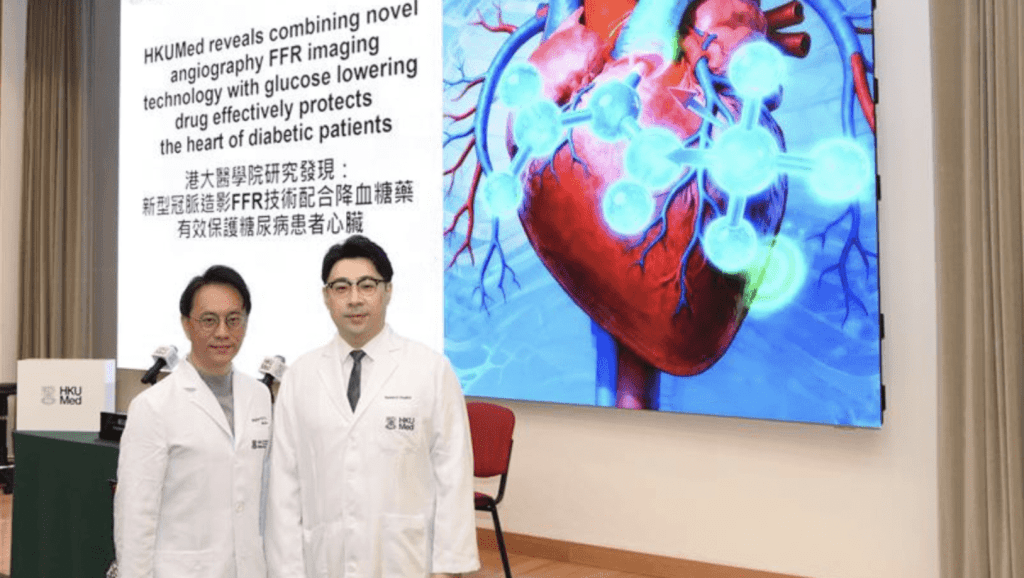
Patients with Type 2 Diabetes often develop complex coronary artery disease, which is challenging to treat and carries high risks. A new study from the University of Hong Kong's Medical School brings promising news: a complementary strategy combining innovative coronary angiography technology with a new generation of blood sugar-lowering drugs can provide dual protection for diabetic patients, significantly reducing the risk of cardiovascular events and mortality by 10%.
For patients with both Type 2 diabetes and coronary artery disease, their blood vessels often have multiple narrowings or blockages due to diffuse atherosclerosis, making cardiac surgeries highly challenging for doctors to achieve "complete revascularization" of all blocked vessels. Due to limitations of traditional assessment methods, some lesions that appear mild on the surface but severely impact blood flow (functional blockages) may be overlooked. This leads to issues like residual stenosis, incomplete revascularization, and ongoing ischemia for most patients post-surgery, increasing long-term heart disease risk.
To address this challenge, a research team led by Professor Yiu Kai-hang, Clinical Professor in the Department of Medicine, HKUMed, utilized a novel imaging analysis technology called "caFFR" (coronary angiography-derived fractional flow reserve). By using conventional coronary angiographic images, it accurately calculates the actual impact of each stenosis on blood flow. This allows doctors to truly understand the extent of blockages and causes of ischemia, enabling them to devise more effective interventional treatment plans. For patients with complex conditions where complete vessel opening is impossible, the new class of blood sugar-lowering drugs, "SGLT2 inhibitors," are used to exert potent vascular protective effects.
The research team, comprising members from the Department of Medicine, HKUMed, and the University of Hong Kong-Shenzhen Hospital, analyzed data from 671 patients. They found that among patients who could not achieve complete revascularization, those also using SGLT2 inhibitors saw their rate of major adverse cardiovascular events within 3 years drop sharply from 17.8% to 8.3%, and all-cause mortality plummeted from 16.3% to 6.3%.
This means that even though structural vascular risks remain, the important protective barrier provided by SGLT2 inhibitors can significantly reduce future cardiovascular disease risk.
Yiu stated that the caFFR system enables functional assessment for diabetic patients, improving revascularization outcomes, while SGLT2 inhibitors provide powerful cardiovascular protection for patients with incomplete revascularization, improving their survival rates.
Yiu emphasized that this dual-pronged, complementary strategy represents a major breakthrough in treating heart disease in diabetic patients: "Our research shows that using the innovative caFFR system for functional assessment in diabetic patients helps doctors more accurately identify lesions truly causing ischemia, thereby enhancing revascularization effectiveness. For patients with incomplete revascularization, SGLT2 inhibitors offer strong cardiovascular protection, greatly improving their survival rates."