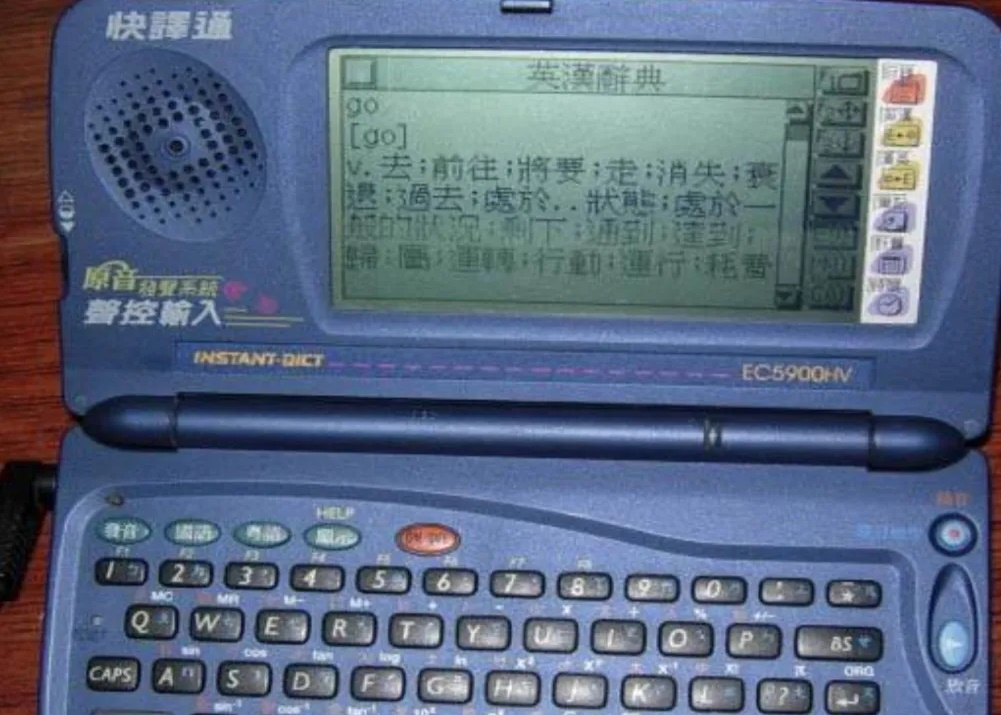
A full-time English tutor posted on social media last Friday (Jul 10), sharing a story about her father, who barely spoke English but spent the equivalent of three months’ school fees on an electronic dictionary for her in the 1990s.
The poster wrote that she was in Form 1 when classmates began using portable electronic dictionaries. She hid her printed dictionary under her desk, she wrote, and “couldn’t see theirs, but hearing them press buttons to look up words made me want one so badly.”
She mustered the courage to ask her father, who worked long hours on Hong Kong Island and rarely bought her toys, for an Instant-Dict that could pronounce English words in Cantonese. He gave only a cold “Mm” in reply.
The next night, the poster got what she wished for. “Dad walked in and placed a box in my hands,” she recalled. “He said, ‘For you.’”
Three decades later, the poster realized the unit cost 3,390 Hong Kong dollars, which is a sum, for her father with a modest education, could have covered several months of his own lunch money and equaled three months of her school fees.
“His educational attainment is not very high, but he knows his daughter needs it for studies,” the poster wrote. “He didn’t hesitate and bought it for me the very next day.”
This story sparked heated discussions among netizens. Many commenters noted that a parent’s love is often shown in actions, not words.
One calculated that HK$3,390 in the 1990s would be roughly HK$7,000 to HK$8,000 today, which is a huge sacrifice that underscored the father’s unwavering support.
The device also revived school-day memories. Dozens of netizens who owned the same model admitted they used it for unintended purposes, including learning the Cangjie input method unintentionally, typing out song lyrics, or playing Gomoku and Snake.
The poster kept the e-dictionary to this day. It carried her through high school, university, and countless translation assignments.
“He didn’t really know English, but he gave his daughter the key to the world,” the poster wrote.