Read More
Beijing has vowed to "safeguard" its interests against a new US policy to restrict investment in Chinese technology, accusing Washington of disrupting global supply chains.
ADVERTISEMENT
SCROLL TO CONTINUE WITH CONTENT
US President Joe Biden earlier announced an executive order directing the Treasury Department to restrict certain US investments in China in sensitive high-tech sectors including semiconductors, quantum computing and artificial intelligence.
China's foreign ministry blasted the move as an attempt to "engage in anti-globalization and de-sinicization," warning that China would "resolutely safeguard" its own rights and interests.
"Beijing is strongly dissatisfied and firmly opposes the United States' insistence on introducing restrictions on investment in China, and has lodged solemn representations with the United States," an unnamed foreign ministry spokesman said in a statement published online.
Biden's executive order "seriously deviates from the market economy and fair competition principles the United States has always promoted, and affects companies' normal operation decisions, damages the international trade order, and severely disrupts the security of global industrial and supply chains," the commerce ministry said in a separate statement.
"China expresses serious concern about this and reserves the right to take measures."
Chinese internet giants Alibaba, Baidu, Bytedance and Tencent have ordered US$5 billion (HK$39 billion) worth of chips from California-based Nvidia vital to powering generative artificial intelligence systems as fears mount the United States will begin restricting exports, according to a report.
It quoted an unnamed Baidu employee as saying: "Without these Nvidia chips, we can't pursue the training for any large language model."
Commenting on the ban, technology and innovation sector lawmaker Duncan Chiu Tat-kun said it has little impact on Hong Kong's startup companies.
Chiu believes Hong Kong's AI and semiconductor corporations had already given up looking for US investors a few years ago.
But he said the ban might affect US dollar funds or investors who participated in private equity and corporate venture capital as companies sometimes are involved in AI-related business.
Finance sector lawmaker Ronick Chan Chun-ying also said the ban will not have a major impact in Hong Kong, as US companies have reduced investment in Hong Kong enterprises since Washington announced sanctions against SAR officials in 2019.
Election Committee lawmaker William Wong Kam-fai said US investment companies supporting US research teams might "dare not allow them to share their studies with us because of the ban."
Editorial: Tightening of screw marks a new episode
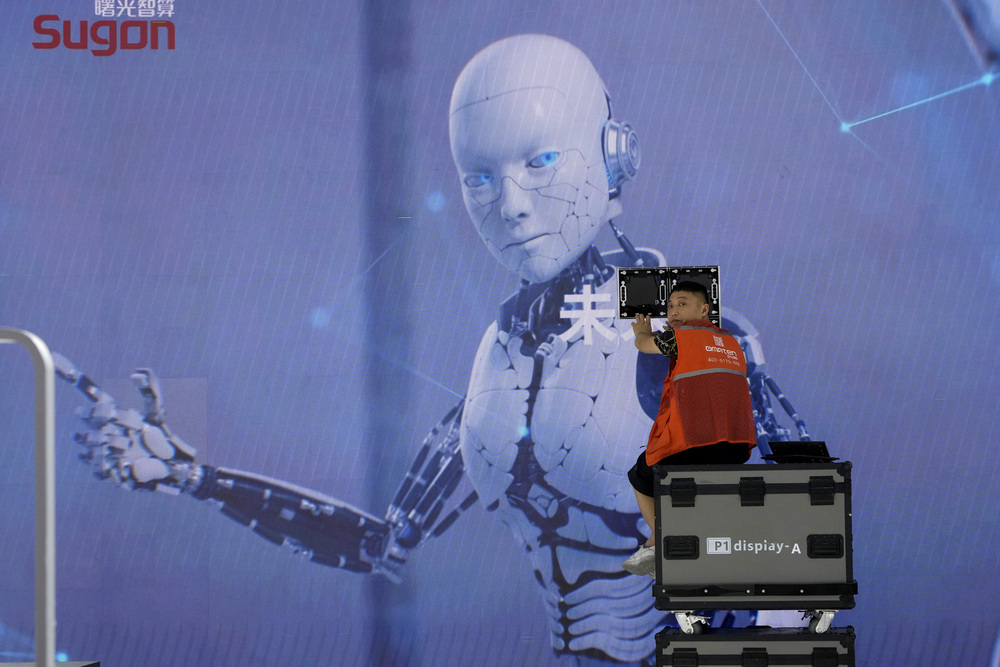
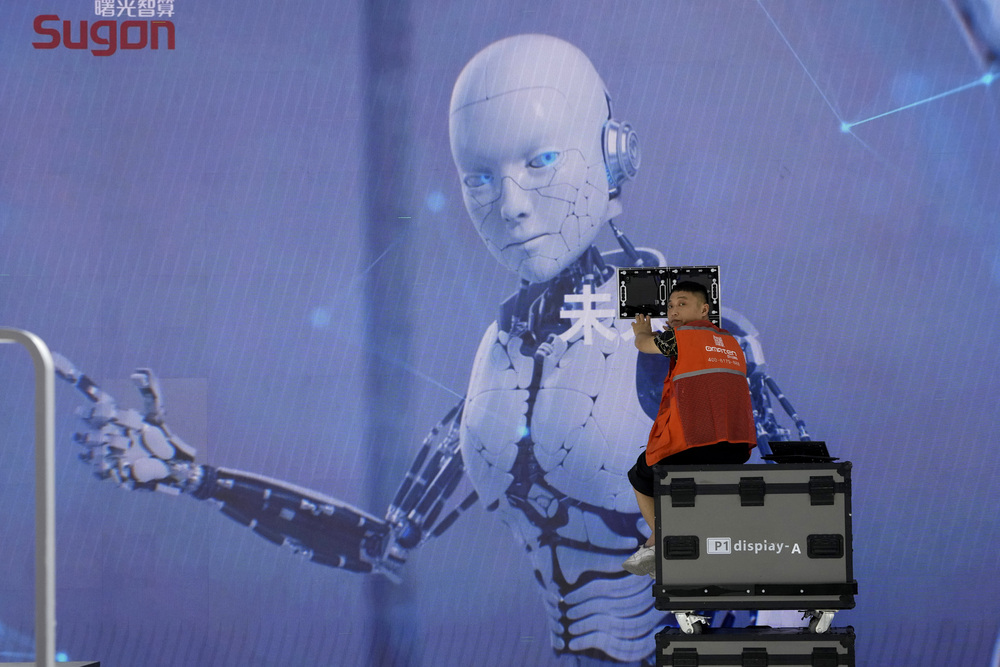
A booth display is set up for a Chinese supercomputer manufacturer at an AI conference in Shanghai in July. AP