Read More



Morning Recap - October 23, 2026
10 hours ago



Late police constable Chu Chun-kwok to receive full honors funeral on Fri
22-10-2026 15:33 HKT
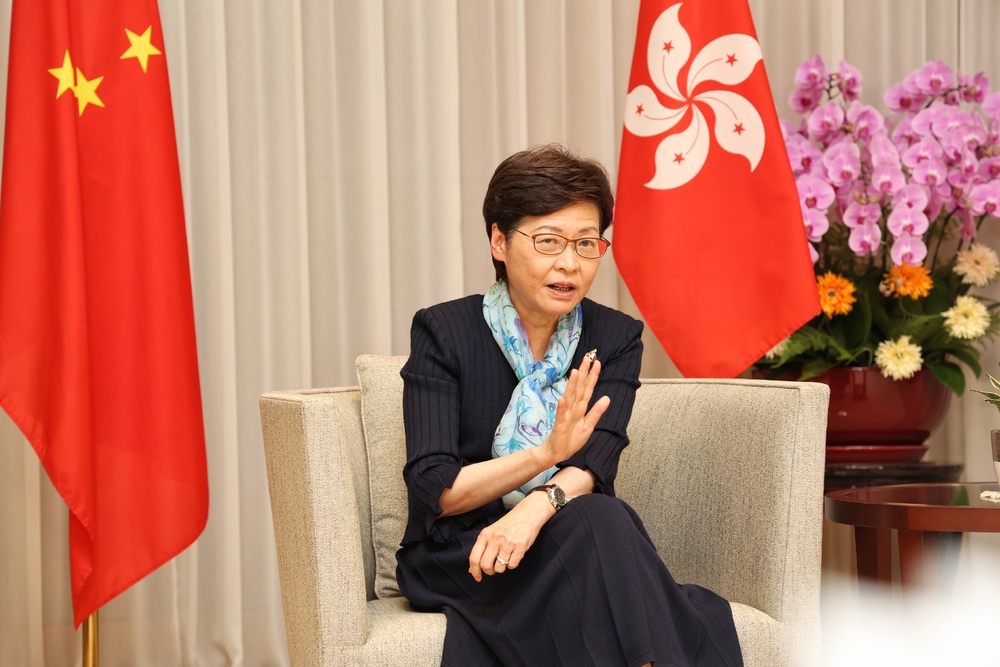
Grievances among citizens while implementing public health measures are "inevitable" as they limit citizens' freedoms, outgoing Chief Executive Carrie Lam Cheng Yuet-ngor said.
That is the reason why the International Bill of Human Rights allows a limitation on human rights and freedoms when it comes to public health and national security, Lam told Sing Tao Daily, The Standard's sister paper.
In the interview, Lam said the public health crisis caused by Covid-19 is unprecedented as it spans a long period of time and involves virus mutation.
The government has to think of different measures to solve the problem at different times, she said.
"No public health measure has earned us a round of applause, as they restrict citizens' freedom and activities, requiring citizens to get vaccinated and undergo virus tests," Lam said. "I do not think there will be people feeling happy for not being allowed to dine outside or go to theme parks."
The International Bill of Human Rights states a few circumstances that human rights and freedoms can be limited, Lam said.
One is public health, the other national security.
"The only thing the government could do is to explain why these [public health] measures are necessary and relax these measures when the situation allows, but this is their nature.
"It is inevitable to have grievances among society."
Lam said she hoped citizens understand that the government is working hard to let them live their life as normally as possible.
This includes allowing them to go to work and leave home, apart from some public health requirements.
Those requirements include lockdown testing operations.
"At first we drew immense fire for doing so, but citizens later understood it, as we do it every night and find as many infected cases as possible," she added.
Lam also said since the failed attempt of the legislation of Basic Law Article 23 in 2003, past chief executives and bureau chiefs had tried to skirt around the problem as they lacked the "confidence to do something that should be done."
In the past five years, she said her administration had put things back on track, restored things back to order and rectified mistakes from their root.
"The national security law is not just a piece of legislation, but has a deeper meaning. It gave us the confidence to deal with problems, and let Hongkongers understand that one country, two systems is based on one country before two systems can show its full advantage."
She added: "I am extremely optimistic about Hong Kong's future, as the foundation 'one country' has already been consolidated. The central and SAR governments should allow 'two systems' to work even better based on the 'one country' principle."
Lam said implementation of the national security law was inevitable as the problem "snowballed" after the government had tried to avoid conflicts since 2003 up until the occupy Central movement in 2014 and the anti-fugitive bill unrest in 2019.
"Only a small fraction in society thoroughly understands one country, two systems, which creates a lot of serious problems and makes it even harder to solve problems like the emergence of confrontations and violence."
For Lam, the most unforgettable event of her term will be the implementation of the national security law on June 30, 2020 as her hands would have been tied without the Beijing-drafted legislation.
"Without the national security law, there would be no 'patriots ruling Hong Kong' and without 'patriots ruling Hong Kong' there would be a lot of things that could not be done," she said.
Lam denied that people were emigrating because of the national security law, saying the emigration wave only emerged over the past year but the national security law was implemented two years ago.
"They emigrated mostly because of high housing prices and Covid border restrictions in the SAR, while overseas countries stepped up with talent appeal schemes," she said. "The push-and-pull factors have contributed to a net outflow of SAR residents."
Every country is poaching expertise in financial, medical and innovative technology sectors, she said, and Hong Kong has to press ahead with policies to retain and attract talent.