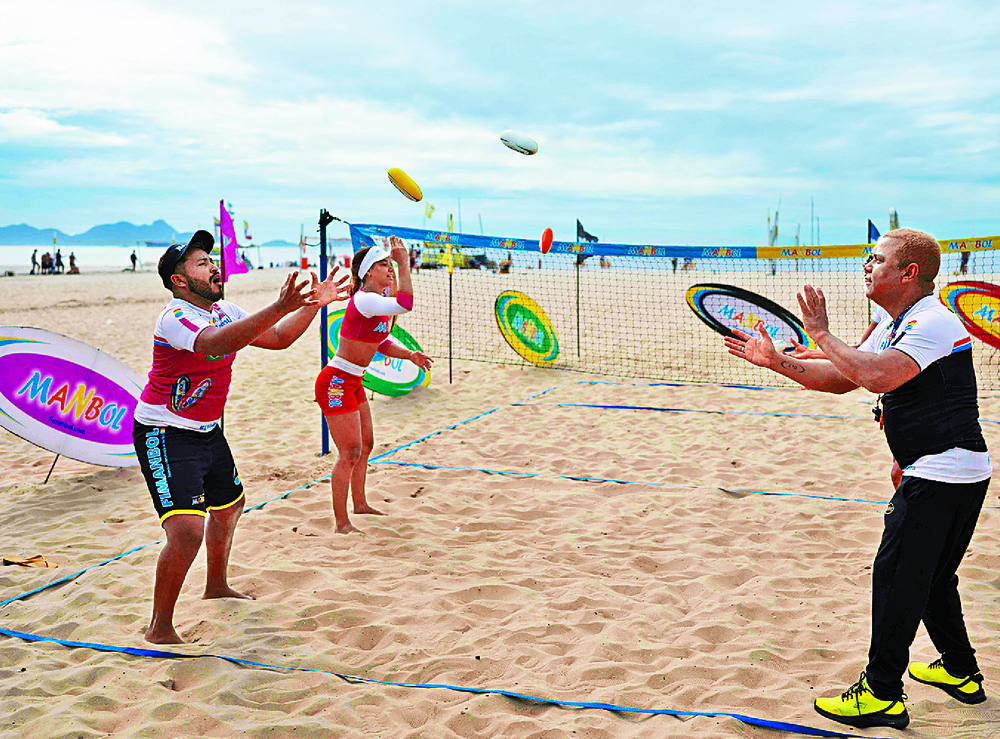
A childhood pastime of kids tossing mangoes to each other in the Amazon has transformed into a proper sport in Brazil, even finding a place among the vaunted beach games played in Rio de Janeiro.
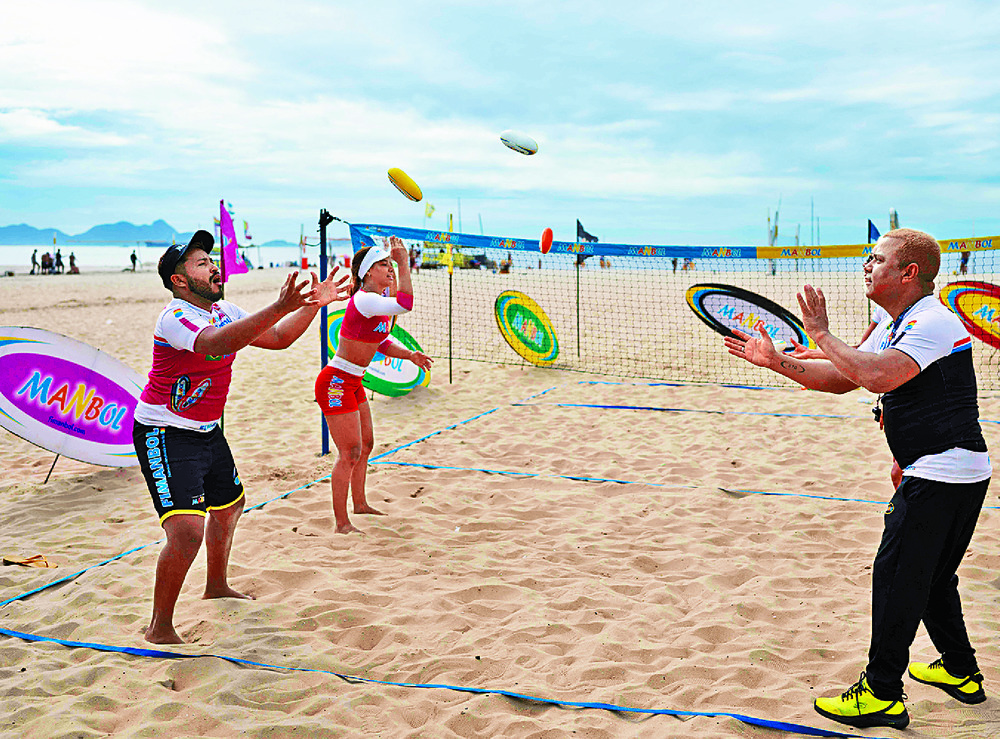
On the hot, golden sands of Copacabana, players simultaneously toss two mango-shaped balls across a net in a fast, fun and tiring test of their reflexes.
Dubbed "manbol" - a mashup of the words for mango and ball - the new game is slowly spreading across Rio's beaches.
It is the brainchild of Rui Hildebrando, based on a game he and his younger brother, Rogerio, used to play as children in the Amazonian city Belem do Para.
"At first, it was a simple game between us - my brother Rogerio would throw a mango at me and I would throw it back. But after a while I thought it would be more fun to each throw a mango at the same time," Rui Hildebrando, 44, said.
After it caught on among youngsters in town, Hildebrando came up with official rules for the game and in 2004 decided to form the Brazilian Manbol Confederation.
The game is now played with mango-shaped polyurethane balls, about 3 times smaller than a rugby ball, on a rectangular court on any surface.
The rules are simple - you win a point if the ball passes over the net and lands on the ground on your rival's side, as long as you also catch the other ball thrown to your side. If both balls fall, the point is replayed.
To win, a team must win two sets of 12 points. Each game can be played with up to three players, with a match lasting between 15 to 25 minutes.
After two decades, manbol is making inroads in Brazil, with some 2,000 players in a nation of more than 200 million people.
The city of Belem declared manbol an official "sporting discipline" in 2016.
Hildebrando said there have been demonstrations of the game in 11 other countries, in South America, Europe and Asia.
On the hot, golden sands of Copacabana, players simultaneously toss two mango-shaped balls across a net in a fast, fun and tiring test of their reflexes. AFP