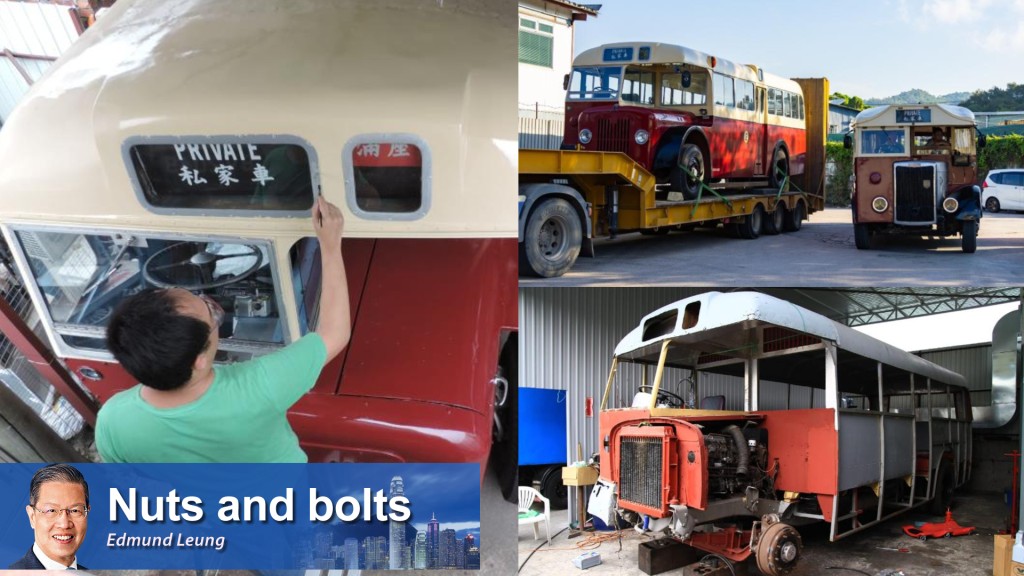
Continuing on the story of vintage buses described in my article last week, I have been filled with strong nostalgic memories ever since seeing them. I guess such nostalgia is shared by many residents and visitors who are fond of buses. They might be wishing they could visit these buses on regular occasions – to touch and smell them.
Restoring them from the scrapyard to serviceable conditions that can allow us to see and enjoy them requires a lot of effort and resources, especially for private collectors.
I learned a lot more about restoring and maintaining vintage buses from talking to the enthusiastic restorers of the Tilling Stevens and Guy Arab buses.
Retrieving original technical documents proves to be next to impossible. The alternative methods involve finding key information amid the sea of old newspapers, visiting university libraries, accessing overseas transport museum archives, and getting the right person with the special technical know-how to advise on the appropriate restoration process.
Consulting retired members of engineering staff also helped to transfer knowledge of the traditional repair process, reviving old craftsmen’s techniques of riveting and painting, among other old skills.
Obtaining parts is always difficult – and a lot of replacement parts need to be custom made. Modern CNC machining, 3D scanning and printing may help to manufacture parts to ensure continuous functioning, but it is not always easy to make them authentic. This is especially vital for visible body parts, unlike mechanical parts that are not usually in view.
Replacing handlebars and rings on the passenger seat backs is a big challenge to ensure they offer similar touch and feel to impress visitors. Finding replacement cloth materials to reflect the era of the original seats is another challenge, as their patterns are long out of fashion and no longer manufactured.
Extra safety features are also added to these vintage buses to cope with modern traffic conditions and enhance road safety. The 1949 Tilling Stevens bus originally used semaphore-type turning indicators, but to bring the vehicle to comply with current road regulations, flasher units are installed.
Much more difficult in the case of buses – when compared to cars – is weatherproofing. Putting a car in storage indoors may be simple and practical, but to store a big bus in a big shed with road access in Hong Kong is prohibitively expensive.
They are therefore usually kept outdoors, covered in canvas. To preserve the paint surface, which was originally applied by brush, rather than the modern method of spraying, a lot of skill and tender loving care is needed, as frequent reapplication of the paint surface is necessary.
A further problem that is not often understood is the need to tow the bus from storage to display areas as these buses are often not licensed for road use.
Towing a bus running on its wheels can easily damage the transmission system, so the propeller shaft needs to be dismantled, adding a lot of extra work each time.
In the particular case of this display at Citybus Depot in Chai Wan last fortnight, the towing operation to bring it back to the storage area in New Territories caused a rear axle hub bolt to shear, necessitating the tedious process of finding a replacement bolt and fitting it back.
A desirable solution we see is the London Transport Museum, where a lot of valuable old buses, together with other vehicles, are housed indoors and available for viewing by visitors. It also organizes occasional runs to allow visitors the experience of riding on them.
Even in smaller places like Macau, authorities have been able to find a location in the city center to house historic racing cars to attract tourists. But for Hong Kong, which must rank equal with London and Singapore for having a long history of bus services – over a century – we deserve to have a home for these historic pieces.
Pursuing this line of thought, it would be a great idea if we could build a transport museum in Hong Kong to show these vintage buses, alongside the various old railway rolling stock, and other vehicles of historic value. It would even be a great tourist attraction if we can organize regular vintage trips where visitors can ride on them in the city streets to let them feel a semblance of the good old days, prior to the advent of underground railways for primary commuting purposes.
In this respect, I would hope our authorities would be more upcoming to help run these vintage buses.
Under present rules, once a vehicle is scrapped, it cannot be re-registered for road use, and buses need to be retired after 18 years of service. Hence, vintage buses salvaged from the scrapyard for restoration are banned from re-licensing for road use. But without the ability to run them on public roads, their historic value cannot be fully utilized.
With proper inspection and appropriate restrictions to only allow occasional runs and only allow them to be driven by designated drivers on restricted routes, vintage bus tours can be an excellent tourist attraction.
But to ban them even from occasional runs for tourism purposes, or even from warming them up to maintain their mechanical integrity, may seem a lost opportunity for these historic treasures.
Hopefully, authorities can be urged to consider granting some concessions to make this happen.
Veteran engineer Edmund Leung Kwong-ho casts an expert eye over features of modern life