Cryptography is the science of encrypting and decrypting information. Strong cryptography is vital to overall individual and societal cybersecurity.
Armies and special agents have always been able to securely exchange secrets even over an insecure channel, which is susceptible to eavesdropping, as long as their information was encrypted.
Broadly speaking, there are two main types of encryption: a symmetric key, in which the same key is used to encrypt and decrypt; and asymmetric key, or public key, which involves a pair of mathematically linked keys.
In 1976, three US computer scientists at Stanford University - Whitfield Diffie, Martin Hellman and Ralph Merkle - came up with the revolutionary concept of public-key cryptography, which allows two parties to exchange information securely even if they had no previous agreement.
Public-key cryptography is pretty much like looking up someone's number in a large telephone directory. If you know the person's name, like having the private key, it is easy to find out her telephone number.
If you don't, you would have to search each entry one by one. Thus, the bigger the possible number of names, the harder it would become to find a person.
The idea rests on a mathematical trick that uses two numbers: one, the public key, is used to encrypt a message, and it is different from the second, the private key, used to decrypt it.
Someone who wants to receive confidential messages can announce the public key to the world, say, by printing it in a directory.
Anyone can use the key to scramble a message and share it openly. But only the receiver knows the private key, enabling him to unscramble and read it.
In practice, public keys are not used to encrypt data but to securely share a conventional, symmetric key - one that both parties can use to send confidential data in either direction.
An example of commonly used public-key-exchange algorithms is RSA, named after its inventors, Ron Rivest, Adi Shamir and Leonard Adleman at MIT. They made it possible to start with a public key and mathematically compute the private key without trying all the possibilities.
The RSA algorithm is based on prime numbers - like 17 or 53 that are divisible only by themselves and one. The public key is the product of at least two prime numbers. Only one party knows the factors, which constitute the private key.
Privacy is protected by the fact that, although multiplying two large numbers is straightforward, finding the unknown pair of prime factors of a very large number is extremely hard even with the most powerful supercomputers available today.
But cryptography is just one slice of a large security pizza.
Using the best encryption algorithm won't stop a person from clicking on a misleading link or opening a malicious file attached to an email.
Encryption also can't defend against the inevitable software flaws, or insiders who misuse their access to data.
Existing encryption standards are safe enough to prevent today's computers from eavesdropping over the internet. The biggest challenge is keeping data secret in the face of accelerating computer power.
Computer scientists have not been pondering today's machines but the threat to that secrecy by the computers of tomorrow. They worry about the coming era of quantum computers, which perform calculations in fundamentally different ways from those used by conventional computers.
A recent poll of experts found a majority believe that by 2036, RSA encryption protocol with keys of 2,048 bits long could be broken by quantum computers in 24 hours. Though 2036 is 14 years away, the future development of quantum machines has worrying implications today.
Next week I shall discuss further if code-breaking quantum machines are real threats or just another tempest in a teacup.
Dr Jolly Wong is a policy fellow at the Centre for Science and Policy, University of Cambridge
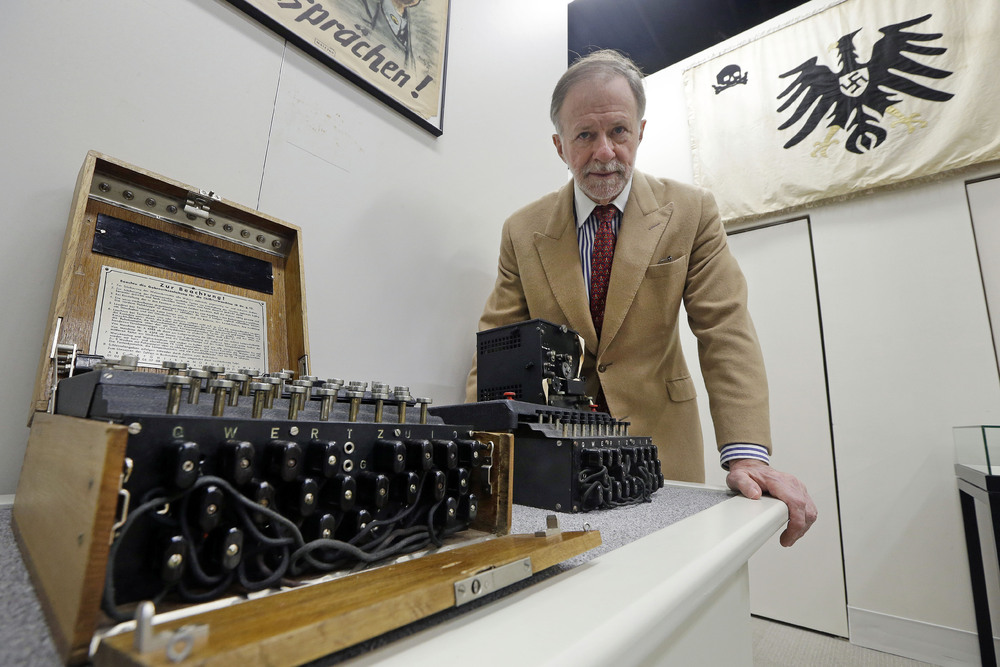
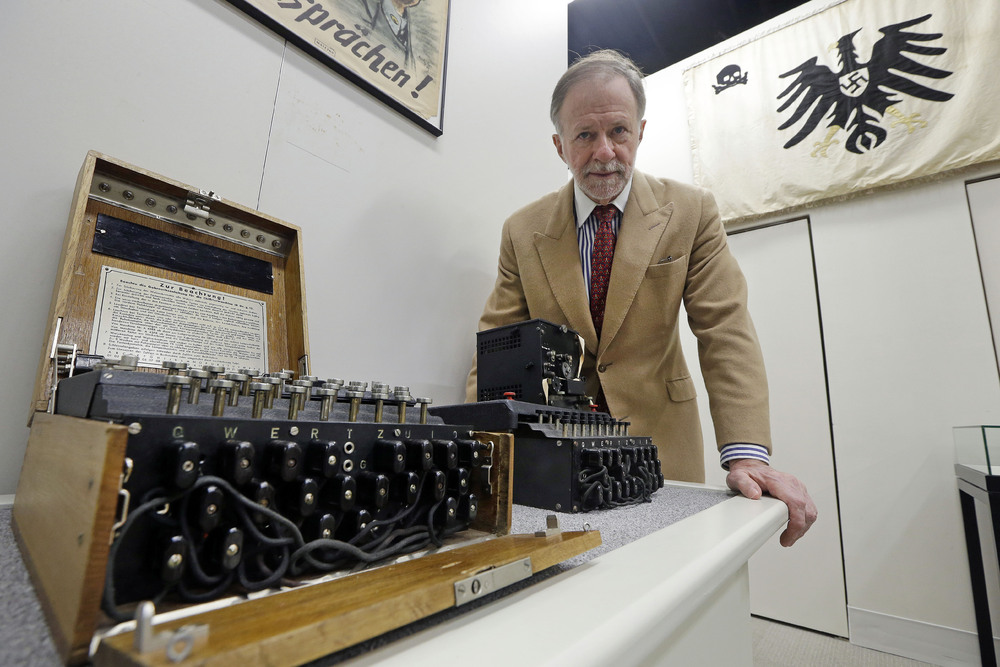
Enigma encryption machines, on display in Natick, Massachusetts, were fundamental to Nazi Germany's war effort until their keys were broken, altering the course of the world war and humanity.