Read More
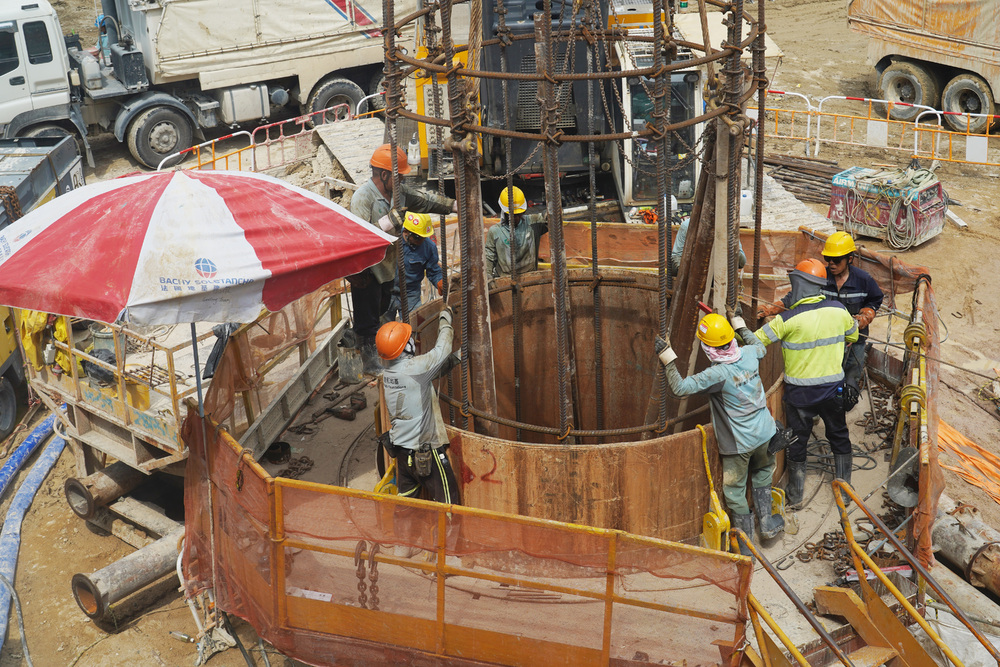
Employers in the construction industry are setting harsh requirements to create difficulty in local recruitment in order to employ foreign labor, a union has found.
ADVERTISEMENT
SCROLL TO CONTINUE WITH CONTENT
Authorities announced in June to import 12,000 construction workers from the mainland and overseas, and they will be employed mainly for public construction projects of contract prices lower than HK$1 billion.
The first round of applications to import construction workers closed on Wednesday with only 26 applications to bring in 5,251 workers, or 43 percent of the quota ceiling of 12,000.
The Development Bureau said on Facebook last evening that the approval procedure is expected to finish by end-September, and it will accept new applications quarterly every January, April, July, and October.
Speaking on radio yesterday, the chairman of the Hong Kong and Kowloon Bamboo Scaffolding Workers Union Ho Ping-tak, said employers have to prove that there is a difficulty in local recruitment by posting job advertisements on the Labour Department's website.
They can only submit an application to employ foreign labor if they cannot employ a local worker after four consecutive weeks.
But Ho said he saw contractor job ads with conditions that were harsher than those that are offered in the market.
"The job postings on the Labour Department website are so weird. Employers are looking for construction workers that have over 10 years of experience, and are fluent in Chinese and English, and are offering a daily wage of HK$700 to HK$900," Ho said.
He added the average daily wage for crane operators can be over HK$1,000.
"If I am good at both Chinese and English, then I won't choose to be a construction worker. I also forwarded the posting to the government, they also felt the employer didn't want to hire workers," Ho said.
He cited the Macau Federation of Trade Unions, saying if imported labor receives a monthly salary, while local workers have their wages calculated daily, it will definitely turn locals into "reserved workers."
"Over 80 percent of Hong Kong workers are paid with daily wages," he said.
"If a construction site needs 10 workers, and the contractor applies to import 10 foreign workers, will the contractor ask five of these workers to rest, and hire another five local workers who are getting daily wages?"
Executive director of the Hong Kong Construction Association Godfrey Leung King-kwok is confident the Bureau and the department will monitor employers' hiring procedures, and noted that the current mechanism is effective in guaranteeing local employment.
He added that there is a need for the industry to import foreign labor, as it is facing an aging worker population, where the workers' average age has exceeded 50 and he expects a retirement wave in the near future.
Chairman of the Hong Kong Construction Sub-contractors Association Lawrence Ng San-wa, said workers imported in the first round will be mostly responsible for structural engineering, as construction works usually take four to five years and different procedures require different expertise.
He added that most of the workers will live in the government's centralized dormitory at the former isolation facility in Yuen Long, which provides some 8,000 places, and said it is feasible to provide transportation between the dormitory and the construction sites.