Read More
Hong Kong is in a good position for scientific development because of government support and good facilities, said Katalin Kariko, the pioneer behind the mRNA vaccines that helped stem the raging Covid-19 pandemic.
ADVERTISEMENT
SCROLL TO CONTINUE WITH CONTENT
The 68-year-old Hungarian-American biochemist is a pioneer of mRNA vaccine technology that has been used in Pfizer-BioNTech and Moderna vaccines and for which she received many prestigious international awards.
Last year, Kariko received the Tang Prize - an international award established by Taiwanese billionaire entrepreneur Samuel Yin Yen-liang - and the Benjamin Franklin Medal in Life Science.
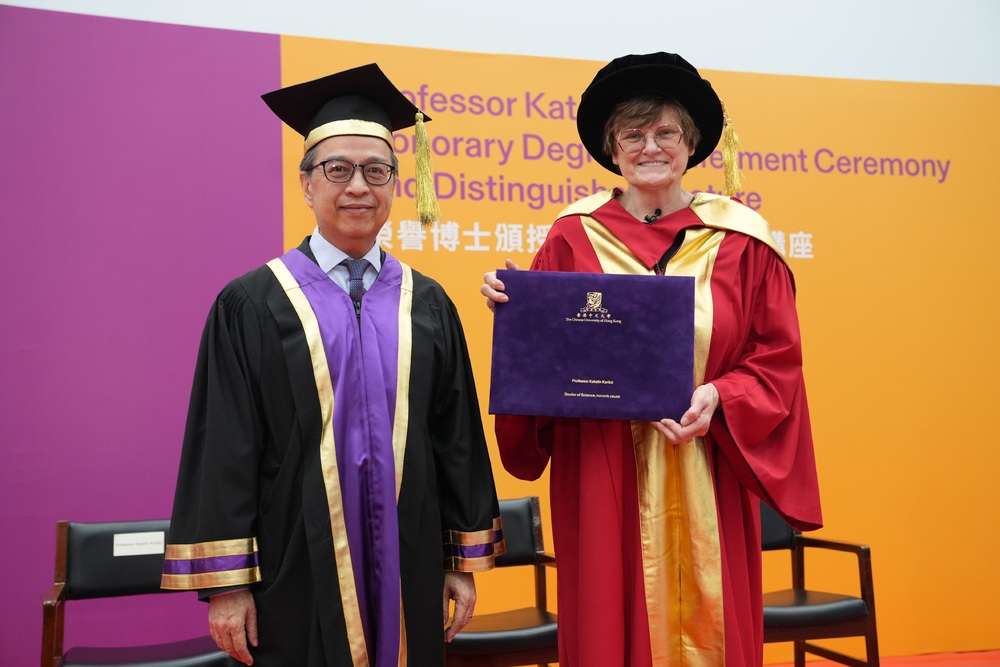
Receiving an honorary doctorate of science from the Chinese University last Friday, Kariko shared her experience developing mRNA for therapy.
"I saw the support of the government and good facilities [in Hong Kong]," she said. "And top quality papers are coming out now in mainland China. The quality of science is unbelievable. I'm sure the future for the whole of China including Hong Kong is great."
When asked about the side effects of mRNA vaccines, Kariko said: "Every medicine has side effects.
"[Vaccines] increase inflammation to activate the immune system. Without it, you wouldn't have the vaccine.
"Side effects existed in vaccines published a hundred years ago. It's just that there had never been that many people getting the same medicine at the same time [so there had never been so many people getting the same side effects at the same time].
"In the United States, people were dying quickly [from Covid], tents were set up [to collect bodies] and we had to act quickly.
"And mRNA technology is needed to develop a product quickly. Sequence information was made available in January, and Moderna was already injecting the first volunteer on March 16.
"People said the mRNA (injected in vaccines) stays [in the body]. Of course not! Every cell has mRNA. It's naturally in our body. It degrades and gets disposed of." But Kariko also said she believed side effects could be lowered with future scientific improvement.
She said vaccines for other diseases such as tuberculosis and malaria are already under clinical trials.
Vaccines for genetic diseases, dust mite and a peanut allergy are also under development.
Asked about the progress of Moderna vaccines for cancer, she said giving a release date for the vaccine "would be irrational, because we don't know when things will happen."
Asked about the high price tag of the shingles vaccine, she said: "We [the development team] didn't want a patent [for the shingles vaccine] because we want everyone to [be able to] access it.
"But we were told nobody would develop the vaccine that way, [because the pharmaceuticals would not be able to earn money without a patent]. But the money (paid for medicine) is put back into research."
She also said women in science should "not stress themselves unnecessarily."
She added: "You don't have to be perfect. My daughter has seen me working hard, and she also did."
Her daughter, Susan Francia, is a two-time Olympic gold medalist in rowing.
Kariko also advised the Hong Kong government to provide high-quality child care to "bring women back into research," so that their careers would not be halted by family responsibilities.
lorraine.chiang@singtaonewscorp.com
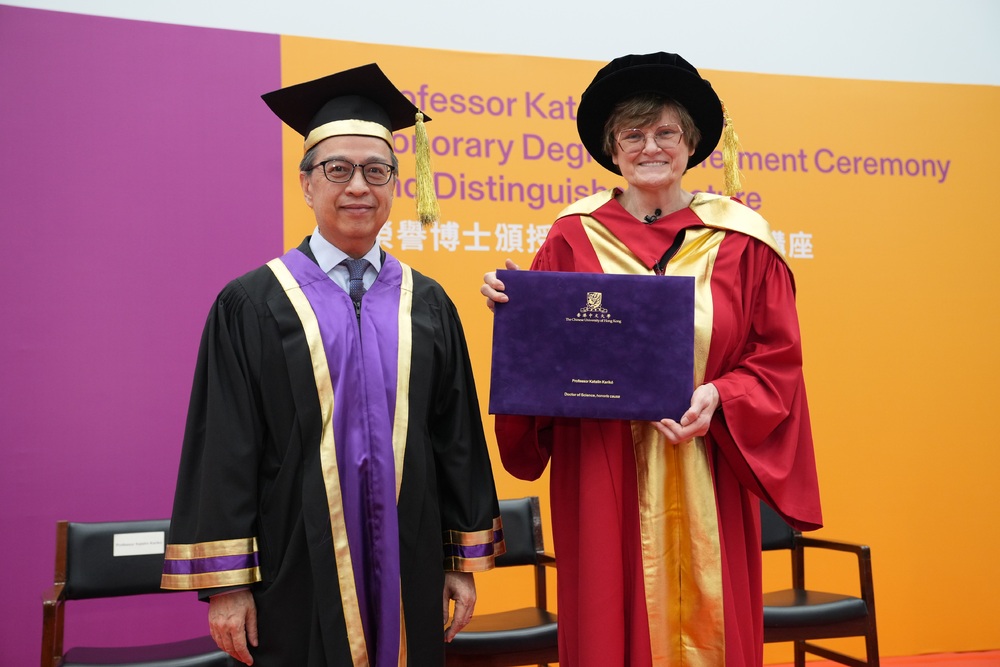
Katalin Kariko receives an honorary doctorate of science from CUHK acting vice chancellor Alan KL Chan.