Read More






Night Recap - May 21, 2026
4 hours ago


ImmD crackdown targets moonlighting domestic helpers arresting 17
19-05-2026 17:52 HKT


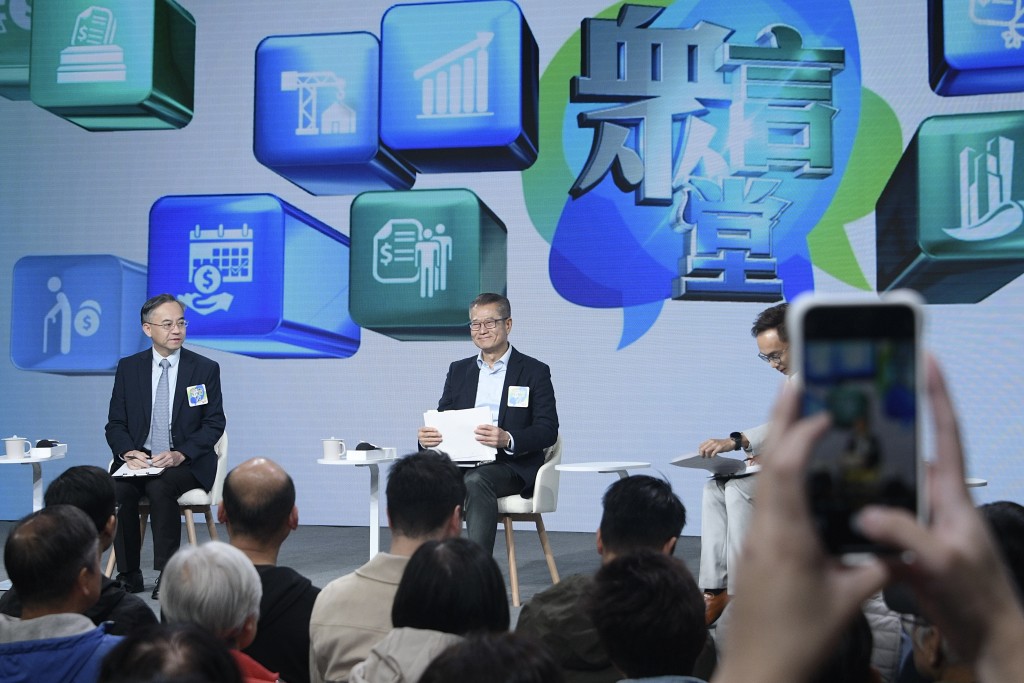
Financial Secretary Paul Chan Mo-po and Billy Mak Sui-choi, associate professor at Hong Kong Baptist University’s Department of Accountancy, Economics and Finance, exchanged direct opinions from the public on the budget and gathered diverse perspectives on Saturday.
A total of 98 members of the public attended, including local residents, the elderly, and youth.
Chan stated that the government is committed to controlling the growth rate of public spending through the Reinforcing Fiscal Consolidation Program, aiming to restore the operating account to a surplus soon.
Benefiting from increased tax revenue driven by the performance of the financial markets, the operating account is expected to record a surplus this fiscal year, marking the first of its kind after several years of deficits.
Yet, numerous infrastructure projects are sure to pressure the balance.
The new budget is expected to be announced later next month.
Chan stated that Hong Kong's economy has maintained stable growth despite a complex external environment and that continued diversified economic development is essential.
According to Chan, the overall economy is stable and orderly, with a 3.2 percent growth rate last year. Exports and the financial market performed well, while visitor numbers increased significantly and the consumer market gradually stabilized. Citizens' real income has improved, and the unemployment rate has remained stable.
He added that economic development is imbalanced, and the government will leverage the "15th Five-Year Plan" to improve the quality of development.
Chan stated that Hong Kong is actively promoting economic diversification and high-quality transformation. Despite challenges such as tariff wars and geopolitical issues, the overall development of the nation remains Hong Kong's most important opportunity.
Chan specifically mentioned that artificial intelligence (AI) has become a crucial force defining regional competitiveness and influencing people's everyday lives. The government will actively embrace the development of AI and welcome suggestions from all sectors of society.
Mak stated that approximately 38,000 people have lost their jobs, mainly due to economic transformation or changes in consumption patterns. Some entry-level positions have also been replaced by AI, and some citizens have failed to benefit from economic growth.
A citizen surnamed Ng specifically mentioned that the Singapore government's tendering platform and the Shenzhen government procurement website both publish detailed tender information, including bid prices from each company, which is beneficial for public oversight of market competition.
In contrast, the Hong Kong Government Logistics Department website only publishes the tender results without providing bid information from companies who lost the bid, making it difficult for the public to assess the competitiveness.
He suggested that Hong Kong refer to the practices of these regions to improve transparency.
In response, Chan highlighted that Hong Kong follows international practices, with tender documents carefully considered from multiple perspectives, and emphasizes openness and transparency.
Another citizen surnamed Cheung expressed concern about the burden on SMEs. He stated that many SMEs in Hong Kong, even with simple structures and single shareholders, still require significant annual auditing costs, which can sometimes exceed their tax obligations.
He suggested the government consider exempting companies with lower turnover from audits to alleviate the burden and improve business efficiency.
Chan pointed out that Hong Kong private companies are currently not required to disclose financial statements.
Some working in the green industry noted that while last year's budget mentioned promoting green technology, the industry is facing bottlenecks due to inconsistent standards.
It is suggested that the government should proactively foster integration with industries in the Greater Bay Area, allowing Hong Kong to play a bridging role.
Another citizen, surnamed Hung, suggested that Hong Kong consider launching a stablecoin pegged to gold, as gold has historically been considered a truly stable asset, which is believed to be especially relevant in the current economy.
Hung believes Hong Kong possesses strong innovation and technology capabilities, boasting high-quality facilities like the Science Park, but lacks opportunities for public interaction and engagement.
He suggested holding more open-air or outdoor exhibitions to showcase technological applications such as robots and drones, allowing citizens and visitors from abroad to more directly experience Hong Kong's innovation and technological vitality.
Chan emphasized that Hong Kong possesses advantages in areas such as financial market development, even attracting envy from other regions.
At the same time, he reaffirmed that Hong Kong also adopts an open attitude to refer to best practices from other regions, including Singapore's achievements in certain areas.
He also mentioned that Hong Kong plays a "super-connector" role under the "One Country, Two Systems" framework, connecting with international standards while also possessing advantages from the mainland, especially in innovative technologies and green fields such as the photovoltaic industry, where the mainland has already achieved leading results, and Hong Kong can play a bridging role.
One of the focuses of this year's budget will be the issue of raising civil servants’ salaries.
Last year, in response to the government's fiscal deficit, salaries were frozen, and some politicians believed that two consecutive years of salary freezes would affect the morale of frontline civil servants, suggesting that the freeze be lifted.
A citizen surnamed Fung is concerned about the aging population and elderly welfare under the fiscal deficit. She opposes sending the elderly to the Greater Bay Area to solve the problem.
An educational psychology instructor pointed out that currently, each educational psychologist in Hong Kong serves approximately four to six primary and secondary schools but can only visit once a week.
She emphasized that many schools accept SEN students, creating a high demand for psychologists, and is concerned that these positions would be lost due to financial deficits.
Paul Chan stated that supporting students is crucial and that the priority of resource allocation within the Education Bureau's policy would be discussed.
Chan explained that creating an independent body to oversee the valuation industry requires thorough review to prevent unnecessary bureaucracy and ensure fair competition among professionals with consistent standards.
On virtual currencies, he recognized blockchain as part of financial innovation vital for Hong Kong's status as an international center but highlighted risks including inadequate investor protection, money-laundering vulnerabilities, and threats to financial stability.
He expressed doubt about widespread promotion to ordinary citizens and called for stronger public education so people can better assess such products.
Regarding government procurement, Chan noted Hong Kong's thriving startup scene—with over 4,000 companies, nearly 30 percent founded by non-locals—and said buying local innovative products gives crucial market validation, citing past examples of accompanying firms to promote in the Middle East.
On healthcare amid an aging population, Chan reaffirmed that the government currently covers 98 percent of public medical costs and will keep or raise that commitment.
He outlined reforms based on "those who can afford it pay more," with stronger protection for the poor and emergency, critical, and chronic cases, while reducing waste—particularly in accident and emergency overuse. Changes will roll out gradually to allow adjustment, maintaining over 90 percent subsidy overall.
For the $2 elderly transport concession scheme, which shifted in 2024 to a 20 percent discount on fares above HK$10 for those 60 or above, Chan said the government will assess any expansion to free rides for those 70 or above in a balanced way, weighing resources and welfare needs.
On talent, Chan said no extra funding is needed for attraction schemes; instead, relaxed entry conditions target key sectors like innovation, technology, and finance.
Support for local graduates includes university resources for commercializing research, plus access to Science Park and Cyberport for startups.
Addressing post-fire building maintenance concerns from the Wang Fuk Court incident, Chan said works proceed according to risk priority with simplified procedures to minimize disruption.
Chan projected an operating account surplus this financial year—the first in years—thanks to strong tax revenue from financial markets, though capital works keep the consolidated account in deficit.
He stressed that core spending on medical, welfare, and education remains at 59 percent of recurrent expenditure.
He welcomed ideas on supporting upwardly mobile youth, ethnic minorities, SMEs, low birth rates, and middle-class elderly facing high costs, noting ongoing measures like baby bonuses, SME financing, and infrastructure upgrades.
While acknowledging calls for new fertility incentives, property rate relief, and relaxed carer allowances, he indicated careful study within limited resources.
Chan concluded that with high geopolitical risks, the government must conserve fiscal "bullets" for stability while driving diversified growth, expressing full confidence in Hong Kong's future and inviting ongoing public input.