Ayaka McGill
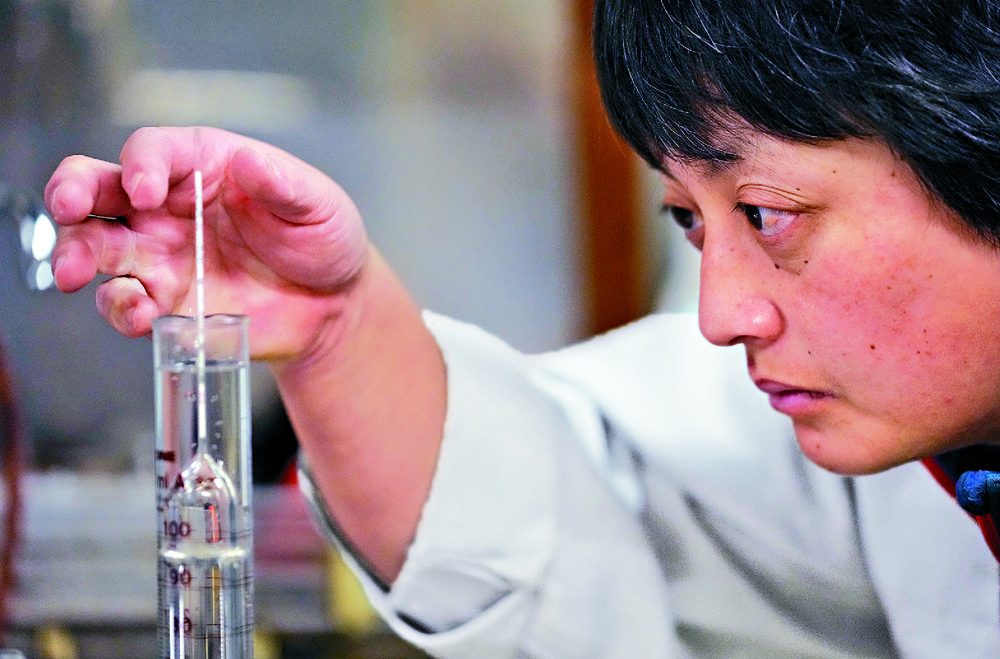
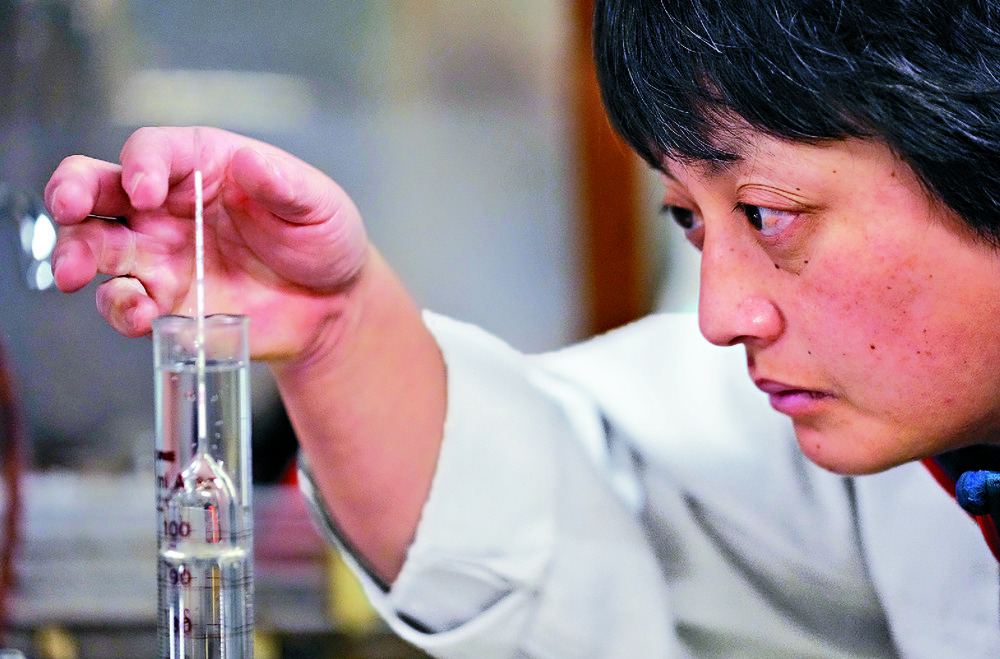
Not long after dawn, Japanese sake brewer Mie Takahashi checks the temperature of the mixture fermenting at her family's 150-year-old sake brewery, Koten, nestled in the foothills of the Japanese Alps.
She stands on an uneven narrow wooden platform over a massive tank containing more than 3,000 liters of a bubbling soup of steamed rice and a rice mold known as koji, and gives it a good mix with a long paddle.
"The morning hours are crucial in sake making," said Takahashi, 43. Her brewery is in Nagano, a region known for its sake.
She is one of only 33 female toji in Japan's thousand-plus breweries.
Women were largely excluded from sake production until after World War II.
Sake making has a history of more than a millennium, with strong roots in Shinto. When sake began to be mass produced in the Edo period from 1603 until 1868, an unspoken rule barred women from breweries.
One theory for the ban is that women were considered impure due to menstruation and therefore excluded from sacred spaces, said Sakeology Center vice director Yasuyuki Kishi at Niigata University.
"Another theory is that a lot of heavy labor and dangerous tasks were involved," he said. "So it was seen as inappropriate."
The breakdown of gender barriers, coupled with a shrinking workforce caused by a fast-aging population, has created space for more women to work in sake production.
"It's still mostly a male-dominated industry. But I think now people focus on whether someone has the passion to do it, regardless of gender," Takahashi said.
She believes mechanization is helping to narrow the gender gap. At Koten, a crane lifts hundreds of kilograms of steamed rice in batches onto a cooling conveyor, after which the rice is sucked through a hose into a room dedicated to cultivating koji.
"With the help of machines, more tasks are accessible for women," Takahashi said.
Sake, or nihonshu, is made by fermenting steamed rice with koji mold, which converts starch into sugar. The ancient technique was recognized under Unesco's Intangible Cultural Heritage this month.
As a child, Takahashi was not allowed to enter her family-owned brewery. But when she turned 15, she was given a tour and was captivated by the fermentation process.
"I saw it bubbling up. It was fascinating to learn that those bubbles were the work of microorganisms," she said. "I thought it amazing that this wonderful fragrant sake could be made from just rice and water. So I thought I'd like to try making it myself."
She read fermentation science at the Tokyo University of Agriculture. After graduation, she returned home, trained for 10 years under her predecessor, and at 34 became a toji at her family brewery.
In the winter peak season, she oversees seasonal workers as production ramps up.
The toji must be able to carefully control optimal koji mold growth, which needs round-the-clock monitoring.
"I was taught that the most important thing is to get along with your team," Takahashi said. "A common saying is that if the atmosphere in the brewery is tense, the sake will turn out harsh, but if things are going well, the sake will turn out smooth."
Women are important for an industry in steady decline since its peak in the 1970s.
Consumption has dropped while many smaller breweries struggle to find new toji. Today's total production volume in Japan is about a quarter of what it was 50 years ago.
To remain competitive, Koten is among many Japanese breweries trying to find a wider market both domestically and abroad.
"Our main product has always been dry sake, which locals continue to drink regularly," said Takahashi's older brother, Isao, who is in charge of the business side. "We're now exploring making higher value sake."
He supports her experiments - every year she creates a limited-edition series,.
"My sister would say she wants to try to make low alcohol content or new yeasts," he said. "I want her to make the sake she wants, and I want to do my best to sell it."
ASSOCIATED PRESS
Mie Takahashi oversees her team and, inset, checks on a fermentation mash. ap