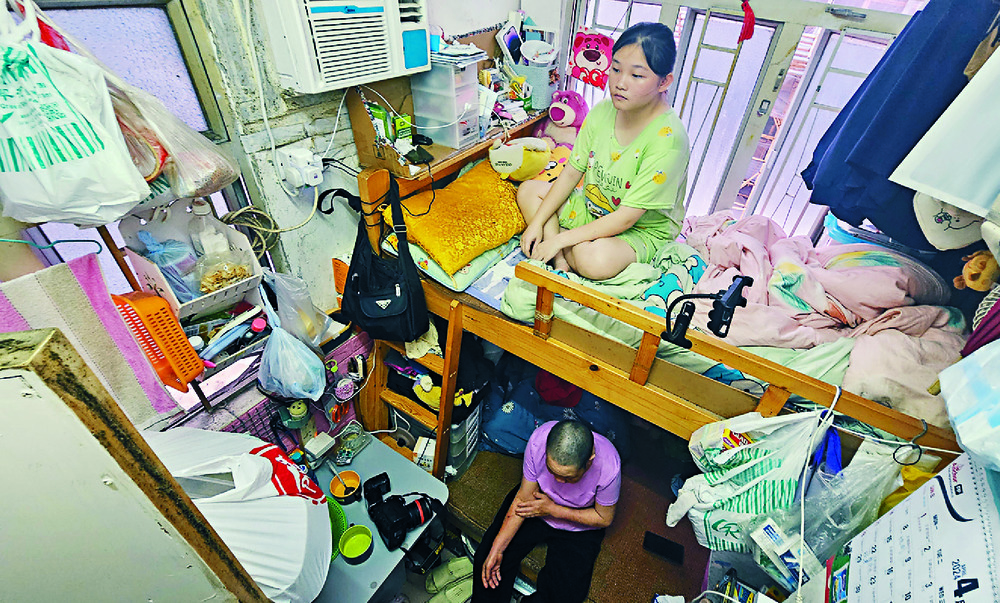
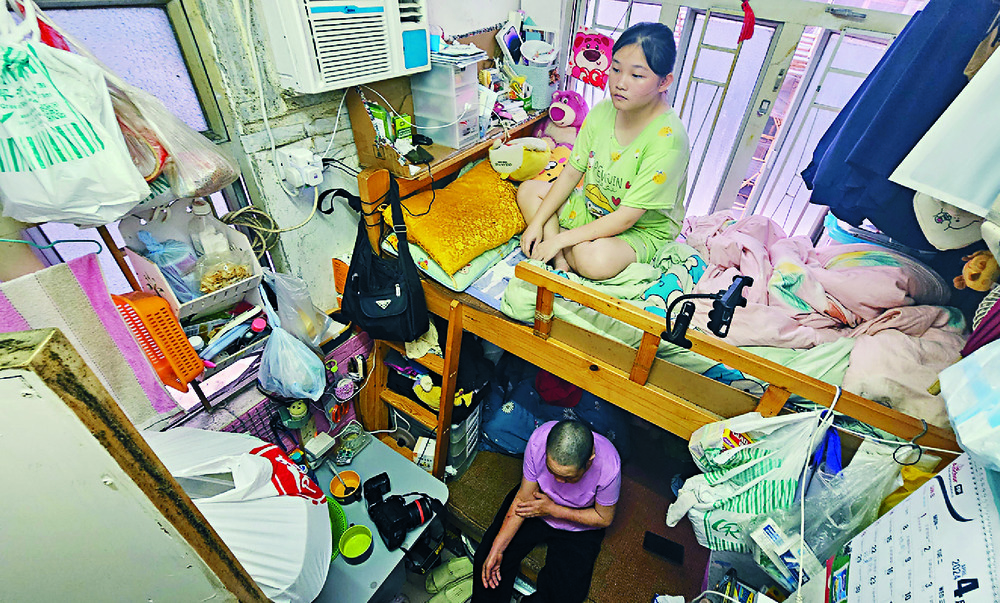
Bit by bit, but unfortunately slowly, Hong Kong is tackling its subdivided flats problem.
Back in January, Nanjing-based developer Jiayuan International, which specialized in the sale of nano-sized 131-square-foot flats for nearly HK$22,000 per square foot, was liquidated by court order.
Beijing then issued a blunt warning that Hong Kong should "bid farewell" to subdivided flats. And now in his policy address Chief Executive John Lee Ka-chiu said he would take action, ending decades of government inaction.
That's the good news.
The less good news is that because of the sheer number of such flats (at least 100,000 housing 200,000 people), Hong Kong will adopt a sort of "baby steps" approach and initially deal with only 30,000 flats, a third of the problem.
The ugly truth is that all possible solutions to this problem are tricky and contentious, not least because many wealthy and well-known Hongkongers have added to their fortunes by harvesting the very high yields of such flats. It is a sad saga that reminds me somewhat of the 2008 financial crisis and its greedy origins in US mortgage-backed securities, which were thinly sliced so as to increase profits.
The government's proposed new policy will force landlords to upgrade their subdivided flats and it is understandable that the penalties for failing to do so will be harsh.
But the suggestion that offenders could be sentenced to up to three years in prison does seem draconian. After all, if the government had built sufficient public housing in the first place, there would never have been a demand for subdivided flats.
Under the new policy the government will rename subdivided flats "basic housing units" and legislate a minimum size and ceiling height as well as essential amenities. They may still be "butchered rooms," as local slang calls them, but they will certainly be more salubrious and homely. Singapore, by the way, calls its smallest units "shoebox flats."
It is also worth considering that subdivided flats were a free-market response to a severe shortage of housing for the poor and the downright indigent.
Without them, a large number of poor would have been forced to sleep outdoors.
The root cause of this shameful treatment was a brazen and calculated policy by the British to restrict the supply of land and drive up prices to a point where the poor could not afford a home.
As for the social demographics of the 200,000 tenants of the 100,000 flats, most of them are either unemployed or from very low-income families.
Some are newly arrived immigrants, mainly legal but some no doubt illegal. Sadly, many of them are unlikely to benefit from public housing.
Another inevitable yet unfortunate truth is that policies continue to favor developers.
Any dilution of the economy's reliance on property values poses a perennial dilemma for the government, relying as it does on land premiums and stamp duty for 30 percent of its revenue, which in turn keeps taxes low.
While Hong Kong depends on land sales for its financial stability, Singapore way back in 1967 enacted the Land Acquisition Act to prevent landowners from making unreasonable profits from land intended for public development.
As a result 80 percent of Singaporeans now live in public housing compared with only about 50 percent of Hongkongers.
A final truth is that while the government's aims are laudable, enforcing larger flat sizes may well create new problems.
Knocking two units into one may be good news for the tenants of one unit but where are the tenants of the other going to live? Will 86 square feet become the norm?
Is it right that an inherently social problem should involve a substantial prison term for those who fail to meet basic housing rules? Sensibly, the government has allowed a substantial period for a public debate and will only enact new laws in 2028 - by which time the problem may well be even bigger of course!
Cheng Huan is an author and a senior counsel who practices in Hong Kong