My article last week described the innovation involved in the construction of two viaduct sections of the Fanling Bypass Eastern Section by placing them through rotation.
As I said, there were a lot of technical details involved to make this work.
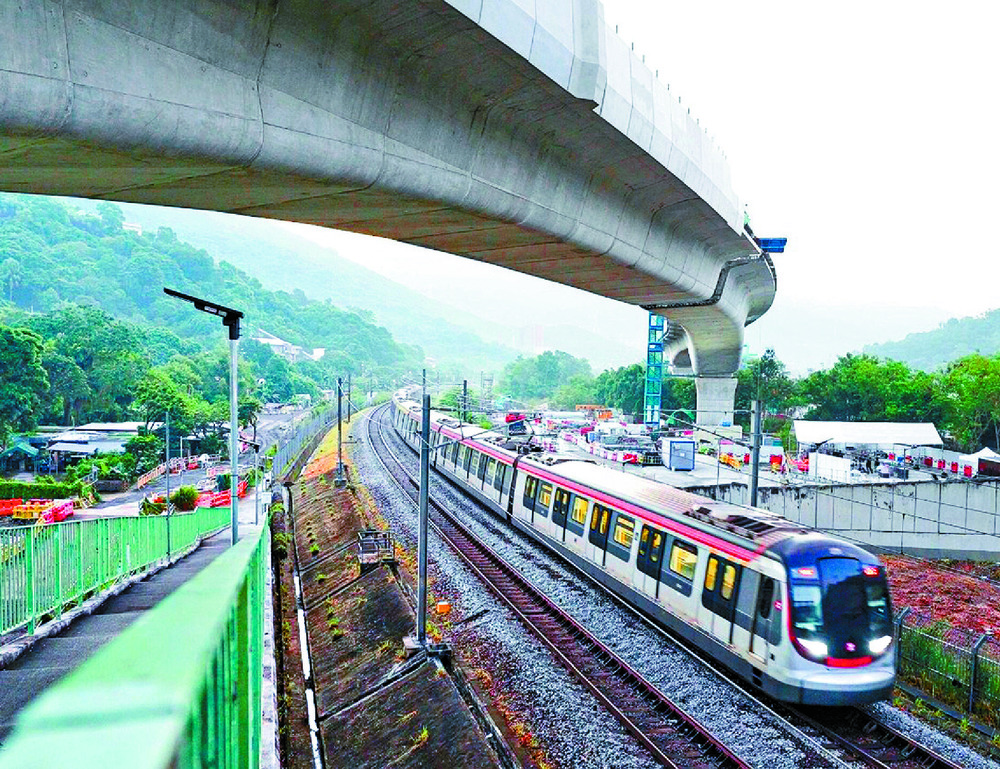
First, the alignment of the viaduct section had to be carefully planned so that its construction alongside East Rail railway tracks and other utilities would not affect their reliable and continuous operation.
Second, as the viaduct section is curved, its center of gravity does not align with the geometrical center.
Careful calculations were needed to determine the center of rotation to ensure that the section was stable when rotated, to prevent it exerting excessive lateral load and toppling over due to an imbalance in weight.
Third, the mammoth weight of the viaduct section, 7,000 tonnes, and its length, 136 meters, meant a huge column was needed not just for support but also to withstand possible additional lateral loads during the rotation.
Fourth and most importantly, the pillar column needed a smooth bearing to facilitate the rotation while being robust enough to support the heavy viaduct section.
Allowances also had to be made to ensure that should typhoon-strength or other extraneous forces be exerted on the section, the column could support it without any risks of failure or falling.
The viaduct section is a balanced T-shape rotated about its pier.
With reinforced concrete and large depth, the whole piece could be safely supported at midspan without any worries.
Two parts enabled the rotation, namely the upper turntable and lower pilecap, which were connected by a spherical bearing rotating about a central steel plinth with bearing surfaces.
The upper turntable facilitated the smooth rotation and the bottom pilecap ensured stability throughout various construction activities.
Instead of using steel balls as for a normal ball-bearing, thousands of pads with a polytetrafluoroethylene coating ensured minimum friction, allowing the turn to be made with the application of just a little force.
Two hydraulic winches were used, pulling in opposite directions, to ensure the rotational movement could be accurately controlled by counterbalancing forces to prevent an overrun.
These winches can pull up to 60 tonnes but the actual pulling force needed was only a fraction of that.
Along the outer circumference of the pillar column bearing was a set of 16 stanchions.
They were there to support the viaduct section during construction and also to provide support in the unlikely event the piece moved out of position during the rotation, which could cause additional lateral loads to be put on the bearing.
Strain gauges were installed below the bearing and stanchions to monitor vertical and lateral loads and to ensure they were within design limits.
The heavy viaduct section was jacked up at the time of rotation to clear the stanchions and, as planned, at no time were they required to serve as backup support.
After the section had been rotated to its final position, the upper and lower turntables, including the stanchions and bearings, were then concreted up to form the final column.
The ends of the section were then joined up with adjacent sections through the conventional method of formwork-travelers.
The whole process, including the rotation of the section, went smoothly as planned.
At no time were the continuous operation of the railway or the integrity of the power lines and water mains put at risk.
This confirms the adequacy of the planning process and expertise of the construction team. The mainland-based contractor has performed similar rotations dozens of times before, all without mishap.
The second viaduct section was rotated into place on Sunday with similar success.
This process saved at least two years of construction time over conventional methods.
It is gratifying to see innovative methods used in building our transport infrastructure.
Engineers continuously revolutionize construction processes and seek new methods for more efficiency and safety.
Careful design and thorough planning ensure they all work to plan, providing safe and efficient construction activities.
As we enjoy the use of new transport infrastructure, we should be thankful to engineers and construction workers for their hard work and dedication.
Veteran engineer Edmund Leung Kwong-ho casts an expert eye over
the features of modern life
It's celebration time for the team behind the construction and rotation of the viaduct section, with the magnitude of the job shown by, below, drone views of the area before and after one of the rotations is made and an East Rail train services runni