In a lecture delivered in 1981, titled "Simulating Physics with Computers," Richard Feynman, theoretical physicist at Caltech and Nobel laureate, laid the foundation for the concept of quantum computing.
Quantum computing promises a massive increase in processing power that we have never seen before.
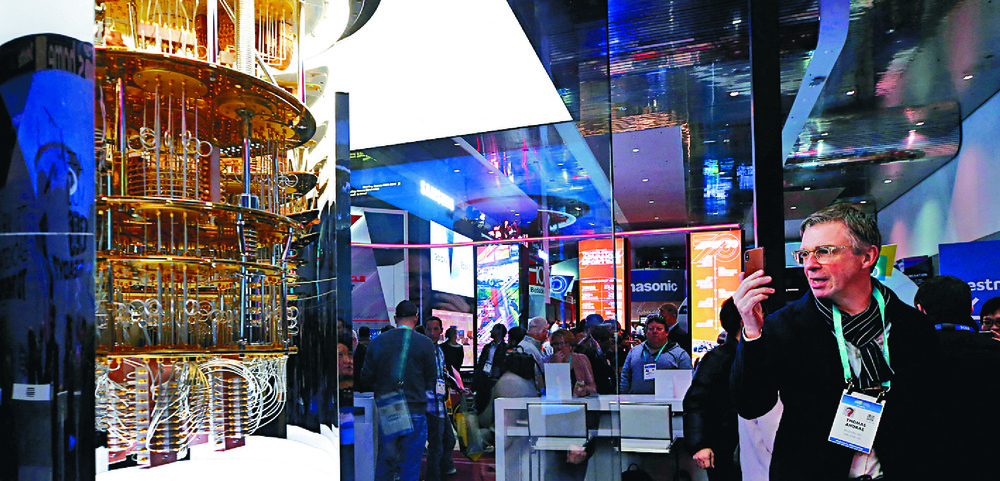
Big tech companies like IBM, Alphabet and Microsoft have been in a race to develop a dependable quantum computer, while major financial institutions such as JPMorgan Chase and Goldman Sachs are investigating potential applications for it.
However, venture capital investments in quantum startups fell 50 percent from US$2.2 billion (HK$17.16 billion) in 2022 to US$1.2 billion in 2023 globally, according to State of Quantum 2024 report, produced by IQM, a quantum tech developer.
Chinese giants Alibaba and Baidu recently pulled out of the race and shut down research units. The deployment of large-scale, fault-tolerant quantum computers is expensive and likely years away.
This week I want to review the potential advantages and inherent limitations of quantum computing.
In our everyday experience, the physical world is 100 percent measurable, deterministic and independent of the observer.
This isn't necessarily the case in the quantum universe, though.
Unlike binary bits in conventional computing, permanently either 0 or 1, at the core of quantum computing are qubits.
Qubits can exist in multiple states simultaneously due to the principle of superposition. For example, layers of rock are superimposed, or laid down one on top of another - the oldest rock strata will be on the bottom and the youngest at the top. So, quantum computers perform many calculations at once to just one for classical computers.
Another key principle in quantum computing is entanglement - which arises from the connection between particles in the same way that a ballet or tango emerges from individual dancers. This allows qubits to be correlated in such a way that the state of one qubit influences the state of another, even over vast distances.
In summary, quantum computers have a unique ability to handle complex problems with quantum objects, which are innately quantum physics in nature, such as climate change, by modeling complex chemical reactions with unprecedented accuracy and crunching massive amounts of data of molecules, catalysts and materials involved in climate-related processes efficiently.
For City College of New York theoretical physicist Michio Kaku, quantum supremacy stems from a belief that its computers' dominance and advantage would displace all other types of computing.
In 2019, quantum supremacy was demonstrated by a team at Google for an artificial problem (but without details) that a quantum processor was able to perform in three minutes and 20 seconds a calculation that could take a classical supercomputer around 10,000 years as a benchmark.
Another concept of quantum advantage was developed for experimental demonstration of a quantum algorithm solving a real-world problem on a quantum machine faster than any classical algorithm running on any classical computer.
However, latest results by scientists from Flatiron Institute and New York University showed that classical computing can be reconfigured to perform even faster and more accurate calculations than state-of-the-art quantum computers.
So, will quantum computers replace classical computers?
This is unlikely to happen anytime soon. Quantum computers may enhance, not replace, classical computers in every aspect.
The fundamental challenge for today's quantum machines is that they are very prone to errors. It will take considerable cost and time to bring to realization large-scale error-free quantum computers capable of running thousands of qubits.
Quantum computing is no doubt a beautiful theory.
Limited by specific practical applications at this point, it will be like driving a car with a rocket thruster in a congested lane.
Dr Jolly Wong is a policy fellow at the Centre for Science and Policy, University of Cambridge
IBM's Q System One quantum computer at CES 2020 in Las Vegas.