Zhangjiajie National Park, with its neat array of quartz sandstone pillars, is a favorite tourist spot of international fame, thanks largely to the movie Avatar. It is a Unesco world heritage site and has national park status.
The scenic area in Hunan was originally alluvial soil, compressed in the ocean bed to form quartz sandstone. Through millions of years of the Earth's movements it was raised to an elevation way above sea level.
Then erosion, started by vegetation on the surface, created cracks, which were aggravated by ice expansion inside them during weather cycles.
Loose stones carried by surface water caused widespread erosion until canyons were formed.
This explains why the pillars are generally of similar height.
At the early stage of this park mountain pass roads were built for access, but as tourist traffic has built up it resulted in route congestion with an increasing threat of air pollution and environmental damage.
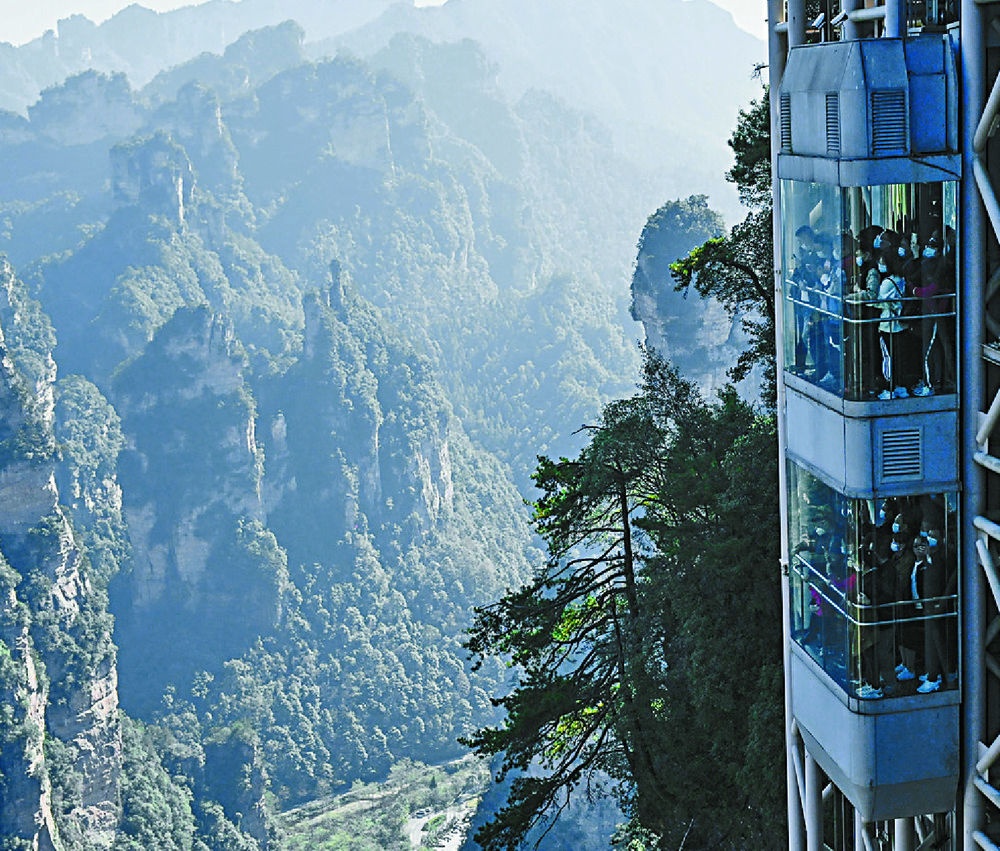
To help visitors move around in the park elevators were built from road level to the top of pillars, which are at an elevation of about 300 meters.
The set of elevators, called the Bailong Elevators, consists of three double-deck lifts, each carrying about 50 passengers, with a rated capacity of 5,000 kilograms.
The total vertical lift is about 320 m.
The lower half of the shaft was built within a sandstone wall, with the upper half in a glass covering supported by a steel structure to offer breath-taking views as tourists rise.
This design minimizes the visual impact of the elevators assembly and ensures a solid foundation for the lift shafts and the machine room.
Construction started in 1999 and operation commenced in 2002.
It was upgraded in 2015 with a higher speed, delivering passengers to the top in about 1 minutes, greatly increasing the total carrying capacity and becoming one of the world's tallest elevator systems.
The three sets of elevators ensure adequate capacity for tourists visiting and leaving the park, allowing for simultaneous up and down traffic while still providing a third lift for redundancy to meet the need for routine maintenance and emergency repairs.
The cable car system and the original mountain path road access provide alternative means to offer a variety of transport to satisfy different needs.
Environmental critics at first criticized this elevator system, claiming that it spoiled the environment with damage to the natural topography of the sandstone cliffs, and as the easier access could attract more tourists it could impose an unnecessary environmental load on the park.
But authorities believe the opposite is true.
First, the electric elevators significantly reduce the need for a large fleet of coaches to ferry tourists, which might cause excessive air pollution.
More importantly, the quicker travel time allows easy daily turnaround of tourists, significantly reducing the need for lodgings and food, eliminating the ever-increasing environmental demands on the park.
Once again, it demonstrates that good engineering can strike an effective balance between accessibility and environmental protection, achieving the purpose of allowing large numbers of tourists to visit while the minimizing environmental impact.
Veteran engineer Edmund Leung Kwong-ho casts an expert eye over standout infrastructure