Read More








Why HKIA's ground transport experience matters | Fongmula | Francis Fong
22-09-2026 02:34 HKT




UK denies BN(O) visas to Hongkongers with protest convictions: report
23-09-2026 18:59 HKT



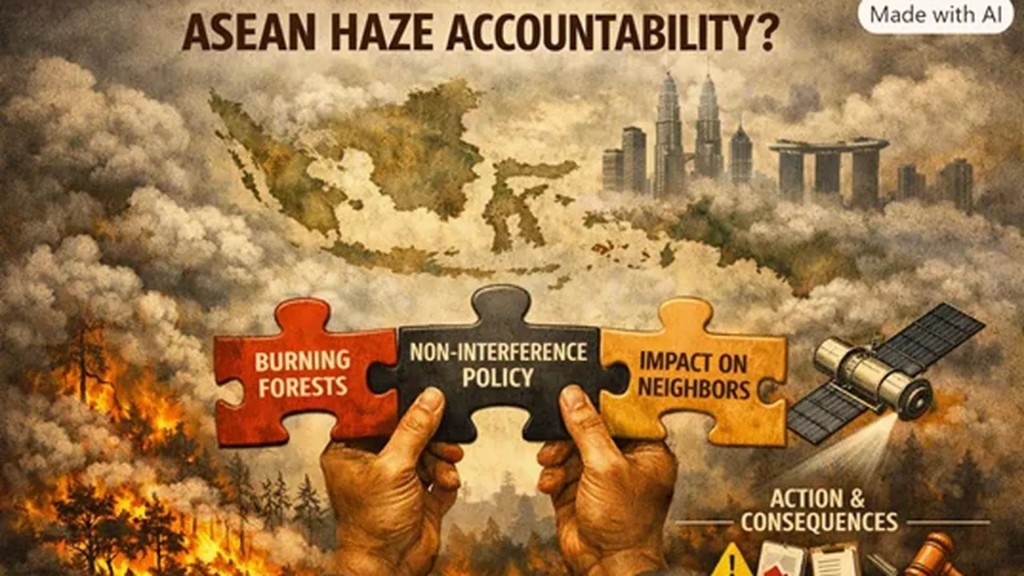
Every year, Southeast Asia goes through the same routine. The skies turn grey. The air smells of smoke. Air quality readings climb. People with asthma and other respiratory problems are told to stay indoors. Schools begin watching the numbers. Governments issue statements. Satellites track the fires.
And then, as usual, ASEAN talks about cooperation.
There is nothing wrong with cooperation. In fact, ASEAN has been talking about the haze for decades. After the devastating fires of 1997–1998, the 10 member states signed the ASEAN Agreement on Transboundary Haze Pollution in 2002. The agreement came into force in 2003 and, eventually, all ASEAN members ratified it, with Indonesia depositing its instrument in 2015.
The agreement itself recognises that states have the responsibility to ensure that activities within their jurisdiction do not cause damage to the environment or harm human health in other states.
So, the problem is not that ASEAN has no rules. The problem is that its political culture has often made those rules difficult to enforce.
ASEAN was built around principles of sovereignty, consensus and non-interference. Those principles made sense in a region emerging from colonialism, conflict and big political differences. Countries wanted an organisation that would cooperate without allowing one member to dictate to another.
But there is a difference between respecting sovereignty and avoiding accountability. When a fire starts in Indonesia and the smoke remains in Indonesia, it is largely an Indonesian domestic issue.
But when the smoke crosses the border and affects people in Malaysia, Singapore, Brunei or elsewhere, it is no longer simply an internal matter. It becomes a transboundary environmental problem.
International law already recognises this distinction. The International Court of Justice has repeatedly affirmed the obligation of states to exercise due diligence to prevent significant environmental harm from activities within their territory from affecting other states.
In the 2010 Pulp Mills case, the Court described prevention of significant transboundary environmental harm as a customary rule of international law. It also linked that duty to due diligence — meaning that states must take appropriate measures and exercise vigilance over activities within their jurisdiction.
This is important because it changes the question ASEAN should be asking. The question should not simply be: "Are we interfering in another country's internal affairs?"
It should be: "What responsibility does a country have when activities within its territory cause significant harm beyond its borders?"
That narrative is not the same question. The ASEAN haze agreement itself provides the answer, at least in principle. Its Article 3 recognises both sovereignty and responsibility. A state has the sovereign right to use its own resources, but it also has the responsibility to ensure that activities within its jurisdiction do not cause environmental damage or harm to human health in other states. The agreement also calls for precautionary measures when there is a threat of serious or irreversible damage.
In other words, ASEAN has already accepted the idea that sovereignty comes with responsibility. What it has not done sufficiently well is turn that principle into a credible accountability mechanism.
That is where ASEAN needs to change.
This does not mean ASEAN should abandon non-interference. Nor should Malaysia or Singapore be given a licence to tell Indonesia how it should govern its forests. That would be unrealistic and politically counterproductive.
What ASEAN needs is something much more practical: a stronger regional mechanism for dealing with environmental harm that crosses borders.
For a start, ASEAN should establish clear thresholds that automatically trigger regional action. If transboundary haze reaches an agreed health-risk level, the matter should not depend on whether governments are comfortable raising it diplomatically. The response should be automatic: data sharing, joint verification, emergency coordination and a formal regional assessment.
Second, ASEAN needs stronger independent verification. Today, satellite technology makes it increasingly possible to identify hotspots, track smoke movement and establish where pollution originates. ASEAN already has regional monitoring capabilities. ASEAN's Specialised Meteorological Centre (ASMC) in Singapore provides regional haze monitoring using satellite imagery, hotspot detection, weather data and smoke-haze trajectory analysis to track fires and transboundary haze across Southeast Asia. The issue is not whether the information exists.
The issue is whether member states are prepared to use that information as the basis for accountability. Third, there should be consequences for repeated failure. These do not necessarily have to begin with punishment or sanctions. They could include mandatory reporting, independent investigations, remediation plans, compensation discussions and, in serious cases, a formal dispute-settlement process.
The important thing is that there must be a point at which endless consultation ends and accountability begins.
Some will argue that this is exactly what ASEAN's principle of non-interference is designed to prevent. But that interpretation is becoming increasingly difficult to defend when the harm itself is transboundary.
International environmental law has moved forward. The International Court of Justice has reaffirmed that states cannot simply ignore significant environmental risks originating within their jurisdiction. The Court has also recognised the importance of environmental impact assessment, notification and consultation where activities may cause significant transboundary harm.
The point is not that international law automatically makes Indonesia legally liable every time smoke reaches Malaysia. That would be far too simplistic. Establishing responsibility requires evidence, causation, attribution and an assessment of whether the state exercised the required level of due diligence.
But that is precisely why ASEAN needs better mechanisms. It needs a way to establish facts, assess responsibility and determine what should happen next.
There is also a danger in making Indonesia the permanent villain in this debate. Forest and peat fires are complicated. They involve weather conditions, land management, local communities, companies and enforcement at different levels of government. Indonesia has also taken measures against illegal land clearing and fire-related offences.
The regional problem cannot be reduced to blaming one country. But neither should the complexity of the problem become an excuse for doing nothing.
ASEAN has been dealing with the haze for more than two decades. Yet the basic experience for ordinary people remains familiar: the smoke arrives, health warnings follow, governments express concern, and then the region waits for the weather to change.
That cannot be the definition of regional cooperation. ASEAN's greatest strength has always been its ability to find common ground. On the haze, however, consensus cannot mean avoiding difficult conversations.
Cooperation should not mean that every serious disagreement is softened until nobody is accountable for anything.
The region needs a more modern understanding of non-interference. Non-interference should mean that ASEAN does not interfere arbitrarily in another state's domestic political affairs. It should not mean that a state can invoke sovereignty whenever activities within its territory produce serious and foreseeable harm outside it.
The principle should be simple: sovereignty carries responsibility. The haze does not stop at an international border. It does not ask whether the people breathing it live in Indonesia, Malaysia, Singapore or Brunei. It does not care about ASEAN's diplomatic sensitivities.
ASEAN therefore needs to ask itself a difficult question: if its existing rules recognise responsibility for transboundary harm, why does the organisation still behave as though accountability itself is an act of interference?
After more than 20 years of the same problem, perhaps it is time to stop treating the haze as an annual diplomatic inconvenience and start treating it for what it is — a transboundary environmental problem that requires enforceable regional responsibility.
Dr Chai Ming Hock, Universiti Sains Malaysia
Source : Weekly Echo
https://www.weekly-echo.com/aseans-non-interference-policy-time-for-a-rethink-on-excuses-for-the-haze/