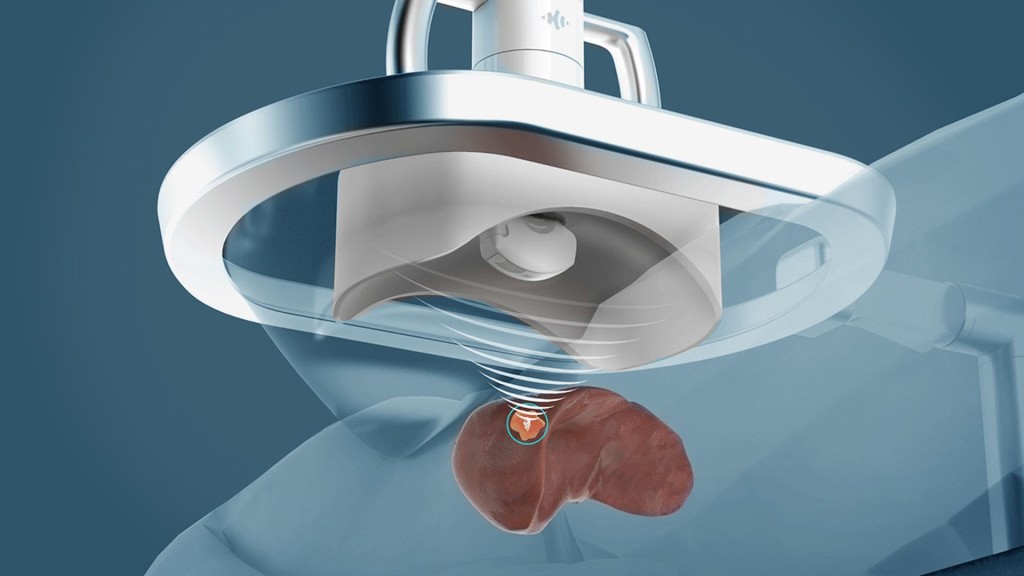
Recent Hong Kong news has highlighted the arrival of histotripsy, an advanced machine-based treatment for liver tumors. Systems donated by the Li Ka Shing Foundation are now available through selected private hospitals and subsidy programs. Histotripsy offers a new option for some patients, but it does not replace specialist assessment or established liver cancer treatments.
Histotripsy is a non-invasive treatment using focused ultrasound waves from outside the body. With real-time imaging, the doctor targets the liver tumor. The ultrasound creates microscopic bubbles inside the tumor, and their rapid collapse mechanically breaks the tissue into tiny particles.
Unlike radiofrequency or microwave ablation, histotripsy does not burn tissue. No surgical cut is made, and no needle passes through the liver. The procedure is usually performed under general anesthesia.
The liver contains vital blood vessels and bile ducts. For tumors close to these structures, heat-based ablation can be difficult: heat may damage nearby tissue, while blood flow through large vessels can reduce treatment effect.
Histotripsy uses mechanical rather than thermal energy. In suitable cases, it may help preserve nearby vessels and ducts while treating the tumor. The body gradually clears treated tissue. Recovery may be quicker and discomfort may be lower when compared with more invasive procedures, although outcomes vary.
A hepatobiliary multidisciplinary team should assess each patient. Histotripsy may be considered for selected primary liver cancers or liver metastases, especially when surgery is unsuitable. Key criteria include:
- A small tumor, ideally under 3 centimeters.
- A tumor that can be clearly seen on ultrasound.
- An ultrasound pathway not substantially blocked by ribs, lung, or bowel.
- Adequate liver function, general fitness, and ability to undergo general anesthesia.
- Patients with prior bile-duct surgery or an existing biliary stent may require additional planning to reduce infection risk.
Histotripsy is promising, but it is not suitable for every liver cancer patient. Surgery, ablation, embolization, radiotherapy, or systemic medicines may be more appropriate depending on tumor stage, location, liver reserve, and overall health. Evidence on long-term recurrence and survival is still developing. Seek early specialist review if you have hepatitis B, hepatitis C, cirrhosis, a liver mass, or confirmed liver cancer.
Dr Cheng Kai Chi, Specialist in General Surgery