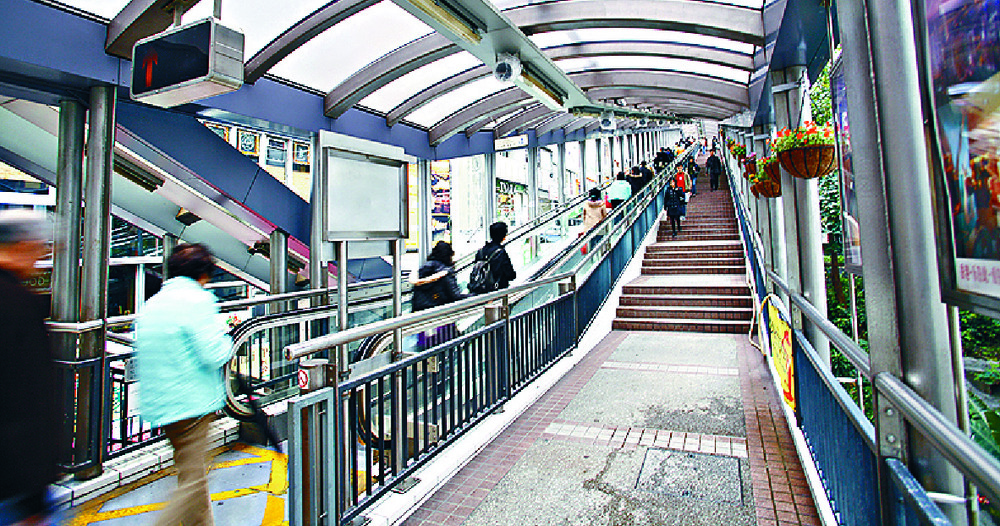
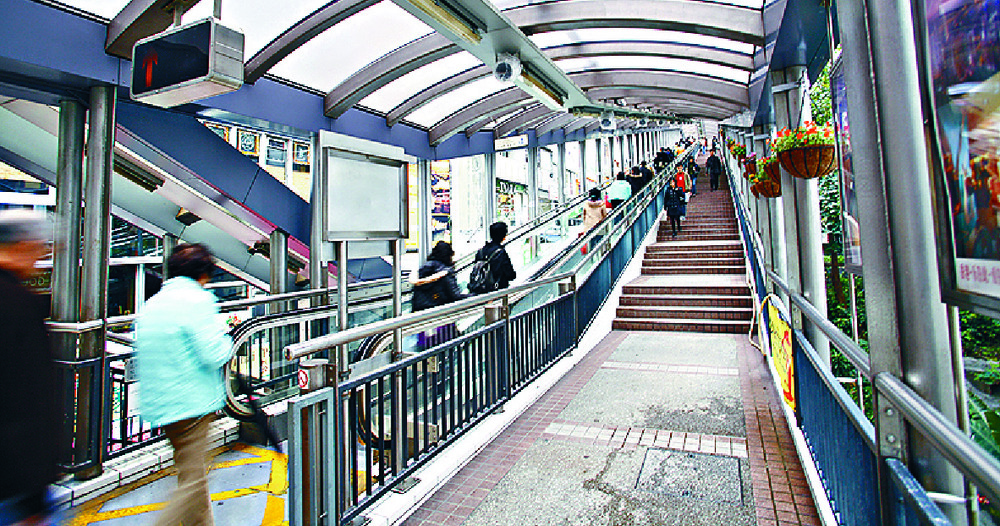
The Central to Mid-Levels hillside escalator system is claimed to be the longest such system in the world.
With a length of more than 800 meters and climbing an elevation of 135 meters, it provides an alternative transport for Mid-Levels residents.
There may be long escalator rides elsewhere in the world. There are deep underground subway systems in Russia, and in the mainland many long escalators with single flights go longer than those here. But for statistical reasons, we count the total lengths of different flights of connected escalators as one system.
Nevertheless, we should be content that we can claim to have two sets of escalators that hold world records, the other being those in Ocean Park.
The greatest advantage of the hillside system lies in its simplicity.
As it is provided by the highways department, it is free for commuters, though some may argue that the taxpayers actually pay for it.
Commuters can get on and off at any time, there are no turnstiles or tollgates.
With the landings at or near other street crossings, commuters and tourists can join or leave at any point.
We can now practically reach various levels of the island without the strenuous effort of climbing steep slopes, by letting this wonderful mechanical device do the lifting.
This escalator system carries about 85,000 people a day, and if you weighed that against bus or minibus transport, it has relieved congestion along Cairn, Bonham and Robinson roads.
To help commuters get to work and back home every day, the escalators run downhill from six to 10 in the morning, and uphill for the rest of the day.
Stairs alongside the escalators provide access in the opposite direction and emergency use when the system is out of action.
The system is mostly sheltered so it can serve us under all weather conditions.
Road signs are provided to guide tourists to points of interest, and for locals, the open system allows easy identification of street locations so that most of us would not lose our way.
Operating costs are low compared to trams, buses and minibuses, and the system has attracted a lot of office workers to live in the Mid-Levels.
If they work in Central, they can do their daily commute without using any vehicles.
With all these conveniences, why have hillside escalators not replaced other modes of transport?
The highways department proposed a very comprehensive plan last year, a system that could provide free transport to residents and visitors and covers all 18 districts in Hong Kong.
But to implement these plans, we first need to clear some streets to build the escalator structure, which invariably requires blocking some streets from road access, and may even require some land resumption to build landings for access.
They will also cause some degree of environmental impact, which for a free and open society like ours, will require extensive consultation with the district council to get consent to proceed, not to mention the likely lengthy discussions inevitable under the current political climate in the Legislative Council.
I remain optimistic that at least some of these proposals will be able to go through for the complex system to be built soon.
Once again, it is easy for engineers to plan and propose efficient transport systems, but implementation takes time and effort.
Let us hope common sense will prevail and we will be able to provide appropriate systems with low capital and at low operating costs for the long-term benefit of the people of Hong Kong.
Veteran engineer Edmund Leung Kwong-ho casts an expert eye over Hong Kong's iconic infrastructure