Read More





The Death of Late Night? What Colbert’s Final Bow on May 21 Means for TV
18-05-2026 21:09 HKT


ImmD crackdown targets moonlighting domestic helpers arresting 17
19-05-2026 17:52 HKT



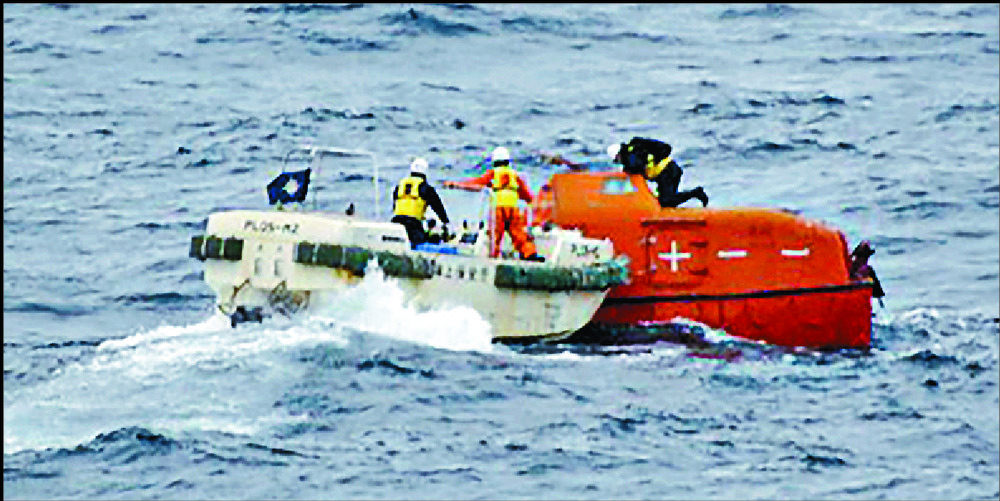
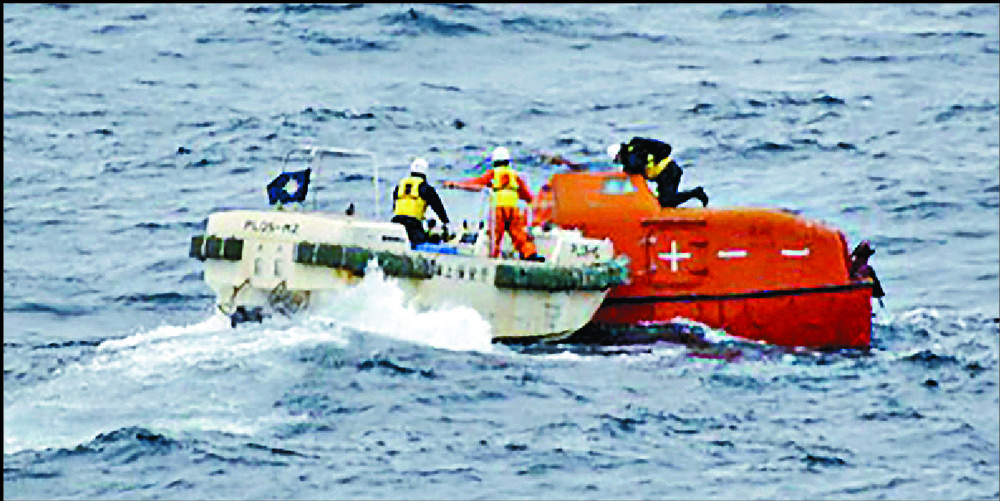
A fatal incident involving a Hong Kong-registered cargo ship, SS Jintain, that capsized off southwest Japan serves to remind us of basic theories about how a ship floats and maintains equilibrium at sea.
Let us firstly examine how an object can float in water.
Archimedes' Principle states that, when an object is placed in water, an upward force equal to the weight of water it displaces will be exerted on it.
This explains how a ship made of steel can float in the ocean, as its total weight is much less than that of the water it can displace due to the hollow cabins.
The more load a ship takes, the deeper it will submerge and the more water will be displaced to provide the upward force.
The last is called the buoyancy force.
The weight of the floating object acts through its center of gravity while the buoyancy force of the same magnitude acts on its center of buoyancy, which is the centroid of the submerged volume.
It is this delicate balance of the two forces, acting along the center line of the ship, that keeps it afloat and stable at sea.
It is relatively easy to design a ship to float, but much more difficult to make it stable in high seas.
Cavities in the ship, called holds, allow the total weight of the vessel to be much less to equalize the buoyancy force.
A properly designed seagoing vessel has each hold separate from others so that in the unlikely event of water leakage, the vessel can still float.
But when the vessel tilts under strong winds and tall waves, it should also be able to return to its upright position automatically, like a roly-poly doll.
To achieve this, ships' cross sections are usually designed with a wide belly shape such that, in a slightly inclined position, the center of buoyancy will move away from the ship's center line.
The upward buoyancy force, now acting on the new center of buoyancy some distance away from the centerline, provides a strong counteracting turning force to push a ship back to its upright position.
Besides, loads with heavy components stacked up high in a hold or on the deck should be within safety height limits, as a higher center of gravity will also move to the side of a ship and upset its stability when it tilts under strong wind or waves.
Most ships have been designed to have the heavy load, such as the engine and fuel, to be placed at the bottom of the hull to lower its center of gravity for added stability.
To minimize risk of water entering the side openings near the deck level when the ship tilts under strong wind or waves, a set of easily recognizable lines are drawn on the side of the hull to facilitate the captain to check the limit of submersion due to cargo and other loads.
These markings are specified for each particular oceangoing vessel under established guidelines to ensure a safety margin with the amount of loads it can carry in different regions of sea water temperature and density.
They are called Plimsoll Lines, named after British politician Samuel Plimsoll of the 19th century who came up with the idea.
Oceangoing vessels are carefully designed by maritime engineers to be inherently stable, but safe seafaring depends also on the experience of the captain to place cargo in appropriate positions, and to control the vessel at times of adverse weather, such as steering the vessel toward the headwind to avoid strong undue forces acting on the side of a vessel that may threaten to upset its equilibrium.
A failure to ensure that may cause disastrous results with casualties and loss of valuable cargo.
Veteran engineer Edmund Leung Kwong-ho casts an expert eye over features of modern life