Another magnificent piece of lifting equipment we occasionally see is the floating crane.
In my previous article on cranes, I mentioned that a vital factor of safe lifting of heavy weight is to have a large solid base for the crane, but for marine applications, this poses a challenge.
To lift heavy equipment in the sea, the barge which houses the crane must be able to float on water, as there are no firm foundations to rest on.
Archimedes' principle states that a floating object will displace an amount of water equal to its total weight. This dictates that the floating crane barge must be large enough to displace that amount of water equal to its total weight without risks of sinking.
When I was working for the Hong Kong United Dockyard group in the 1980s, it prided itself as the owner of the largest floating crane in this region, the Titan, which could lift 100 tonnes.
It was used for salvage and for construction of facilities near the waterfront. It was a special piece of equipment that we used to erect container cranes and other pier facilities.
Progress in the past 40 years has seen the lifting capacity grow by a hundred times.
Floating cranes capable of lifting tens of thousands of tonnes are now frequently used to build oil rigs and to salvage grounded sea vessels.
But their cumbersome size and huge weight mean that they can only work in the open sea.
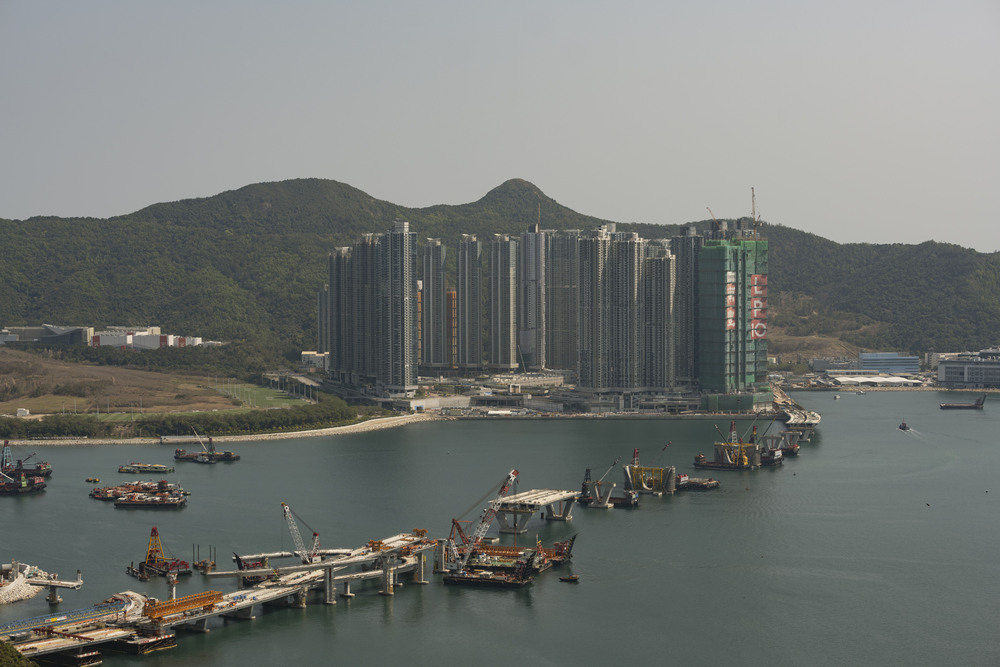
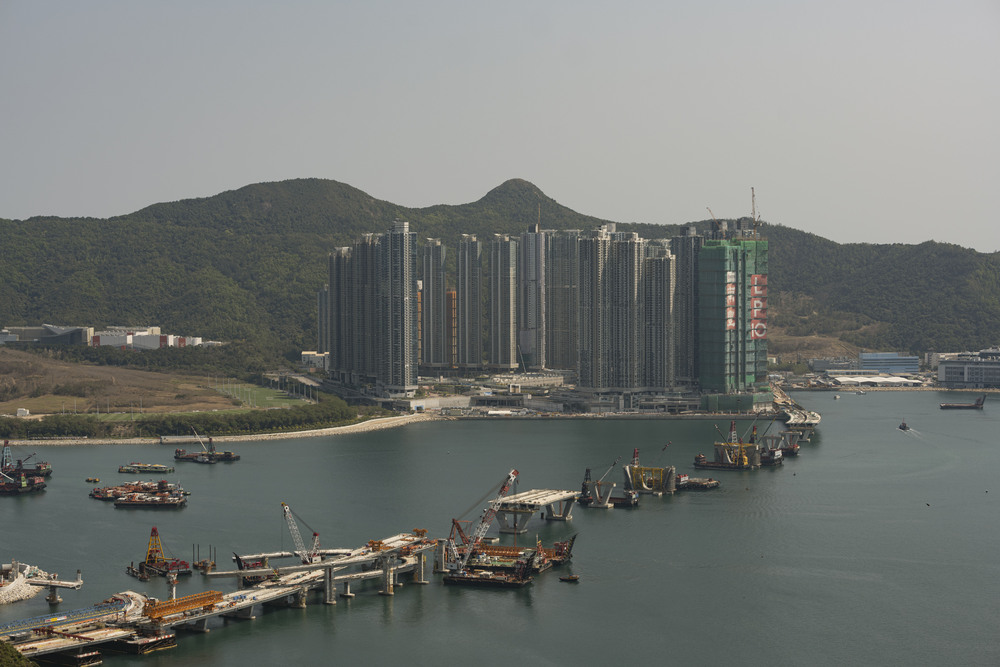
We in Hong Kong have recently seen an enormous piece of marine lifting activity in the form of the new bridge in Tseung Kwan O, for the Lam Tin-Tseung Kwan O Cross Bay Link.
The bridge, formed of steel sections and an "infinity arc," are constructed in huge sections weighing tens of thousands of tonnes.
While the infinity arc was launched by a submersible barge and located by hydraulic jacks, the other straight steel sections were lifted and placed in position by a gigantic floating crane.
This giant crane belongs to Zhenhua Harbour Machinery Group in China. It is reported to be capable of lifting 20,000 tonnes at the front and 5,000 tonnes at the side.
It is more than adequate for lifting the bridge sections, which are in the region of 10,000 tonnes per piece.
Traditionally, the largest floating crane in the world used to be from the Netherlands. The Thiaf by Heerma is reported to be capable of lifting 14,200 tonnes.
But growing construction needs for marine works in this region has prompted even larger floating cranes.
For lifting huge pieces of structure at sea, not only must the floating barge be able to carry the total weight, but it must also be long enough to prevent from toppling.
Hence the large difference in lifting capacity, at end or at side, for the rectangular barge that we saw.
It is gratifying to see one of the world's largest pieces of equipment being used in Hong Kong.
Once again, it demonstrates that we have the ability to execute construction work to world-class standards.
Veteran engineer Edmund Leung Kwong-ho casts an expert eye over Hong Kong's iconic infrastructure
The Cross Bay Link bridging Lohas Park in Tseung Kwan O with Lam Tin has an infinity arc central span that must have been heavy for the floating cranes.