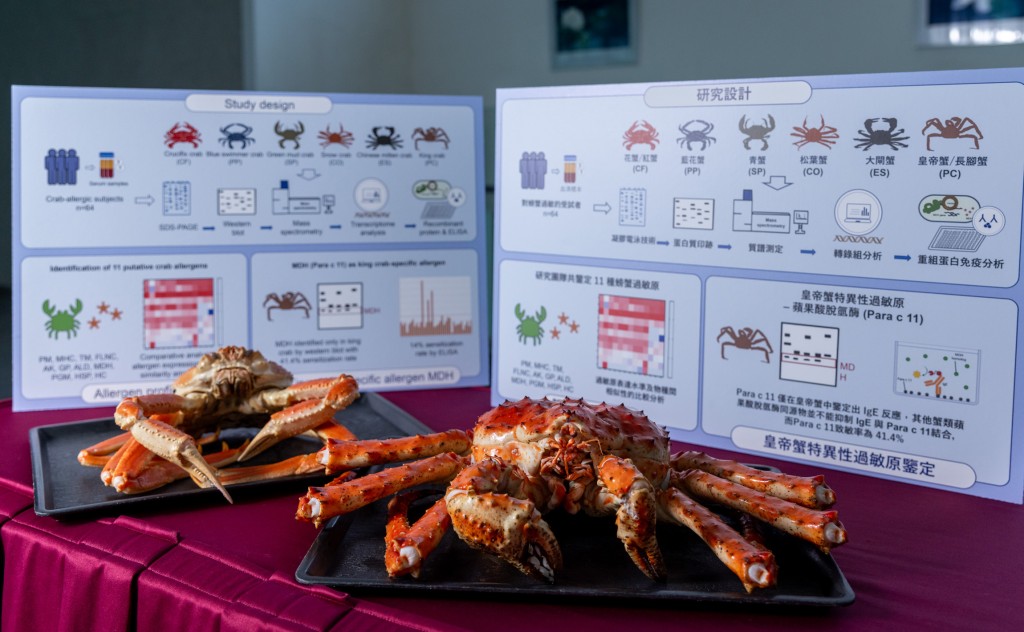
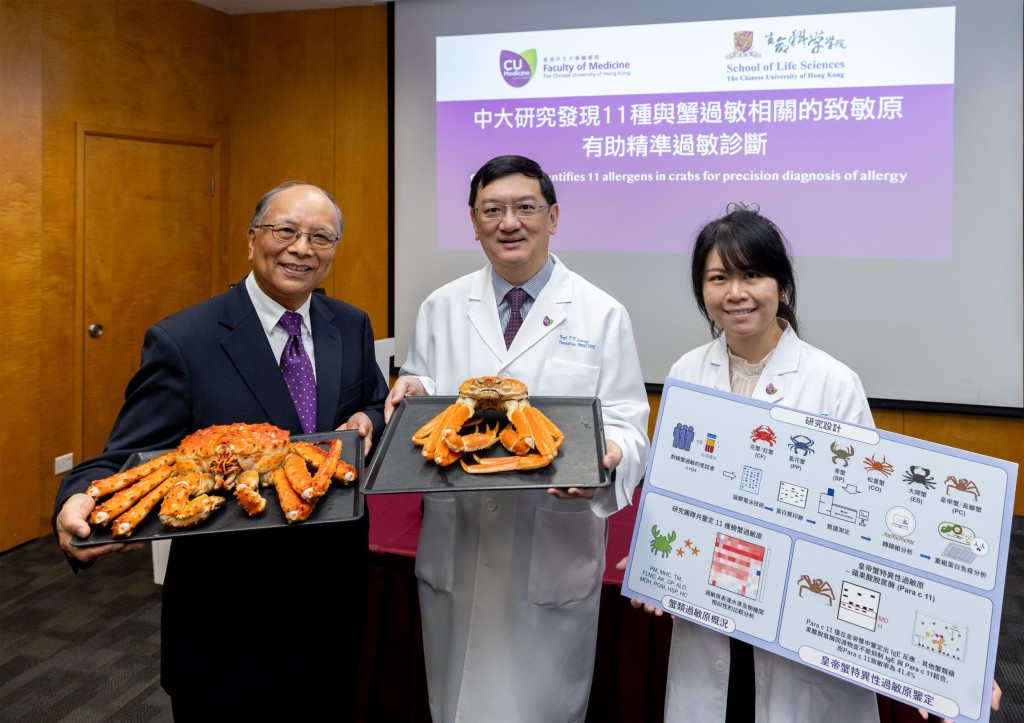
The Chinese University of Hong Kong's (CUHK) Faculty of Medicine (CU Medicine) has conducted an in-depth study of six commonly edible crabs species, revealing not only 11 different crab allergens but also a unique allergen specific to king crab that could reshape treatment options for people suffering from seafood allergies.
2pc of global population suffers from shellfish allergy
According to the report, approximately 2 percent of the global population suffers from crustacean allergy and mollusk allergy (collectively known as shellfish allergy), including shrimp, crab, scallops, mussels, clams, lobster, oysters, and abalone.
It is highlighted that shellfish allergy is a leading cause of anaphylaxis among adolescents and adults in Hong Kong, with crab being the second most common type of allergy after shrimp.
Allergic reactions include hives, angioedema, wheezing, and in severe cases, anaphylactic shock.
11 confirmed allergens among widely consumed crabs
Beginning in 2022, researchers analyzed 64 serum samples from crab-allergic patients, examining extracted proteins from the muscle tissue in the claws of six commonly consumed crabs in Hong Kong, including Charybdis feriata (Flower crab), Portunus pelagicus (Blue Crab), Scylla paramamosain (mud crab), Chionoecetes opilio (snow crab), Eriocheir sinensis (Chinese mitten crab), and king crab.
Notably, a total of 11 crab allergens were identified, along with eight new discoveries.
The team found that tropomyosin (TM) and arginine kinase (AK) are the major allergens across all crab types, exhibiting over 90 percent high epitope similarity, indicating a significant allergenic potential among the tested crabs.
As some crabs possess unique allergens, patients with crab allergies have shown varying responses to different allergens. For instance, some may be allergic to mud crabs yet they can safely eat Chinese mitten crabs.
King crab: Not a true crab?
The team clarified that king crab is not classified as a true crab but belongs to the family Lithodidae, having evolved from the ancestors of hermit crabs.
Additionally, the study identified a king-crab-specific allergen known as malate dehydrogenase (MDH), which has the highest sensitization rate at 41.4 percent.
The allergen has been registered as "Para c 11" in the allergy naming database of the World Health Organization and the International Union of Immunological Societies (WHO/IUIS).
Following these findings, the research team believes that advancements could lead to precise allergy diagnoses, providing scientifically backed treatment recommendations for shellfish allergy patients and thereby improving their quality of life.
(Phoebe Poon)