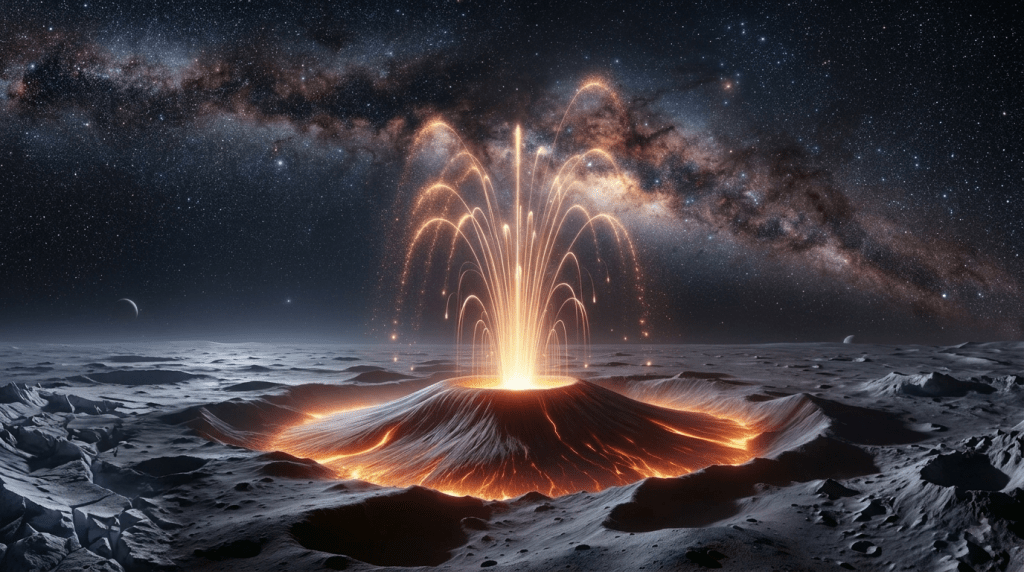
A joint study by The Chinese University of Hong Kong (CUHK) and the University of California, Los Angeles (UCLA) reveals that Moon volcanoes continue to exhale for years after erupting, offering new pathways to explore lunar evolution.
The research team has proposed a novel explanation for the formation of lunar volcanic glass. The research reveals that the environmental impact of lunar volcanic eruptions can last for years, updating the scientific consensus.
Previously, most scientists thought that lunar volcanic glass formed from the rapid cooling and degassing of magma during volcanic eruptions.
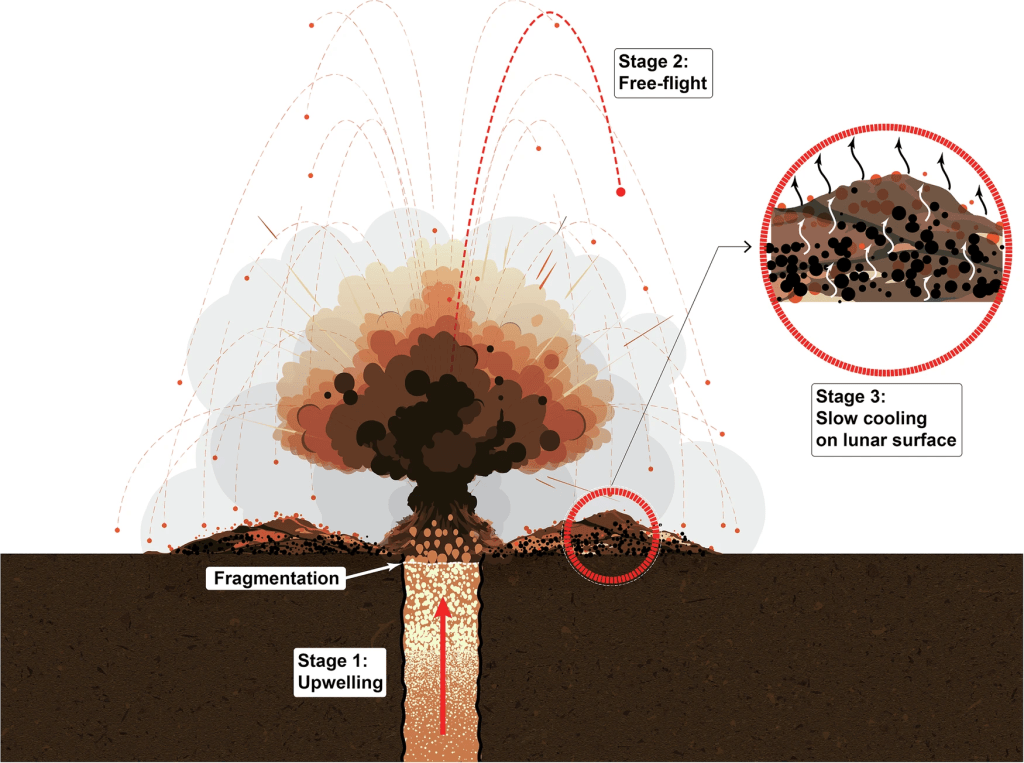
However, after analysing the famous sample 74220, orange volcanic glass beads brought back to Earth by Apollo 17 in 1972, the research team discovered that lunar ejecta did not lose all its gas components at once while in flight.
Instead, when these materials fell back to the lunar surface and were buried by surrounding debris, they continued to slowly cool and exhale gases for several years.
The evolutionary stages of lunar volcanic glass beads.
“The findings not only affect how we interpret the information about the lunar interior recorded in the Apollo samples but may also change our understanding of how surface moisture and other volatile components migrate on the Moon,” said Zhan Yan, co-first author of the study from CUHK’s Department of Earth and Environmental Sciences.
“Our research shows that if we ignore the prolonged cooling and continuous degassing process this ejecta undergoes after falling back to the lunar surface, scientists might underestimate the amount and composition of volatiles originally contained within the Moon,” Ni Peng from UCLA, also a co-first author of the study, added.
The team stated that the study will help scientists reassess the long-term impact of lunar volcanic activity on the Moon’s environment, and provide a new approach for studying the Moon’s internal water resources and other volatile substances, such as sulphur, chlorine, and fluorine.
The findings were recently published in the prestigious international scientific journal Nature Communications.