
Read More
Democrats' takeover of Congress in the midterm elections will send ripples through key US economic and global-market themes, including artificial intelligence sector, US interest rates and the war with Iran.
ADVERTISEMENT
SCROLL TO CONTINUE WITH CONTENT
The result is in line with previous market predictions that put Democrats' odds above 90 percent for the House and around 60 percent for the Senate.
AI policy test
A Democratic sweep of both chambers of Congress would likely bring more AI regulation and security on data center buildout.
However, there is indeed global demand for AI infrastructure, which has been the core engine for the development of the US economy, no matter who takes over the Congress. AI is not just a Republican-driven issue, said Michael Strobaek, global chief investment officer at Lombard Odier, adding that a bit of regulation may not be too bad.
But except for a minor compromise for the next two years, the Democrats won't be able to impose a suspension on tech because Trump will veto any restrictions on data centers, Strobaek said.
Notably, Trump retains veto power and broad authority over tariffs, immigration and foreign policy, limiting Democrats' ability to change his agenda, unless he needs money and budget to fulfill those policies, according to Samy Chaar, chief economist at Lombard Odier.
"We need to tone that down," Chaar said.
Fiscal policy and interest rates
Democratic control of Congress will bring a net positive outcome for markets, as it could likely curb the scope for further fiscal expansion and ease upward pressure on US interest rates.
Fiscal policy would shift from tailwind to small headwind with an increase of debt ceiling with Democrats on sectors like healthcare and some room for compromise to vote for a continuing resolution on others, Chaar said.
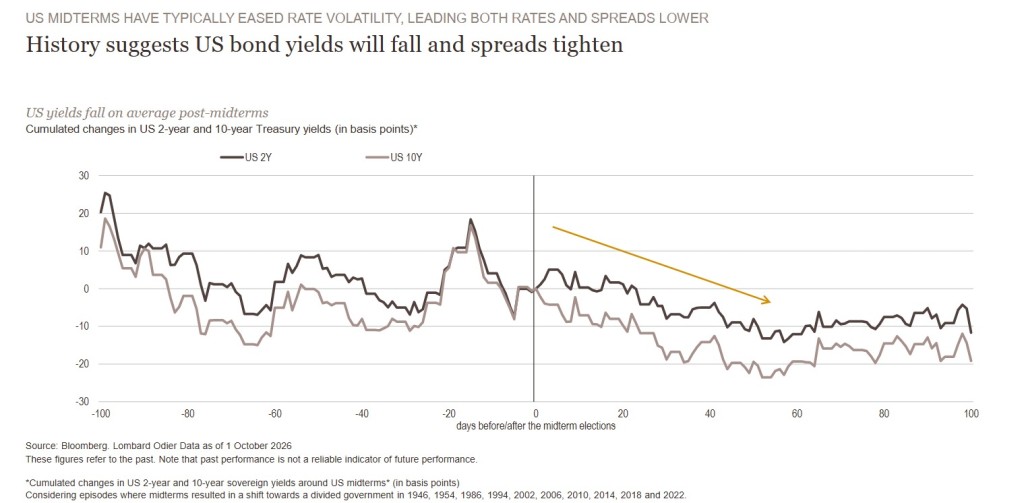
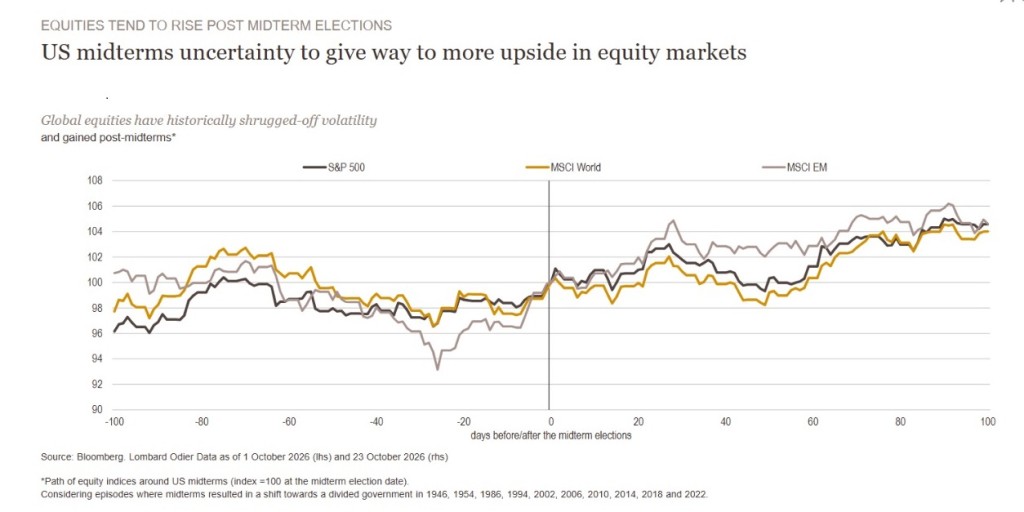
When Democrats take over the Senate, Trump can no longer nominate key members in key institutions like the Fed. With Fed independence, interest rates would be raised again possibly in December this year. Yields tend to trend downward after midterm elections. But it's probable for long-term yields, not yet for short yields, and markets tend to drift upward in general, Strobaek said.
People in the US are complaining about Trump who lifts their cost of living as well as the rising prices of oil. "I think probably the most important thing that at least the two years showed was they failed pretty spectacularly on the promise of bringing the cost of living and affordability down in the US," he said. “I am a strong believer that ultimately inflation and or prices is what breaks democracies and or swing governments."
The company has added duration exposure in the US government bonds, finding yield levels attractive, though it retains a preference for five‑to‑seven‑year maturities, as yield curves across most countries remain extremely flat, according to Strobaek.
The US dollar will stay strong in the near-term future, and it is too early to begin hedging it, he added. Meanwhile, Chaar predicted that Democrats will start raising taxes for sure, which should come from corporate taxes, but not from wealth taxes on individuals or from labor income.
Iran war and oil
Democrats will likely enhance the constraints on Trump and prevent the escalation of the conflict. Even as Trump frequently flip-flops on his decisions and the situation of the war is full of uncertainty, Trump cannot get the budget for a longer-term war, according to Chaar .
The energy sector will probably be most affected as Trump is and will always remain a deep believer in energy and fossils, Strobaek said. The Democratic party is supportive of renewable energy.
In addition, the new Congress's inauguration is on January 3, 2027. Republicans retain control for roughly two months, giving Trump a theoretical opening for additional moves. Geopolitical disputes are unlikely to settle quickly, but near-term market volatility and a fresh spike in oil prices remain risks.
The midterm elections determine which party will hold majority control of the House of Representatives and Senate for the next two years. This not only shapes the White House's room to implement policy over the remaining president's term, but also offers early clues for gauging the landscape of the 2028 presidential race.
Frank Feng