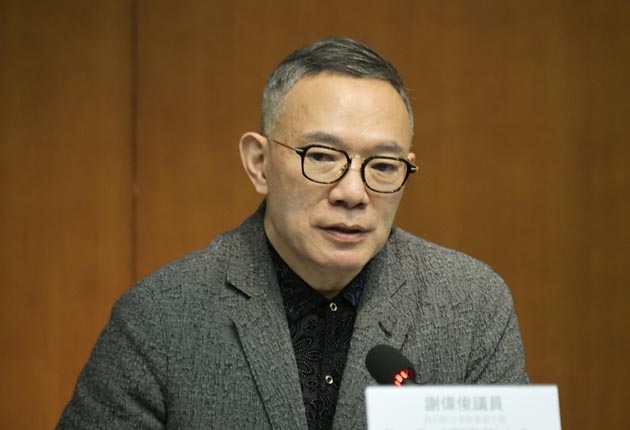
It naturally caused one to wonder whether it was due to the imminence of Article 23 legislation that a seemingly minor complaint from lawmaker Paul Tse Wai-chun led to a fiery rebuttal from Chief Executive John Lee Ka-chiu in the legislature's question-and-answer time yesterday.
Whether it was due to this or not, Tse was not involved in the social unrest in 2019 - indeed, he was returned to the Legislative Council via the Election Committee so must be more than 100 percent pro-establishment.
The complaints that Tse made in the Legco chamber were believed to be also shared by a number of other lawmakers.
But who would dare to take them up further after hearing Lee rebuking Tse for speaking the "dangerous" words and nearly accusing him of inciting conflicts by evoking memories of what happened in 2019?
Nonetheless, the chief executive's rebuttal did contain a rather strong message that even lawmakers are expected to take heed of the "new normal."
If they continue to think in the "old normal" way, they can expect to be reprimanded - and that is the bottom line.
It was pretty clear that something Tse said to Lee must have hit a nerve or he would not have been so angry.
So what was that?
It was not the first time that Tse had claimed Lee's administration had been showing favoritism to mainlanders who had been making complaints about their experience in the city on the Chinese social media platform Xiaohongshu, which literally translates as the "Little Red Book" - a reference borrowed from the small red book that collected quotations made by then-Chinese leader Mao Zedong.
Prior to yesterday's outburst, Tse had already blamed officials for allegedly displaying "pro-Xiaohongshu" governance.
Yesterday, he took it further.
In addition to criticizing the police for excessively issuing parking tickets during the Day and Night Vibes campaigns and cracking down on independent bookstores, the Election Committee lawmaker criticized the government for showing favoritism towards mainland users of Xiaohongshu, even though they were not taxpayers in Hong Kong.
It was probably at this point that the chief executive believed Tse had crossed the red line encroaching on the sensitive issue of the relationship between the SAR and the mainland.
Would Lee have spared Tse if the latter had confined his criticisms to only how Lee's administration had handled the Day and Night Vibes and the police ticketing pedestrians for jay-walking as part of what he called "heavy-handed" law enforcement approach by the authorities?
Probably, as this would not encroach on the politically sensitive limits of cross-border relationship. Then, Lee might have also been able to refute the criticisms by simply expressing disagreement with Tse.
On questions that may contradict the cross-border relationship, the chief executive had to be politically correct and make clear at the same time that he expected lawmakers to be politically correct like him too.
Perhaps this was the simple truth that Tse was taught yesterday.
Paul Tse