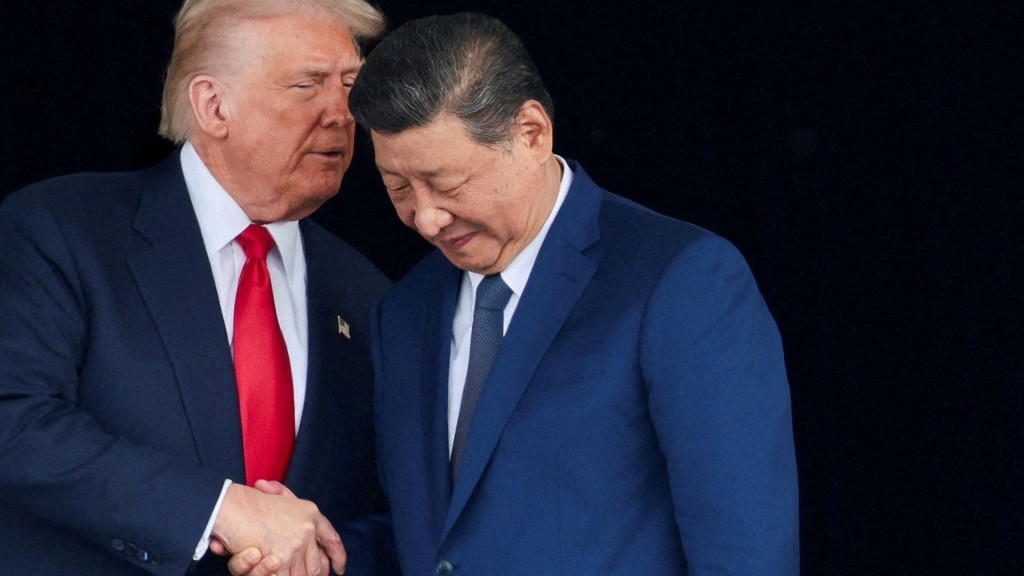
The intricate dance of global power among the United States, China, and Europe is undergoing significant transformation, particularly under US President Donald Trump’s skepticism towards traditional alliances and leveraging closer ties with China to exert pressure on long-standing US allies.
This came after Trump openly articulated a view that many US allies are not truly friends, suggesting they have disproportionately benefited from trade with the US compared to China.
Trump specifically cited France, claiming it does not treat the US any better than China does, pointing to perceived unfair taxation of US technology and tariffs on American goods.
A transactional approach to international relations
As a businessman-turned-president, Trump tended to adopt a transactional approach to international relations, where loyalty is measured by economic advantage.
Despite saying the US is going to “aggressively revoke” Chinese student visas earlier this year, Trump reversed course on that move and recently stressed that reducing Chinese student numbers would “paralyze the entire system” of American universities.
Chinese nationals constitute the second-largest group of international students in the US, after Indian citizens, contributing billions in tuition fees and supporting numerous jobs across various sectors. In the 2023-24 school year, international students contributed more than US$43.8 billion to the US economy.
By signaling an openness and friendly approach to China – first the tariff war cooldown and now the turnabout on Chinese students – Trump could be aiming to retain the crucial economic benefit while simultaneously using a perceived rapprochement with Beijing as a diplomatic tool to influence European allies.
Complicated trade dynamics and European concerns
The history of trade disputes provides ample context for the evolving dynamics.
The US-China trade war initiated by the first Trump administration saw the imposition of tariffs on hundreds of billions of dollars worth of Chinese goods. China retaliated in kind, leading to significant economic repercussions for both nations, including job losses and a reshuffling of global supply chains.
Concurrently, US-Europe trade relations have also been fraught with disputes. Long-standing disagreements over issues like subsidies for aerospace giants Boeing and Airbus, digital services taxes, and agricultural product standards have further complicated transatlantic trade.
Trump’s repeated threats of additional tariffs against European goods, coupled with accusations that the EU does not purchase enough American products, highlight a transactional approach that could push European nations to re-evaluate their economic partnerships.
Europe, meanwhile, has its own complex relationship with China. The EU has frequently challenged what it perceives as unfair Chinese trading practices, including anti-dumping measures on various products like coke, steel, and textiles, and concerns about intellectual property rights infringement and currency manipulation.
Recent developments include the EU considering a law to phase out Huawei and ZTE equipment from the bloc’s telecom networks and launching investigations into other green technologies.
The EU finds itself in a delicate position, balancing its economic interests with China against pressure from the US and its own concerns about Beijing’s economic practices.
Under the situation, Trump’s strategy of potentially drawing closer to China, even rhetorically, could serve as a powerful bargaining chip. By appearing to offer China a more stable relationship while simultaneously pressuring European allies with tariffs and criticisms, Trump could aim to compel countries like France to align more closely with US demands or risk being economically marginalized.