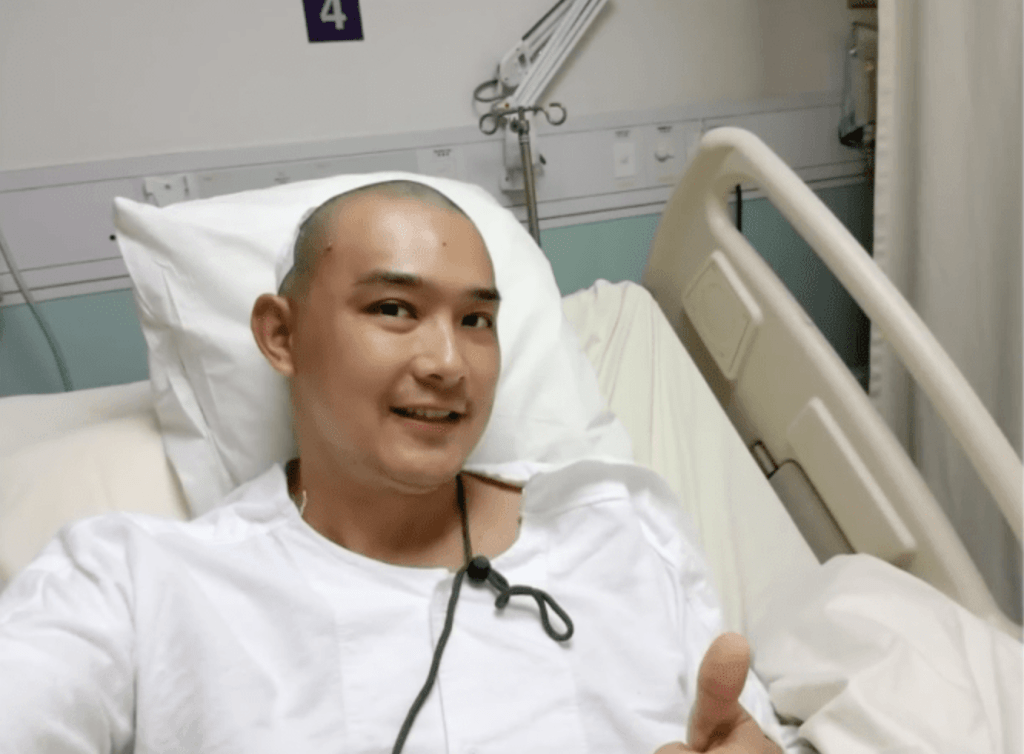
Martin Lau Ka-chung, known as "Ka Chung Gor Gor" (Brother Ka Chung), who hosted the TVB children's program After School ICU and grew up alongside many in Hong Kong, recently shared his cancer journey on the TVB program Popular City. Now 48, he recalled how, eight years ago, while trail running, he suddenly lost his balance and leaned to one side. After seeking medical help, doctors discovered a 6cm diameter tumor in the left side of his brain. How do brain tumors form? What are their types?
Hemiplegia After Brain Surgery; His Daughter Became His Greatest Motivation
Lau never smoked or drank alcohol and loved sports. At the end of 2017, while working as an anchor for Cable TV Entertainment News, he found himself getting increasingly tired every day, with worsening leg strength and difficulty walking. He was afraid to seek medical help but eventually mustered the courage to face reality. The surgery lasted 7 hours, but the true test began after the operation.
He suffered severe after-effects: blurred vision, slurred speech, and even temporary hemiplegia (paralysis on one side of his body). He had to relearn how to walk and talk, and even how to sense temperature. This was a major blow for someone who had worked as an MC.
To overcome his "tongue-tied" speech, he constantly practiced with speech scripts in hand. Lau admitted that his daughter's support made him realize he was not fighting cancer alone. "I must watch my daughter graduate from university with my own eyes." This fatherly love became his greatest motivation for persisting in his recovery.
Personality Change After Major Illness, Learned to Slow Down
In a 2022 interview with Sing Tao Headline, Lau mentioned that, unwilling to disturb his family to help him go to the bathroom in the middle of the night, he pushed himself to stand and walk after just one month of rehabilitation through sheer willpower. He said, "As an entertainer, I've experienced everything: jumping into the sea in winter, filming period dramas in summer, sleeping in coffins. I've endured it all. As long as you let go and face it, you'll be fine." He stopped worrying about whether his legs would fully recover, because "this is just the physical shell; what matters most is what's inside." After his major illness, he admitted his personality changed, and he learned to slow down. He described it as: "A man must have experiences to grow. Now I can play any role, not just an empty shell."
Studying Chinese Medicine to Help Himself and Others
To recuperate, Lau used his spare time to study traditional Chinese medicine and is currently pursuing a six-year degree in Chinese medicine at the University of Hong Kong. He hopes to use his personal experience and TCM knowledge to help himself and others. Having faced despair himself, he understands the fear of life and death that patients face. He encourages fellow patients with his own story: "I hope everyone won't give up. Grit your teeth and get through it." His life goals, aside from raising his daughter to be a wise person, also include a strong desire to win an award at TVB's Anniversary Awards. "I just want an award – any award will do. Even a 'Best Newcomer' award..."
How Do Brain Tumors Form? What Are the Types?
According to the Hong Kong Hospital Authority, the brain is roughly divided into the cerebrum, cerebellum, and brainstem. The cerebrum acts as the body's command center, composed of two elliptical hemispheres. Each hemisphere has four lobes – frontal, parietal, temporal, and occipital – each controlling different bodily functions. When local brain tissue undergoes abnormal cell division and proliferation, it forms a mass. This mass could be a benign tumor or a malignant tumor (commonly known as brain cancer). Benign tumors grow slowly, rarely spread, and generally pose less health threat. Malignant tumors grow much faster, invade and compress nearby healthy brain tissue, affecting brain and bodily functions, and can be life-threatening. Brain tumors can be classified into primary and metastatic types:
1. Primary Brain Tumors
Primary brain tumors originate in their original location, continuously growing and enlarging. They can be benign or malignant. Tumors are generally named after the cell type from which they originated. A common type is glioma. For example, astrocytoma arises from diseased astrocyte cells.
2. Metastatic Brain Tumors
- Local metastasis: Occurs when malignant tumors migrate from elsewhere in the body to the brain. This is most common in nasopharyngeal carcinoma.
- Distant metastasis: Occurs when cancer cells travel through the bloodstream to the brain, forming one or multiple intracranial tumors, for example from lung cancer or breast cancer. Distant metastasis may sometimes be discovered long after primary tumor treatment; 15% of patients have no history of cancer or tumor.
12 Symptoms of Brain Tumors
- Localized or generalized seizures (epilepsy)
- Tinnitus, dizziness, hearing loss
- Headache, vomiting
- Endocrine disorders
- Confusion or altered consciousness, personality changes, memory loss
- Clumsy or weak limbs, sensory loss or numbness
- Hemiparesis (weakness on one side), involuntary tremors
- Facial muscle numbness, pain
- Difficulty swallowing
- Slurred or difficult speech
- Vision loss, double vision (diplopia), blurred vision
- Loss of bladder or bowel control
Who is at Higher Risk for Brain Tumors? Is Male Risk Higher?
According to the Hospital Authority, the exact causes of brain tumors remain unknown. However, the following risk factors may increase the chance of developing a brain tumor:
- Age: Although anyone can develop a brain tumor, risk is higher for those over 40. Some tumors, such as medulloblastoma, occur almost exclusively in children.
- Sex: Males have a higher likelihood of developing the disease.
- Genetics: A family history of glioma.
- Chemical exposure: Occupational exposure to radiation, formaldehyde, vinyl chloride, and acrylamide.
Sources: TVB Program Popular City, Hong Kong Hospital Authority