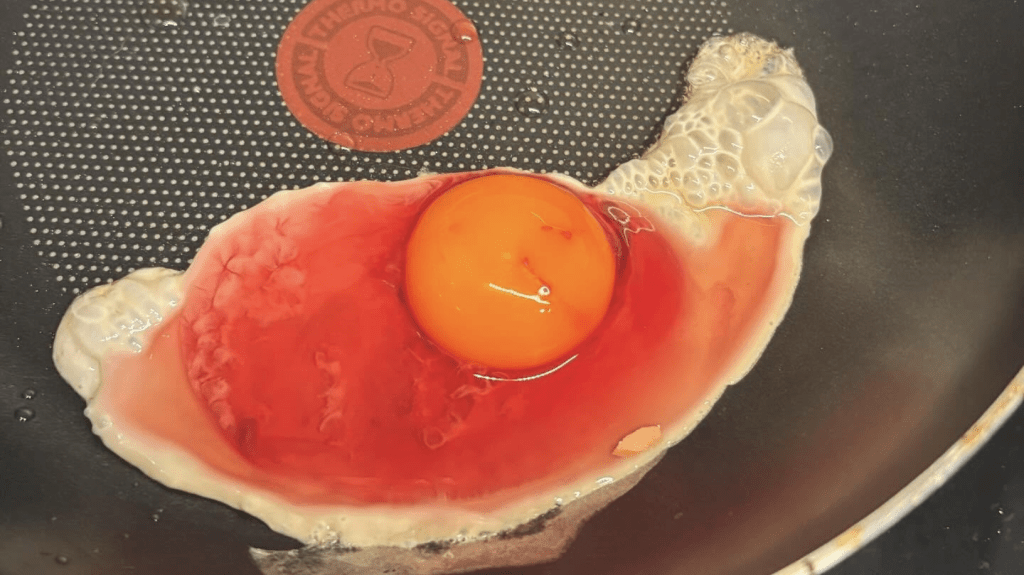
Recently, a netizen shared on social media that they were shocked to find a large amount of egg liquid appearing blood-red when cracking an egg, exclaiming "so scary," which sparked heated discussion. Many are confused about whether encountering "blood eggs" means they are still edible, with some worried about potential food poisoning after consumption.
A Taiwanese netizen shared on Threads that they were stunned to find the cracked egg liquid covered in a blood-red color. Many comments expressed sentiments like "absolutely would not dare to eat it," "too terrifying," and "feels like I'd have nightmares tonight." Some even commented, "It might be because the chicken was sick or infected, and there could be Salmonella inside the egg," indicating widespread unease about abnormalities in eggs.
Taiwan's Ministry of Agriculture has previously stated that the red blood stains or black spots found in eggs are actually "blood-spot eggs" or "foreign matter eggs." This occurs because during the hen's ovulation process, tiny amounts of blood or epithelial tissue migrate to the yolk or egg white and subsequently become encapsulated within the egg. The Ministry of Agriculture emphasizes:
- "Blood eggs" are a natural anomaly during egg formation, with a relatively low occurrence rate.
- They do not affect food safety and are safe for normal consumption, but attention should be paid to the expiry date.
Moldy Eggs / Cracked or Damaged Shells: Do Not Eat
The Ministry of Agriculture points out that consumers should be most wary of "moldy eggs" – eggs whose shells crack due to transportation impact and develop mold spots from microbial contamination during storage. Such eggs are strongly advised against consumption.
To ensure egg quality and food safety, Hong Kong's Centre for Food Safety reminds consumers to note the following after purchasing eggs:
- Eggs available on the market have typically undergone commercial processing involving washing or spraying with mineral oil, which does not damage the protective cuticle.
- Consumers do not need to wash eggs. Improper washing may damage the cuticle. Wetting the shell can facilitate microbial entry, and water on the surface can help bacteria survive.
- If eggs are contaminated by bird droppings, they can be washed with water (household detergent can be used if necessary). After washing, the eggs should be cooked immediately.
Summary of Expert Advice
When selecting and handling eggs, check that the shells are intact without cracks. If buying loose eggs at the market, choose those with clean, unblemished shells. After bringing them home, you can gently wipe them with a clean, soft cloth. Follow the principle of "do not wash, store refrigerated" by placing the eggs directly in the refrigerator without washing them with water.