Read More



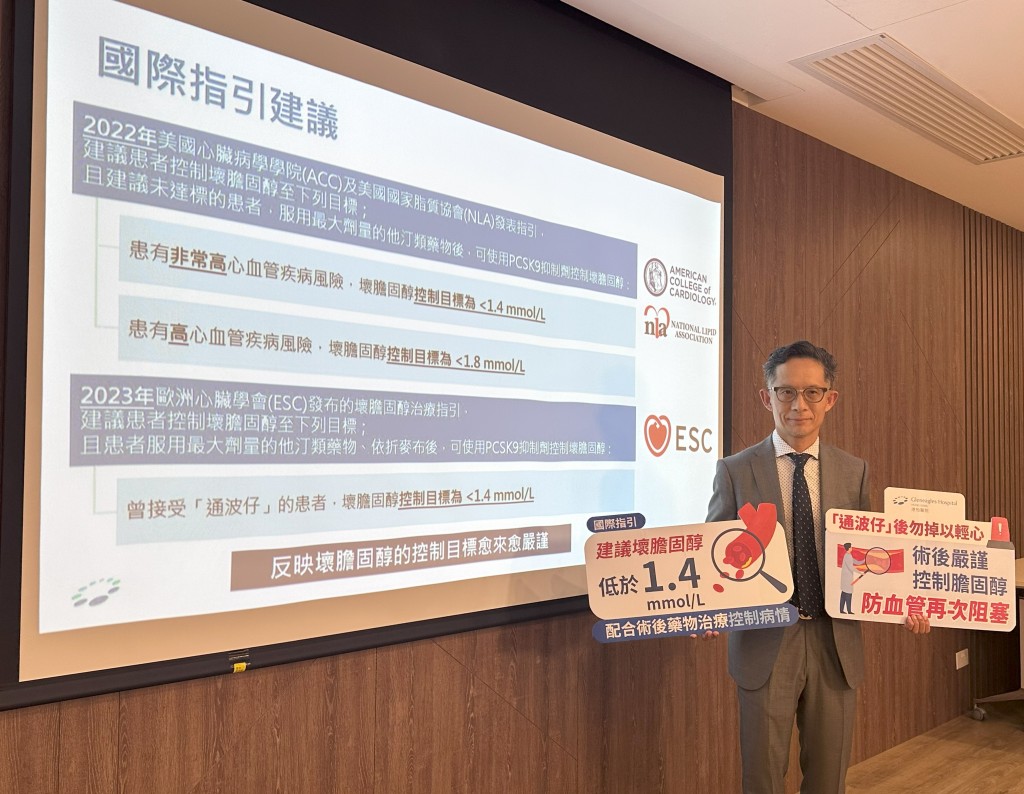
Coronary angioplasty (Percutaneous Transluminal Coronary Angioplasty and Stenting, PTCA/S) is a minimally invasive cardiac procedure with high success rates, minimal trauma, and fast recovery, and it has been widely utilized. Dr. TSE Tak Sun, Director of the Cardiac Catheterization & Interventional Centre and Honorary Consultant Cardiologist at Gleneagles Hospital Hong Kong, pointed out that post-surgery is not a one-and-done solution, patients must rigorously manage their cholesterol levels to reduce the risk of recurrence.
Atherosclerosis refers to the buildup of plaques in the arterial walls caused by the accumulation of lipids, particularly low-density lipoprotein (LDL), also known as "bad cholesterol." Over time, these deposits thicken the arterial walls, gradually narrowing or even blocking the arteries. When the condition worsens, it can cause myocardial ischemia or even heart attack, leading to cardiac arrest and death. Dr. TSE pointed out that if doctor finds that a patient’s coronary arteries are narrowed or blocked by 70% or more, they may recommend coronary angioplasty.
Although coronary angioplasty effectively improves vascular conditions, it is not a permanent solution. Post-surgery care, particularly strict cholesterol management, is crucial in reducing the risk of recurrence. In general, 70% of the body’s LDL is produced by the liver, while 30% is absorbed from food. When treating high cholesterol, doctors typically recommend patients starting with lifestyle and dietary adjustments. However, research indicates that relying solely on a healthy lifestyle and dietary control generally reduces LDL levels by only 13% to 20%. Thus, medication may be required for further cholesterol management. Statins, a common first-line cholesterol-lowering drug, reduce the liver’s cholesterol production. Doctors tailor medication combinations based on the patient’s condition for optimal results.
For generally healthy individuals, it is recommended to maintain LDL below 2.6 mmol/L. According to guidelines by the European Society of Cardiology (ESC), patients who have undergone coronary angioplasty should maintain LDL below 1.4 mmol/L, with levels reduced by at least 50% or more from their baseline.
However, achieving these targets remains challenging despite clear medical guidelines. Large-scale studies indicate that even with aggressive treatment, 80% of high-risk and very high-risk patients fail to meet the recommended LDL targets.
For patients who do not respond well to oral medications, personalized treatment plans can be discussed with their doctors, including the addition of PCSK9 inhibitors to more effectively stabilize LDL levels. Studies have shown that combining PCSK9 inhibitors with oral cholesterol-lowering drugs can further reduce LDL levels by 43% to 60%.
In addition to medical treatments, patients should actively improve their lifestyle and dietary habits to enhance treatment outcomes further. Regular cholesterol monitoring, maintaining a healthy weight, and following a balanced diet that is low in salt, sugar, and saturated fats are recommended. These measures not only help manage cholesterol levels but also promote cardiovascular health and reduce the risk of recurrence.