Read More
In 1986, the regime of Ferdinand Emmanuel Marcos was toppled and the dictator was forced to flee to Hawaii to live in exile with his family members.
ADVERTISEMENT
SCROLL TO CONTINUE WITH CONTENT
Five years later, after the old man died, the Marcos family returned to the Philippines.
This week, the son of the late dictator won the presidential election in a landslide victory.
Ferdinand "Bongbong" Marcos Jr will take over from Rodrigo Duterte to return to Malacanang, the presidential palace in Manila, to extend his father's legacy.
How did Junior manage the strike-back?
On one hand, his alliance with the Duterte family has been strategic to his rise to power. This was built on the conventional power base of the two controversial families in the north and south of the Philippines.
Marcos Jr has pledged to carry on with Duterte's policies at home and overseas - albeit doing so less violently - and is expected to keep maneuvering between China and the US.
On the other hand, his skilful and extensive use of social media proved instrumental to his success, successfully rebranding the controversial period of his father's regime as a golden age of prosperity.
His stunning victory could be a classic political case study, showing how social media can change the balance in the most subtle way in modern-day politics.
Social media is now an indispensable tool in any election - though with the ostensible exception of an one-man race that is also called an election.
The senior Marcos was president of the Philippines from 1965 to 1986, during half of which he ruled the country under martial law.
When he was deposed by the People Power revolution in 1986, the country was in a state of economic collapse.
That is what Filipinos of the older generation would be able to recall. But Marcos Jr had to appeal to younger voters with no memory of what happened back then.
To be fair, the Marcos age was not totally dark as the president was popular in the beginning. And in a competitive election, Marcos Jr knew he had to play up the golden side and avoid the dark period of his father's time in office.
He used social media extensively to promote narratives tailored to the purpose.
This all began at least a decade ago with videos constantly uploaded onto YouTube and shared on supportive Facebook pages.
Unlike others used to getting their information from mainstream media, those relying on social media for most information tend to readily accept it in the way it has been presented to them.
According to a collaborative fact-check project for the 2022 Philippines' election, 92 percent of online information about the Marcos campaign was favorable.
In contrast, 96 percent of online information about his main rival, Leni Robredo, was negative.
Marcos did not take part in any TV debates or give any media interviews.
He didn't need not to since the main battlefield of the election was neither the TV nor newspapers but social media.
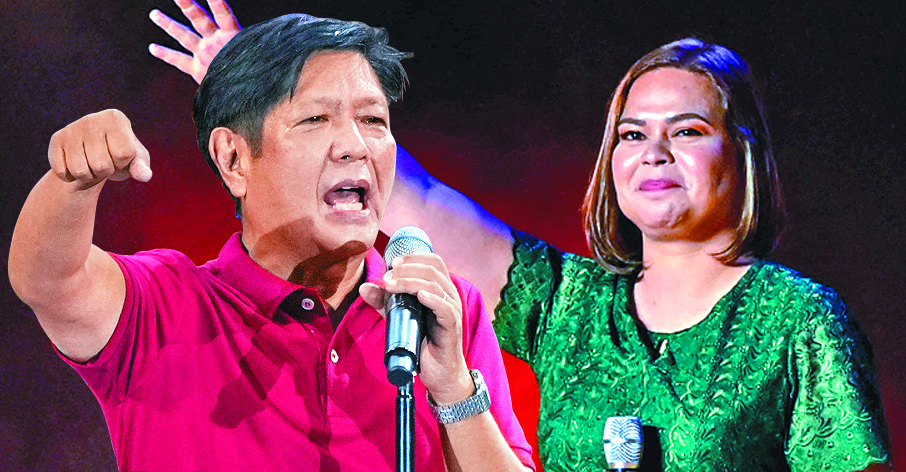
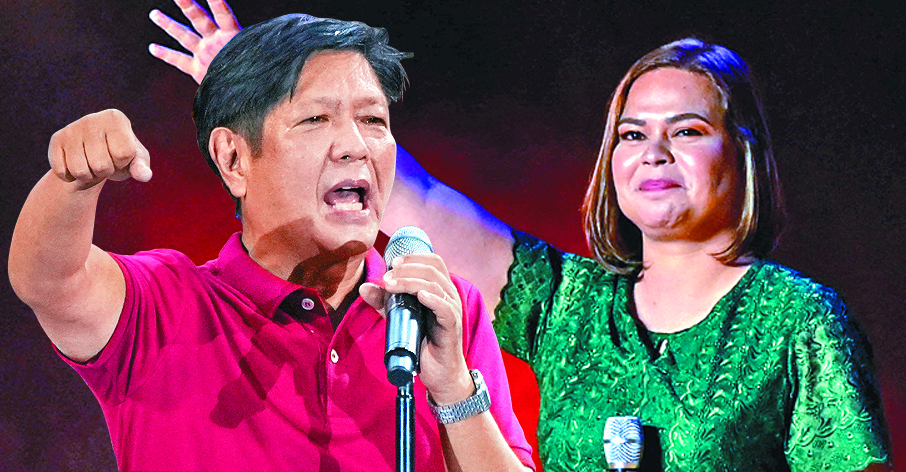
Ferdinand 'Bongbong' Marcos Jr and running mate Sara Duterte, daughter of current president Rodrigo Duterte.