Read More
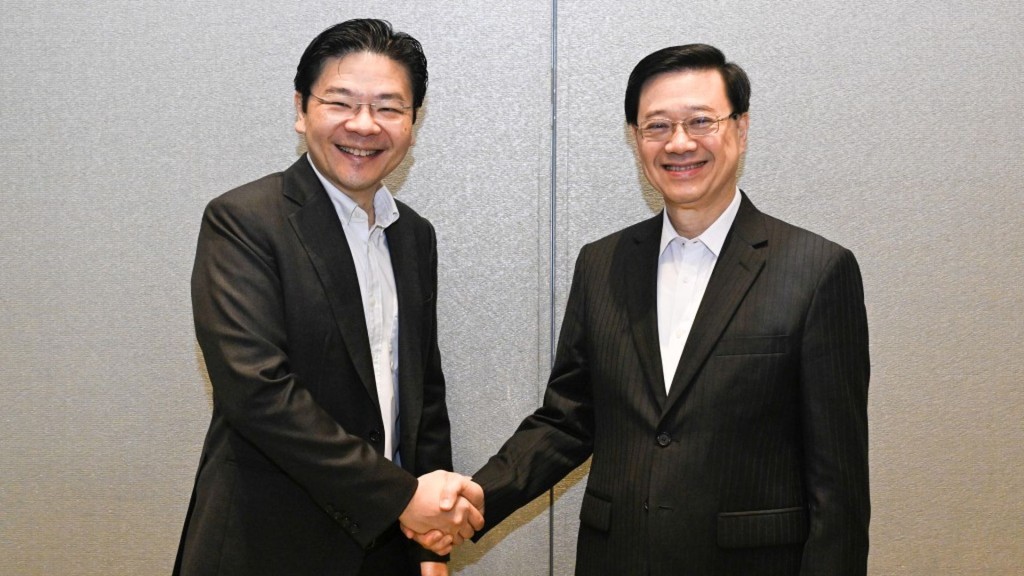
Singapore just raised the stakes. Prime Minister Lawrence Wong will personally chair a newly launched “National AI Council,” backed by a SG$1 billion (HK$6.16 billion) public research commitment through 2030. A “Champion of AI” program will help local enterprises scale through AI adoption. The message is clear: Singapore intends to lead. But across the South China Sea, Hong Kong is not standing still.
ADVERTISEMENT
SCROLL TO CONTINUE WITH CONTENT
Quietly, methodically, the city is assembling its own AI arsenal – one that leverages not only public funding and institutional reform, but also something Singapore does not have: direct, structural integration with mainland China’s fast-moving, cost-efficient AI ecosystem.
Hong Kong’s AI Plus: not just catching up, but leapfrogging
Hong Kong’s “AI Plus” strategy is taking shape across multiple fronts. The AI Supercomputing Centre at Cyberport is already live, with computing power strengthening.
That is not just infrastructure – it is a signal.
A HK$1 billion Artificial Intelligence Research and Development Institute will be launched, bridging upstream research and commercial application. Meanwhile, HKGAI V1 – the city’s first homegrown large language model optimized for Cantonese, English, and Putonghua – is already in deployment. That matters. In AI, language is culture, and culture is a moat.
Subsidy, scale, and startups
The numbers are substantial. A HK$3 billion AI Subsidy Scheme covers up to 90 percent of computing costs for universities and enterprises using AISC resources. Another HK$3 billion is earmarked for the Frontier Technology Research Support Scheme, aimed at attracting world-class researchers to Hong Kong. And the HK$10 billion Research, Academic and Industry Sectors One-plus Scheme or RAISe+ is already matching funds for at least 100 university teams turning research into startups.
This is not a piecemeal policy. It is an interlocking ecosystem.
The mainland advantage
Yet Hong Kong’s true differentiator lies beyond its borders. Mainland China’s AI sector has matured rapidly and at a fraction of Western development costs.
The emergence of DeepSeek last year stunned global markets. Another breakthrough is widely anticipated this year.
For Hong Kong, proximity is not just geographic; it is operational.
Just yesterday, the Chinese University launched the world’s first AI satellite from Guangdong – a feat made possible by cross-border collaboration with mainland partners. This is not outsourcing.
It is symbiosis. Hong Kong supplies global standards, research credibility, and capital mobility. The mainland supplies scale, speed, and supply chain integration.
Where Hong Kong has already won
Singapore’s recent announcement also included SG$1.5 billion to revive its slumping stock market. That is an admission: for all its AI ambition, the city-state is playing defense in finance.
Hong Kong, by contrast, has already secured its position as the listing destination of choice for both mainland and overseas enterprises. While Singapore scrambles to attract volume, Hong Kong focuses on quality – and global trust. The city’s capital markets remain deeper, more liquid, and more internationally integrated.
The verdict
Has Hong Kong done enough? Not yet. No one has. But the city is no longer reacting – it is building. With supercomputing capacity, targeted funding, and an open pipeline to the mainland’s AI engine room, Hong Kong is quietly assembling a proposition that Singapore cannot match.
The AI race is not a sprint. It is a decathlon. And Hong Kong is finally fielding a team.