A mainland traveler's critique of Hong Kong's long-standing escalator etiquette has sparked heated discussion online, reigniting questions over commuter convenience, pedestrian flow, and railway safety.
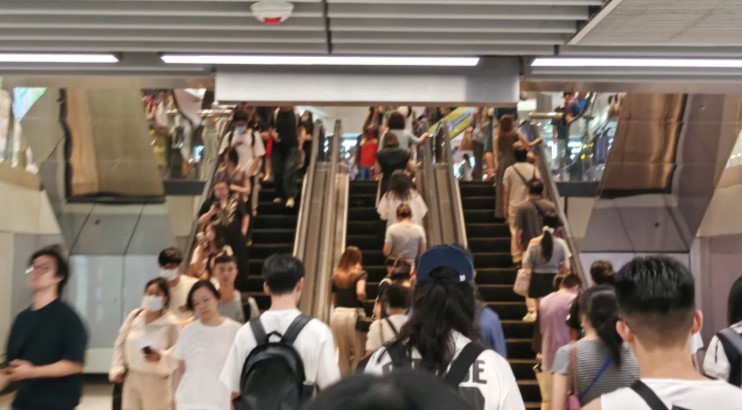
Writing on the social media platform Xiaohongshu, the visitor shared observations of subway commuters strictly keeping to the right side of escalators while leaving the left lane completely vacant.
The traveler expressed bewilderment at the practice, noting that extensive bottlenecks formed at the foot of escalators even though very few people were actively walking up the vacant side.
Labeling the convention an overly rigid queuing habit, the visitor questioned why commuters refused to adapt to alleviate severe platform congestion while also raising concerns that uneven weight distribution on a single side of the machinery could cause mechanical breakdowns.
Internet users defend local commuting customs and efficiency
The post quickly drew numerous reactions from both Hong Kong and mainland internet users, with many defending the tradition as an established aspect of the city's fast-paced urban lifestyle.
Several commentators argued that different cities operate under different social rhythms, urging visitors to respect local practices rather than expecting a single universal standard of efficiency.
Other respondents noted that the unspoken rule serves as an essential express lane during peak hours.
Regular commuters remarked that having an open path allows individuals in urgent situations to move quickly without obstruction, asserting that the practical benefit for hurried passengers outweighs the loss of standing space.
Transit operator continues push for two-sided standing
While the convention of standing on the right developed organically to accommodate hurried commuters, transit authorities have repeatedly warned that walking on moving escalators carries inherent safety risks.
In response to frequent crowding and minor accidents, the MTR Corporation has stepped up educational initiatives in recent years, advising passengers to hold the handrail and remain stationary on both sides of the steps.
The railway operator has also urged travelers carrying heavy or oversized luggage to use station lifts instead, seeking to curb platform congestion while reducing the likelihood of falls and mechanical stress.