Overtures by China to the Taliban indicate a bid to extract maximum benefit from the dramatic collapse of the US project in Afghanistan.
But Beijing will remain watchful of the hardliners now running the show in Kabul, especially as Afghanistan borders Xinjiang, home to the Muslim-majority Uygurs.
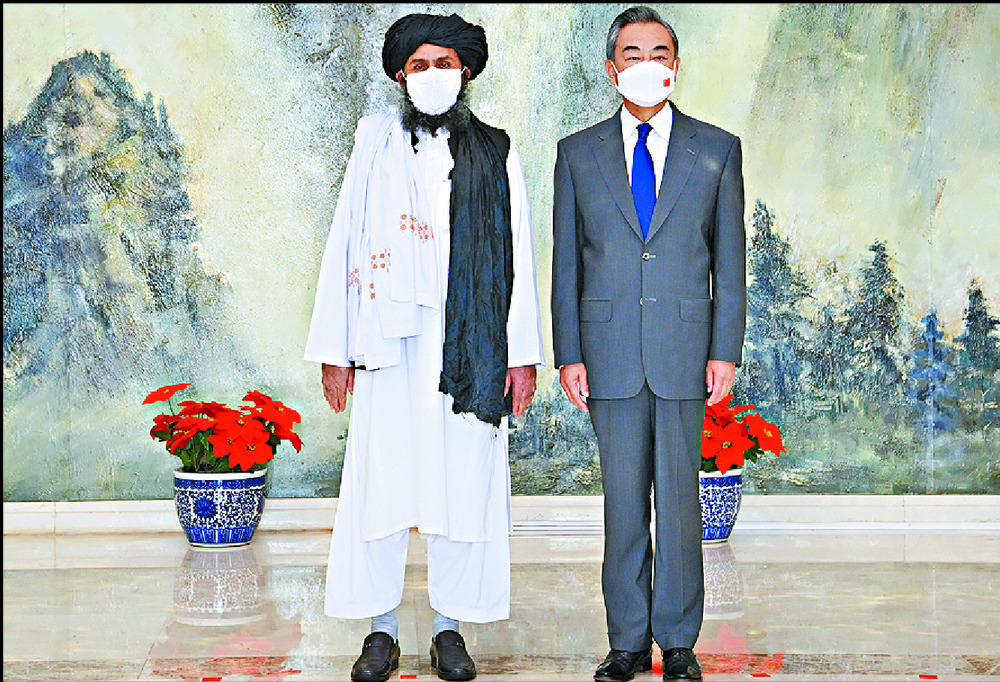
A fortnight before the Islamists seized power in a stunning lightning offensive, Foreign Minister Wang Yi hosted a Taliban delegation in Beijing. And just a day after the Taliban entered Kabul, the word from China was it was ready to deepen "friendly and cooperative" ties with Afghanistan.
While Beijing says it has no desire to direct any political settlement in Kabul, it appears to have scented an opportunity to press its Belt and Road interests.
As power transitions to the Taliban, China has a few key demands, says Hua Po, an independent political analyst in Beijing.
"The first is to protect China's investments and ensure security of Chinese nationals," he says. "Second, it is necessary to cut off relations with East Turkestan separatists and not let them return to Xinjiang."
But pragmatism appears to be prevailing over ideology toward a group whose religious doctrines have left China queasy.
And the Taliban appear to have understood that if they want good relations with China, they will have to leave China's Muslims - whose plight is a rallying cause for Islamists worldwide - alone. Indeed, a Taliban spokesman has said Afghan soil will not be used "against any country's security."
State media has buffed up the potential of driving major economic schemes under the new regime, from the Aynak Copper Mine project - Afghanistan's largest deposit, and second largest in the world - to the northern oil fields of Faryab and Sar-i-pul.
Beijing-backed firms have pumped hundreds of millions of dollars into rights to mine and build, but extreme insecurity has iced most plans.
Meanwhile, Afghanistan's substantial lithium deposits have manufacturers of electric vehicles licking their lips. And China is the world's largest EV maker.
The Taliban "look forward to China's participation in the reconstruction and development of Afghanistan," the foreign ministry's Hua Chunying said.
China's embassy in Kabul remains operational, though Beijing began evacuating citizens months ago as security deteriorated.
Afghanistan has for centuries been a cauldron of big-power aspirations in central Asia. Many have eventually foundered.
While the Taliban try to rebrand as a more moderate force than during their first brutal incarnation, they remain an unpredictable entity leading a volatile country.
"Chinese know this history, and they know this is a government they are not going to trust entirely," says Raffaello Pantucci, a senior fellow at the S Rajaratnam School of International Studies in Singapore.
And that makes a hasty investment drive unlikely, he adds.
He asks: "Why is it suddenly a more attractive prospect now, when you have a less stable situation with a government that is not immensely reliable?
"I don't foresee Chinese companies saying 'let's go and mine some lithium' especially in some parts of the country that are still very dangerous."
But Beijing is wringing maximum propaganda value from America's foreign policy failure in Afghanistan. State media pumped out images of Afghans storming Kabul airport in an effort to flee as a sign of the chaos prompted by the US retreat.
Hua has said that Washington left "an awful mess of unrest, division and broken families. America's strength and role is destruction, not construction."
State media has also peddled the idea that the US rush out reflects its fair-weather attitude to all allies - including in Taiwan.
US President Joe Biden, hammered over the disorderly retreat, has defended the withdrawal, saying China and Russia would "love nothing more" than his country to have continued to sink resources into the Afghanistan quagmire.
But once the moment for quick point-scoring passes, China will take a much colder pragmatic view of Afghanistan under the Taliban, analyst Hua says.
Foreign Minister Wang Yi hosts Taliban cofounder Mullah Abdul Ghani Baradar, in Tianjin at the end of last month.