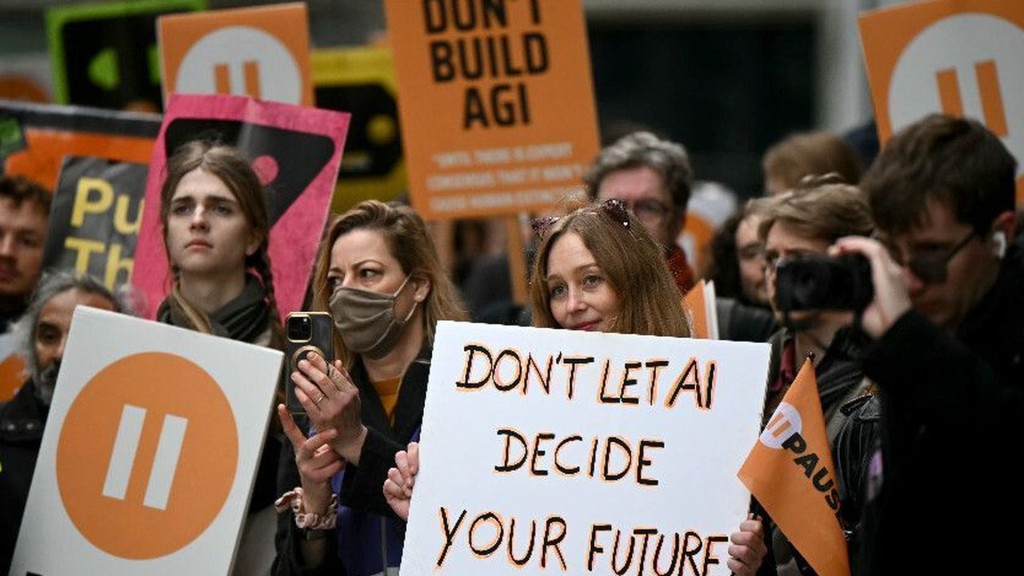
A rebellion is surfacing in America. It is not an armed rebellion to topple an unpopular government. It is an angry backlash against artificial intelligence, or AI. The Wall Street Journal described it as an American rebellion against AI that is gaining steam.
The country got an astonishing taste of this rebellion against AI during some college graduation ceremonies last month. It is an age-old tradition for colleges to invite distinguished people such as politicians and business leaders to give commencement addresses. Commencement speakers celebrate the academic achievements of graduating students with speeches that inspire and motivate them as they transition to the next stage of their lives.
The University of Central Florida invited top real estate executive Gloria Caulfield to be the commencement speaker for its 2026 graduating class. She chose to inspire graduates by lauding AI as the next Industrial Revolution. Her remarks drew loud boos from the new graduates who were already worried about their job prospects as AI reshapes the labor market.
A week later, former Google chief executive Eric Schmidt told graduating students during his commencement speech at the University of Arizona that AI will become the main feature of how work is done regardless of what career path they chose. He too was greeted with loud boos.
The graduating students who booed at the rapid rise of AI belong to Generation Z, people born between 1997 and 2012. Unlike most other countries, America’s Gen Z, informally called Zoomers, see AI as a threat to their futures. A recent Gallup poll found only 18 percent of Zoomers are hopeful about AI. About half fear the risks are higher than the benefits.
A Stanford University study cited by The New York Times found that of the 30 countries researched, Americans had the least faith in their political leaders being able to properly regulate AI.
The newspaper said that, compared with some other countries, neither the US government nor corporations feel the need to help those made redundant by AI.
Many US companies are already cutting jobs to make way for AI. Meta, the parent company of services such as Facebook and WhatsApp, recently cut 8,000 jobs or 10 percent of its workforce.
President Donald Trump had intended to sign an executive order two weeks ago that would allow the government to review new AI models before their release. But he abruptly canceled the signing after fierce pressure by leading AI companies.
Surveys show almost 80 percent of Americans want the government to strictly regulate AI. They fear job losses, the loss of personal privacy, and the abuse of AI to spread disinformation. Many local communities have blocked or are pushing back against giant AI data centers.
They say data centers require an immense amount of water and electricity, which will ruin the environment and increase water and energy costs for ordinary people. Leading AI companies are spending hundreds of millions of dollars in the November Congressional mid-term elections to back candidates who support AI.
Michael Chugani is a longtime journalist who has worked in Hong Kong, the US, and London