Last Thursday I wrote on the appointments of Xia Baolung as Hong Kong and Macao Affairs Office director and the two directors of the central government liaison offices in Hong Kong and Macau as deputy directors of HKMAO.
I referred to the streamlining of the reporting up to the top leadership in Beijing into one as straight jacketing and the upgrading of the rank of the HKMAO director from minister to the level of a national leader as a major decision to eliminate miscommunication and reporting on important Hong Kong happenings.
I also referred to the unique working relationship developed between President Xi Jinping and Xia when they served together as party secretary and deputy party secretary in Zhejiang for five years.
Using Zhejiang as a platform, those years enabled Xi to incubate his ideas to take China forward as a global leader in a high growth and vibrant part of China that is equivalent in size to a typical country in Europe.
And as Xi was promoted into the state leadership, Xia took over as party secretary in Zhejiang to continue the incubation.
Nonetheless, no sooner than Xia's appointment to the HKMAO hot seat was announced, skeptics here and overseas began criticizing him as a hardliner having no experience on Hong Kong affairs.
He was also accused of being responsible for pulling down the holy cross and churches in Zhejiang and how this would not bode well for democratization and rebuilding trust in protest-torn Hong Kong.
I shall offer my views on these accusations.
I have been a Hong Kong representative of Zhejiang's Chinese People's Political Consultative Conference and later a member of its standing committee for 15 years, the last 10 of which saw Xi and Xia taking up the leadership in Zhejiang. I was therefore able to observe their style of governance at close range.
Xia was promoted from Tianjin municipality to be number two in Zhejiang. As deputy party secretary, his duties included overseeing the wellbeing of Zhejiang compatriots living in Hong Kong, Macau, Taiwan and overseas.
In his first official visit to Hong Kong around 2008, the United Zhejiang Residents Association, an umbrella body representing all municipal residents' associations, hosted a working lunch with him.
Being the chair of the Shaoxing clan and a provincial CPPCC member, I had the honor to sit next to him.
It took Xia no time to mention that despite born in Tianjin, following his parents being posted to work there, and having worked there most of his life, his ancestry was in fact Shaoxing in Zhejiang. He spoke of how thrilled he was to be posted to his ancestral province to work for his compatriots.
As his name Baolong meant "precious dragon," I asked if his Zodiac sign was dragon.
He said yes and I said me too! He then asked in which month in the lunar calendar was I born. I said month six. He said he was born in month 10 and should therefore address me as the "older brother dragon." The table laughed and toasted. Such was the fraternal relationship he wanted to build, no trace of being a hardliner at all.
Xia's first trip took him to housing estates in Tsuen Wan, which has a concentration of three generations of Zhejiang residents, beginning with the first working in the cotton spinning, weaving and garment manufacturing factories in the post-war years.
He also visited Heung Yee Kuk and villages in the New Territories to get a deeper feel of Hong Kong, including a visit to the fishing village at Tai O, which was built on stilts and had to be preserved.
The preservation project was headed by Randy Yu Hon-kwan, a chartered surveyor who now chairs the only district council still controlled by the pro-establishment camp. Seeing talent, Xia invited him to serve on the Zhejiang CPPCC, where he still serves.
By coincidence, during Xia's tenure, two of Beijing's top officials in Hong Kong appointed under the Basic Law, namely the PLA garrison commander and the director of the local office of the Ministry of Foreign Affairs, also happen to be of Zhejiang ancestry, as was Rita Fan Hsu Lai-tai, the then Legislative Council president and National People's Congress standing committee member.
The group of close to 50 Hong Kong-based members of the Zhejiang CPPCC, who make frequent visits to the province and to whom Xia and his colleagues have easy access, are a unique and diverse group spanning three generations, who have been contributing to the economic, social, educational and political wellbeing of Hong Kong, in good and challenging times, for the last 70 years. They include:
Members of the shipping families, the Tungs and the Paos.
Members of the textile families, the Chens, Chaos and the Anns. The Chaos also founded Dragon Air, while Ann Tse-kai chaired the Basic Law drafting committee.
Members of banking and financial services families, including the Lee family who helped fend off the run on the Hong Kong dollar during the Asian financial crisis.
Academics like Professor Tsui Lap-chee, former president of University of Hong Kong.
Hence, to say Xia has no experience of Hong Kong can only be pure and ignorant conjecture!
Next: part III of the article will focus on Xia's achievements in Zhejiang and the taking down of the Holy Cross and churches.
Edward Chow is a current affairs commentator and a former Zhejiang CPPCC member for 15 years
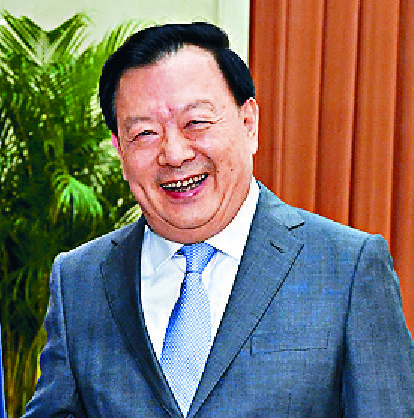
Xia Baolong