Read More




Amber rainstorm warning issued at 11am
4 hours ago




Iran demands transit fees in yuan, stablecoins for Strait of Hormuz passage
03-04-2026 02:45 HKT
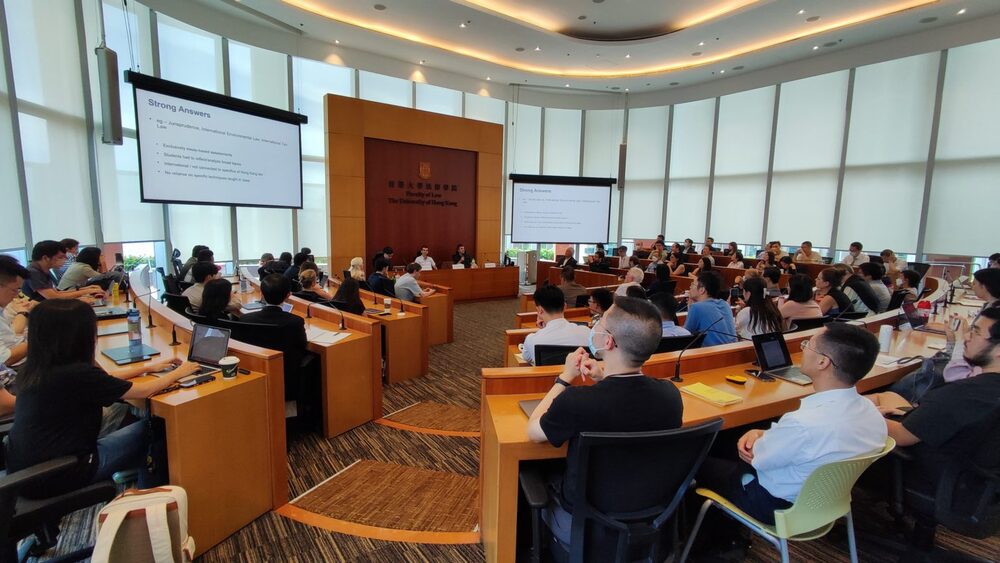
The gradually lower threshold in universities here is giving more students a chance to choose majors that they are interested in instead of the ones that they can enter, said a student currently reading law at the University of Hong Kong.
More than 16,000 students have been offered places at nine local universities as a result of the Joint University Programs Admissions System on August 9, slightly higher than last year's 15,800.
Ahead of the universities announcing this year's admission scores, normally during information days in October, some popular programs for top students - including law at the Chinese University of Hong Kong and HKU - have seen a drop in admission scores in recent years.
According to the universities' official statistics, despite HKU adopting a new system in 2019 that candidates get bonus points for achieving level 5 or above in individual subjects, by counting candidates' six best-performed subjects, the median admission scores for its law school still dropped to 35 marks from 38 in 2019.
A fourth-year law student Chan, told The Standard that he felt fortunate that he could enter the law school with a DSE score that was lower than the admission median in the past.
"With my scores, it would have been impossible to get into law school if I had been a DSE candidate a few years ago. Even though my mark was still lower than the program's median score, I still made it into my dream program," he said.
"Now I no longer need to look for programs that fit my DSE results, I can instead choose what I would like to study."
The drop also applied to CUHK's law school, where the median scores for its new intakes had gone from 32 marks in 2019 to 29 last year, which counted candidates' performance in four core subjects and two electives.
CUHK director of admissions and financial aid Andy Wong Ka-chat said the three-year pandemic and an increase in students studying abroad had led to a drop in candidates applying for law school.
But he expected the median scores would gradually rebound when the public regains confidence in Hong Kong's legal sector.
"For the CUHK bachelor of law program, we would not compromise on the language proficiency of our students. We would still require candidates to have obtained at least level 5 in DSE English exams," Wong said.
Hok Yau Club student consultant Ng Po-shing told The Standard that secondary schools have been enhancing their career education in recent years to give students a better understanding of their dream jobs. "They gradually know that there are plenty of majors in universities, and it's not necessary for them to study that hard to get into medicine or law schools."
The declining student population is also a reason behind the overall drop in admission scores this year, Ng said, as the ratio of students obtaining top grades - levels 5, 5*, and 5** - remains unchanged.
"Level 5** is only awarded to the highest-achieving 10 percent among the level 5 candidates. This means that when the number of DSE candidates drops, the number of top students will also drop," he said.
He said universities should offer more interdisciplinary programs so students can equip themselves with knowledge from different fields upon graduation, especially those that generally have better job prospects such as artificial intelligence and finance.