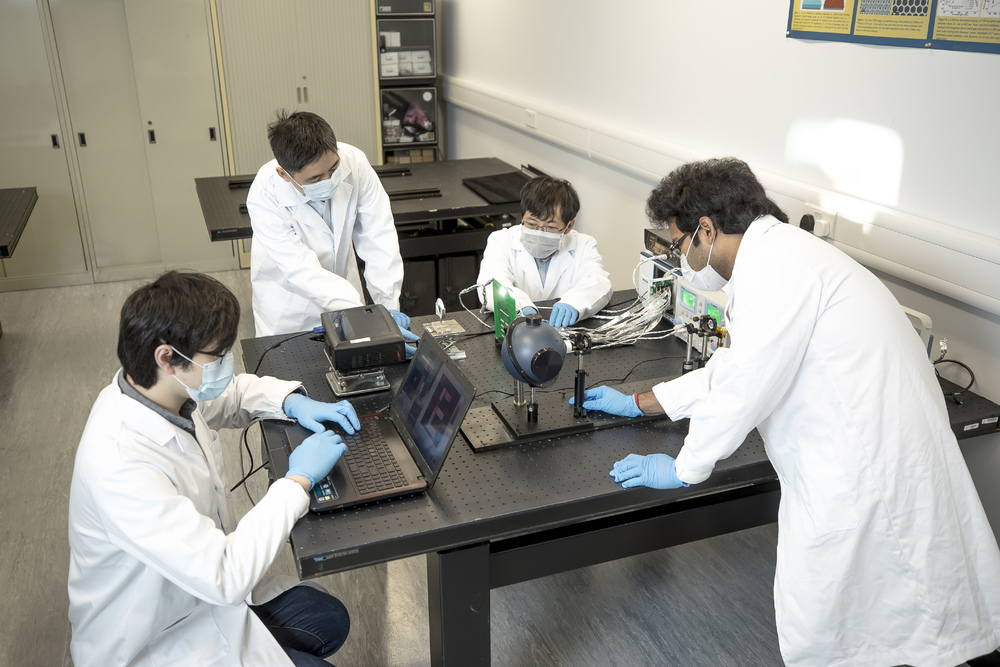
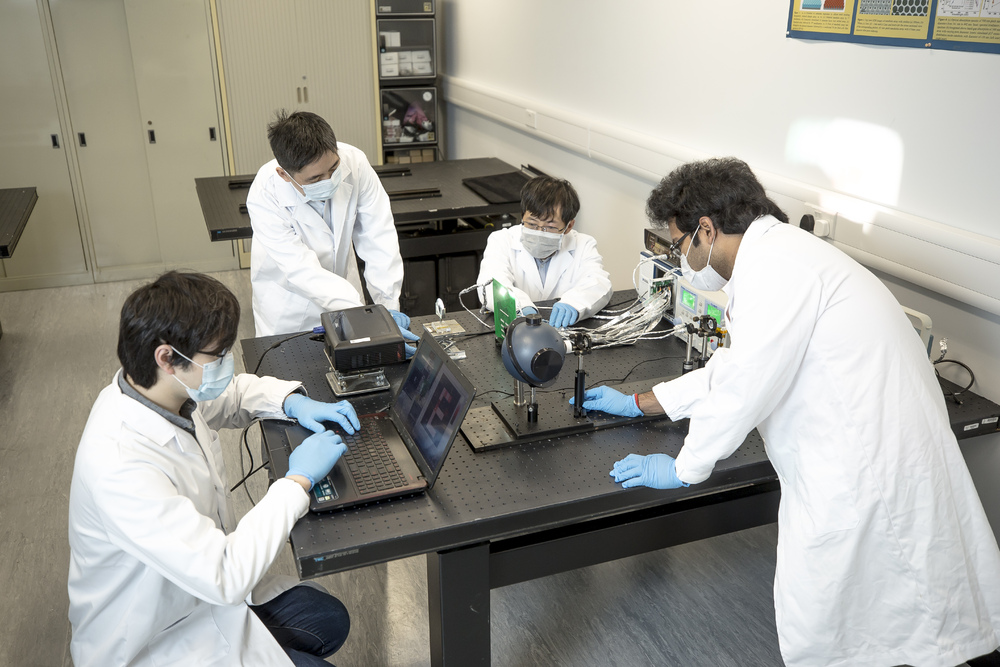
There's light at the end of the tunnel for people suffering from visual impairment with researchers coming up with the world's first 3D artificial eye that has capabilities that exceed even those of the human eye.
However, the artificial eyeball can only help those blind people whose optic nerves still function and even people with retinal diseases regain eyesight, but not those who are genetically impaired.
Developed by the Hong Kong University of Science and Technology, the research team plans to continue the study with in-vitro and animal tests as well as human clinical trials.
Called the Electrochemical Eye, it replicates the structure of the human eye.
It consists of a hemispherical retina made up of a high-density array of nanowires that mimic the photoreceptors on a human retina - an inner layer of the eye that senses light and sends signals to the brain.
"Solar cell materials were used for nanowires to stimulate neurons so no external power supply is needed to run the artificial eye," said Gu Lei-lei, one of the lead professors.
Gu said as the liquid metal fiber, which is similar to the optic nerve, is located behind the artificial retina, EC-Eye does not possess some weaknesses of the human eye, such as light transmission loss and having a blind spot.
"In this sense, it is more similar to the retina of an octopus. We learn from two creatures, humans and octopus, to optimize the bionic eye's structure," Gu said.
The hemispherical artificial retina has a nanowire density that is much higher than that of photoreceptors in a human retina.
Its bionic retina can provide a resolution image (25,400 dpi) that is two times higher than the human retina (8,500 dpi) and 500 times higher than existing prosthetic eyes (about 45 dpi).
Due to the highly sensitive nanowire, night vision can be obtained in the future when placed with infrared materials.
The team, which is also led by Fan Zhi-yong, professor of electronic and computer engineering, started the nine-year research project in 2016.
The study, conducted with the University of California, Berkeley, was published on May 20 in the scientific journal Nature.