As Xinhua News Agency issued an "authoritative bulletin" citing the Politburo as calling for a sense of "urgency" for doing a good job in economic work, there was also a sense of urgency in the way the bulletin was made.
The powerful Politburo held its monthly meeting yesterday.
While Xinhua would have been expected to release the bulletin later in the evening in accordance with past norms, this release was made in the middle of the day and early enough to send stocks in the city and the mainland to recent highs.
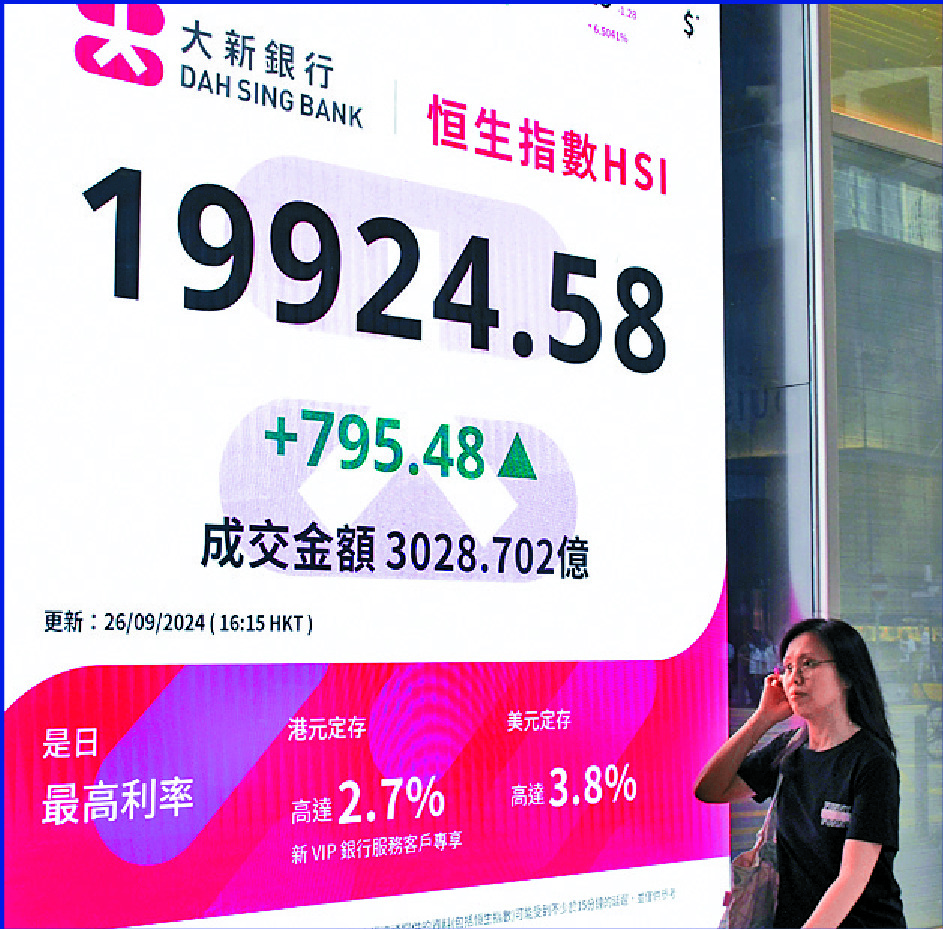
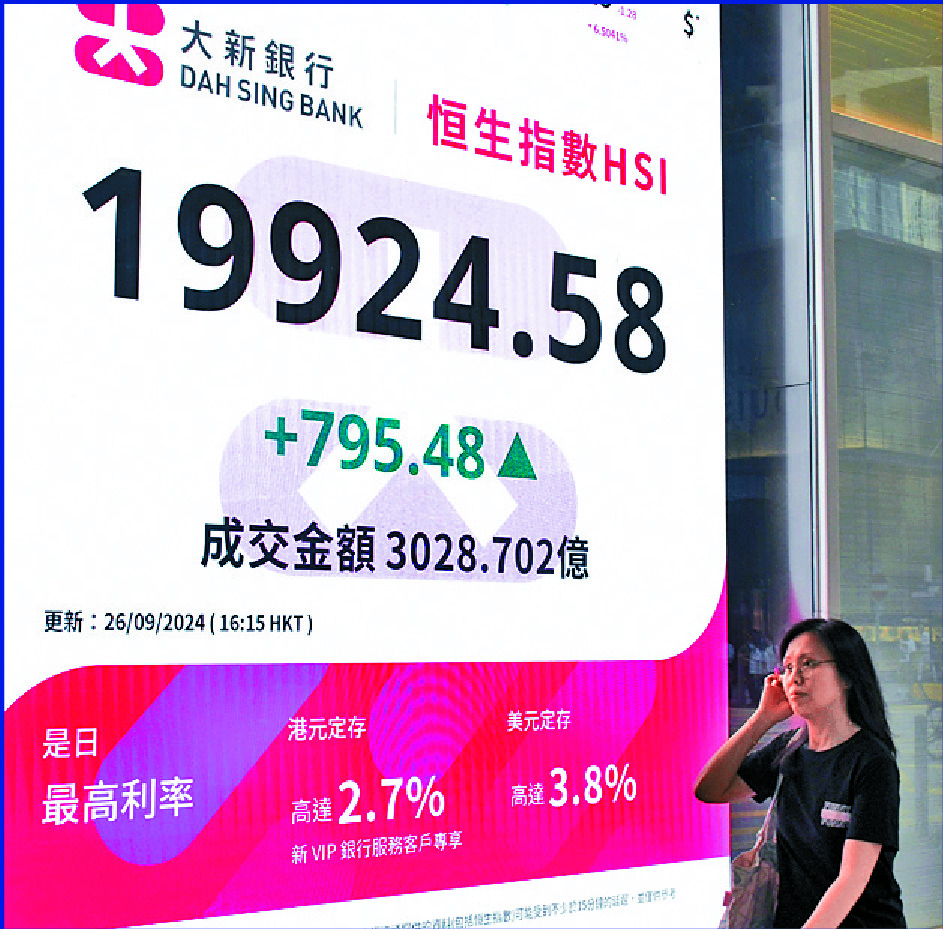
The Hang Seng Index was about to recapture the 20,000 mark after a 4.2 percent lift, while Shanghai's composite index easily shot past the 3,000 level.
The announcement was consistent with one of the outcomes reached by the Politburo.
According to Xinhua, the leaders have decided that it is necessary to boost the capital market whereby medium and long-term funds will be guided and bottlenecks opened up for social security, insurance, wealth management and other funds to enter the market.
The earlier-than-usual announcement achieved a head-start. Had the leaders decided to make it after the market had closed, the overall picture in the Hong Kong and mainland stock markets might have been different.
Mainland banking authorities, led by the People's Bank of China, unveiled a slew of monetary tools earlier this week to stimulate the economy by cutting banks' Required Reserve Ratio to increase liquidity by 1 trillion yuan and lower interest rates.
But investors - though feeling excited over the "boldest" stimulus since the pandemic - continued to question whether monetary tools alone would be strong enough to fix an economy in which factories are shutting down, unemployment keeps rising among young people and wages are being slashed by half or more, in addition to a collapsed real estate sector.
It was argued that monetary policies have to be backed by fiscal initiatives at the same time in order to achieve the best results.
The Xinhua release shows the Politburo is trying to fill in the gap with the fiscal piece.
It says: "The meeting stressed that it is necessary to intensify the counter-cyclical adjustment of fiscal and monetary policies [and] ensure necessary financial expenditures."
However, notice the words the bulletin mentions about the emergence of "new situations and problems" that demand a sense of "urgency."
What are the new situations and problems? As usual, the official bulletin does not specify, but it is presumed they are related to the international situation, including the imminent change of US president.
Monetary and fiscal politics often go hand in hand as a country's economy is fixed.
The bulletin stops short of elaborating on what the exact fiscal measures are going to be after spelling out the direction.
But it can be expected that individual policies will be announced in the near future to stimulate, for example, household consumption as the country seeks to lower its reliance on trade with its major trading partners, including the US and Europe.
The fiscal spending will be funded mainly by various kinds of bonds.