Read More





They are concerned that this would mean additional homework for children when they are already loaded with tight study timetables that are also saturated with private tutorial sessions and extra-curricular activities.
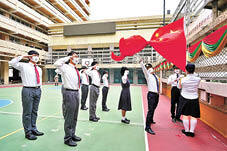
Education in the SAR has already undergone a fundamental transformation in recent years, with increased emphasis on patriotism.
Strictly speaking, whether or not the bill is inserted in Annex III of the Basic Law will have no material impact on the course of patriotic transformation taking place here - but it could limit how local officials and educators promote patriotism.
Once included in the Basic Law annex or given effect through local legislation, the national bill - or its equivalent Hong Kong version - would become law.The question is, a law usually tends to be restrictive in nature. Facing such a law, it would be easy for decision makers - including officials and school principals - to err on the side of caution in order to avoid making mistakes, fearing they could land in a precarious position.
Yesterday, the SAR's only representative on the standing committee, Starry Lee Wai-king, cited her understanding that the proposed patriotic legislation would not be inserted into Annex III of the Basic Law following its passage.Furthermore, Lee - also a lawmaker for the Kowloon Central geographical constituency - doubted whether it would be necessary for the SAR to pass legislation to give local effect to this national bill.
Rather, she believes Hong Kong can come up with alternative arrangements that are suitable for the SAR.Lee's remarks may be viewed as an assurance.
Under the one country, two systems arrangement, the SAR is expected to handle its own affairs. If Lee's prediction turns out to be correct, this would be consistent with the constitutional design.Speaking ahead of the Executive Council meeting yesterday, Chief Executive John Lee Ka-chiu expressed confidence that the SAR would have no difficulty in meeting the requirements of the national legislation because so much has already been done locally.
The NPC standing committee began its three-day deliberations on Monday, with a draft of the bill introduced for first review.As soon as the draft was revealed to standing committee members, speculation was widespread that it may either be included in the Basic Law Annex III or legislated locally to give effect to the SAR.
In light of the comments, it is likely that Hong Kong would be allowed to devise its own scheme of patriotic education to uphold the "one country" goal and practice the "two systems" arrangement.