Read More











Separation of powers as a political concept is often sound in theory but bad in practice, and recent events in the top US court are a good example.
Before the United States is a golden opportunity for politicians on the right to plant their influence in the judicial system to shape the American way of life for decades to come.
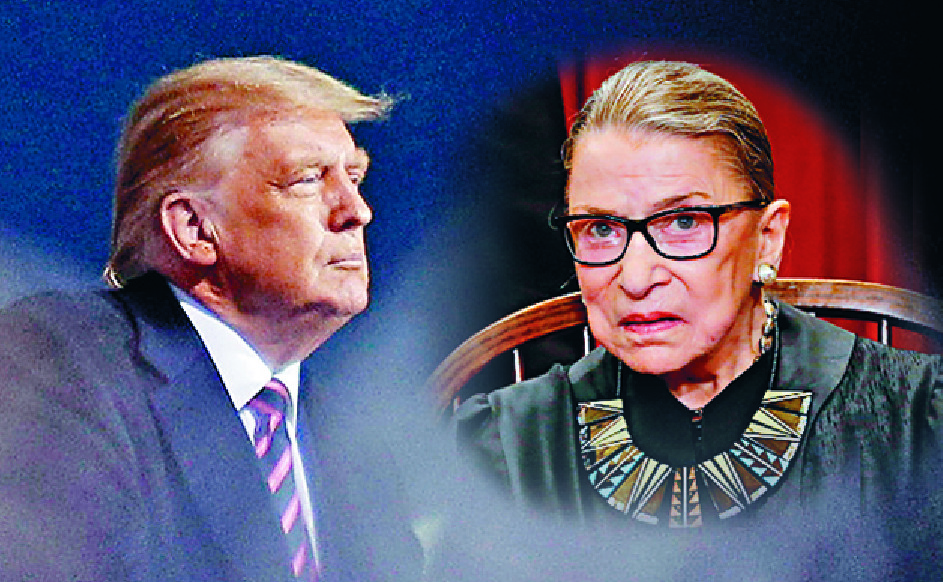
The death of Supreme Court judge Ruth Bader Ginsburg, a vanguard of liberal values, may have been expected, given she'd been suffering from an advanced stage of cancer, but her passing away was still untimely.
Roughly six weeks before the US presidential election, the death has become a hot political issue immediately. Her wish to have her successor selected only after the November 3 presidential election is most unlikely to be respected.
This is not only about respecting RBG's deathbed wish; it is morally right in a democratic sense for the selection to be made only after the vote, given that it is only just over a month away.
Since a Supreme Court appointment is a lifelong one, it will be best to leave the matter to whoever wins the election - be it Donald Trump or his challenger Joe Biden - and the Republicans or Democrats who control the new Senate.
As such, it was alarming to hear Trump say he would nominate a female judge to fill Ginsburg's vacancy as soon as this week and Senate majority leader Mitch McConnell publicly undertake to call for a vote on Trump's nominee.
Even though it wasn't surprising that Trump would seize the opportunity to expand conservative values in the top court, it's nevertheless unsettling. The attempt to increase the conservative-liberal ratio in the top court from five-four to six-three is most inappropriate, mocking the noble notion of separation of powers that is treasured so much by a purported democratic society.
The US has a democratic system whereby the president and congress are chosen in elections and, as a further means of checks and balances, the president nominates Supreme Court judges for the Senate to approve. These appointees serve for life so that they won't be intimidated by a change in government.
The idea isn't perfect but it may be the fairest. The powers are not completely cut off from each other but are subject to the greatest possible checks and balances.
Yet, it does happen from time to time that the principle is bent to partisan interests, as is happening in the present case.
If McConnell deems himself right in 2016 in refusing to consider Barack Obama's nominee even though it was months prior to the election, it sets a precedent and the Senate shouldn't consider any nominee until after the inauguration of the new president.
As such, McConnell's pledge to call a vote on Trump's nominee is sickening plain and simple.
It's clear that Trump is hoping for a political boon for his presidential issue from this campaign. Although one Republican senator has broken ranks, stating Ginsburg's replacement should be the choice of the president to be elected in November, it will require several more Republicans to defect to stop this blatant politicking and overturning of US political customs and norms.