Read More
It was a bloody Monday for the Hong Kong stock market yesterday following the absence of any signs of relaxation in China's zero-Covid policy and there were no economic stimuli announced after the Communist Party congress.
ADVERTISEMENT
SCROLL TO CONTINUE WITH CONTENT
Add to that experienced party officials with financial and economic backgrounds are set to retire.
The benchmark Hang Seng Index plunged as much as 1,128.3 points yesterday to the lowest in 13-and-a-half years before closing at 1,030.43 points, or 6.36 percent, lower at 15,180.69. Market turnover reached HK$161.8 billion, the highest since June.
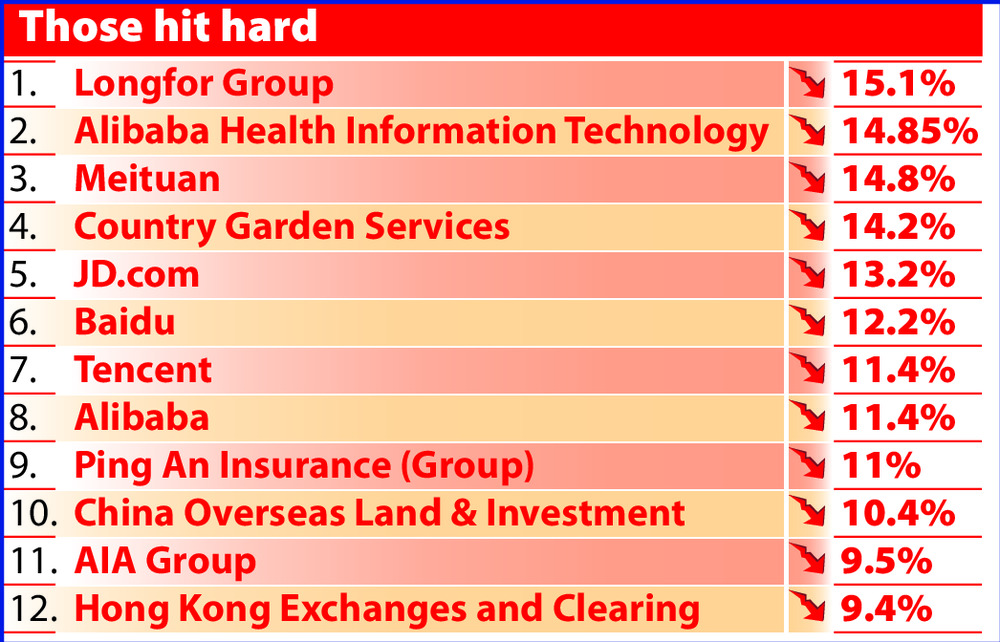
The Hang Seng Tech Index hit a fresh new low after sinking nearly 10 percent, with giants Alibaba, Tencent, Meituan and JD.com all tumbling more than 11 percent as investors remained skeptical that President Xi Jinping and his allies will seek a rejuvenation of private enterprise.
Since the beginning of this year, the HSI has plummeted more than 35 percent, making it the worst performer among major stock markets in the world. The Nasdaq Composite Index has lost more than 30 percent of its value.
Analysts said the HSI may not yet reach its bottom. There is still downward adjustment pressure in the short term, said Kenny Ng Lai-yin, a strategist at Everbright Securities International.
The Shanghai Stock Exchange Composite Index and the Shenzhen Stock Exchange Composite Index also fell around 2 percent. But the Hang Seng Futures rose 100 points by last night.
"Market sentiment could remain cautious near-term on China, on concerns of a shift in focus toward more state control versus a market-driven approach under the new leadership team," said Xiaojia Zhi, the chief China economist at Credit Agricole CIB. "The exit path from zero-Covid is not yet clear."
Economists remain wary about future growth, given the rolling Covid lockdowns. Authorities suspended in-person schooling and dining-in at restaurants in a district at the center of Guangzhou, stoking concerns about potential disruption in the manufacturing hub.
The market meltdown also followed the leadership reshuffle, which showed Xi's unquestioned grip over the ruling party after he secured a third leadership term and the retirement of more market-oriented officials. Premier Li Keqiang, 67, and economic czar Liu He, 70, plus central bank governor Yi Gang, 64, and banking regulator Guo Shuqing, 66, were dropped off lists of full or alternate members of the Central Committee.
The men - who have strong academic credentials and are known for promoting policies supportive of opening up the economy - are all around the official retirement age of 65 for minister-level officials. They are expected to be replaced by Xi's allies after he installed six associates on the Politburo's Standing Committee, putting his former chief of staff, Li Qiang, in line to become premier.
It is clear that national security and the party's political security will take precedence over economic growth, said Drew Thompson, a visiting senior research fellow at the National University of Singapore's Lee Kuan Yew School of Public Policy.
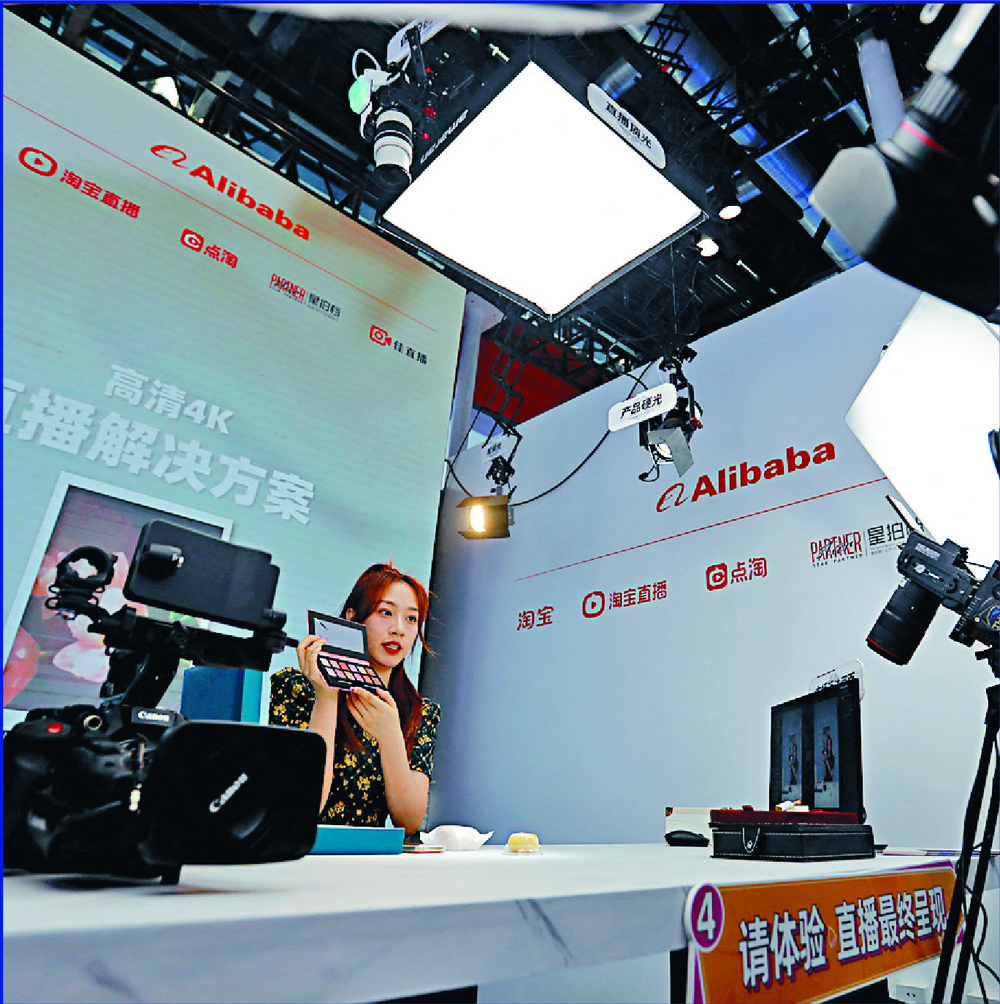
Tech stocks took a beating.