Read More




Amber rainstorm warning issued at 11am
7 hours ago







Iran demands transit fees in yuan, stablecoins for Strait of Hormuz passage
03-04-2026 02:45 HKT
China's top legislative body will meet again on Sunday in a rare move that could fast-track the enactment of a national security law for Hong Kong.
Prominent pro-Beijing figure Lau Siu-kai said the National People's Congress Standing Committee is "highly likely" to approve the national security law in the three-day session set from June 28.
That would mean the national security law would come into force on July 1 - the 23rd anniversary of Hong Kong's handover to China.
"I believe the committee is in full agreement on all elements of the law that have already been made public, and hence there is a high possibility that it will put the law to a vote during their next meeting even though it has not been placed on the agenda yet," Lau said.
The announcement was considered rare as the last NPCSC session had just wrapped up on Saturday and it typically meets every two months.
But Tam Yiu-chung, Hong Kong's sole delegate to the NPCSC, brushed off claims that it was unusual for the committee to meet twice in a month.
"The meeting time of the Standing Committee depends on the workload and urgency," Tam said.
"It is true that we normally meet every two months, but we have also called additional meetings in the past, therefore it is not particularly special."
Both Tam and state media Xinhua News Agency stopped short of saying whether the national security law is listed on the agenda, but Tam said it could be added on the agenda afterward.
According to the Legislation Law in China, a bill which has been put on the agenda may be brought to a vote after two deliberations if a preponderant consensus is formed.
Speculation was rife that the draft of the national security law was not on the agenda of the last session, but it was announced after the meeting started that the draft had already been passed to the Standing Committee for scrutiny.
Meanwhile, former deputy director of the Basic Law Committee, Elsie Leung Oi-sie, said the Beijing-appointed adviser for the Hong Kong commission to safeguard national security has no law enforcement powers and that his or her role remains advisory instead of as an "overlord."
This came after the pan-democratic camp alleged that the Beijing-appointed national security adviser will act as a "political adviser" to the chief executive instead of a "national security adviser," making the adviser an "overlord" who controls the chief executive on behalf of the central government.
On a radio program yesterday, Leung brushed off these claims, saying the adviser only offers counsel and only the commission can decide whether or not to accept the advice.
"If you say the adviser has 'supreme power' over the chief executive, it should be clearly stated in the law. But based on the illustration of the drafted legislation, the adviser's role will remain advisory," she said.
The former justice secretary also said there will be very few cases for which Beijing would wish to assume jurisdiction and that these would only be in particular circumstances to be spelled out in the bill.
"In the colonial era, a governor who breached the law was tried in Britain instead of Hong Kong. Allowing suspects to be tried in the mainland might be paving the way for the chief executives or principal officials who threaten national security to be tried in mainland courts," Leung said.
In a joint statement last night, Secretary for Security John Lee Ka-chiu led the heads of the disciplinary forces - including the police commissioner, customs commissioner, director of fire services, correctional services commissioner, director of immigration and controller of the government flying service - to pledge their "full support" for the enactment of the national security law.
A government spokesman said the Security Bureau has begun preparation for the law and special teams from the police force and the Department of Justice are under way.
At the same time, pro-Beijing newspaper Wen Wei Po wrote yesterday that those advocating Hong Kong independence should be regulated by the law as their remarks should not come under freedom of speech.
The article said it is an international consensus that freedom of speech is not absolute and shall be restricted when it threatens national security.
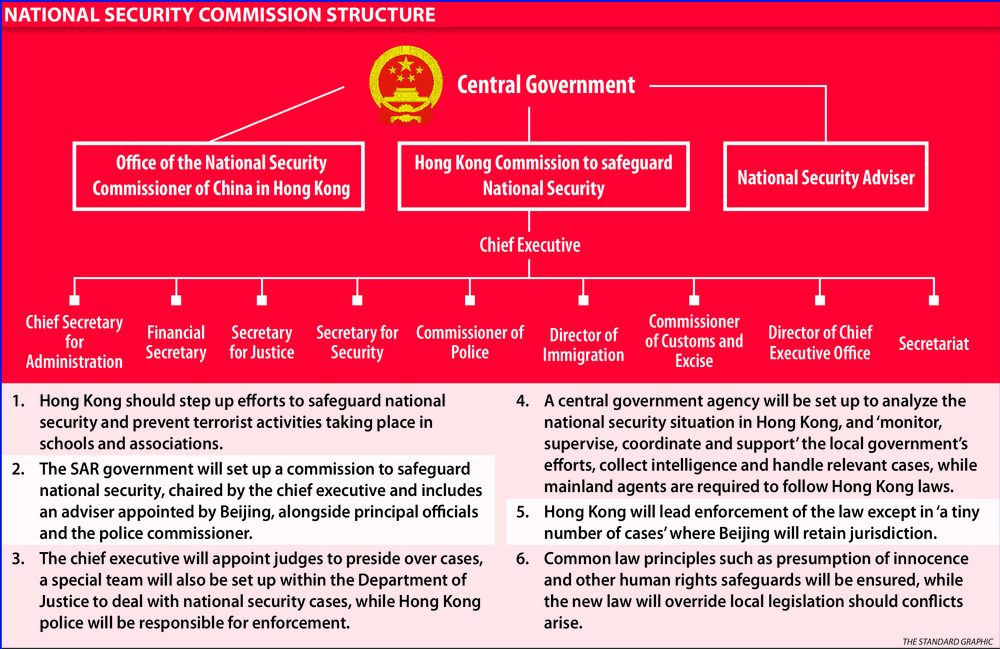
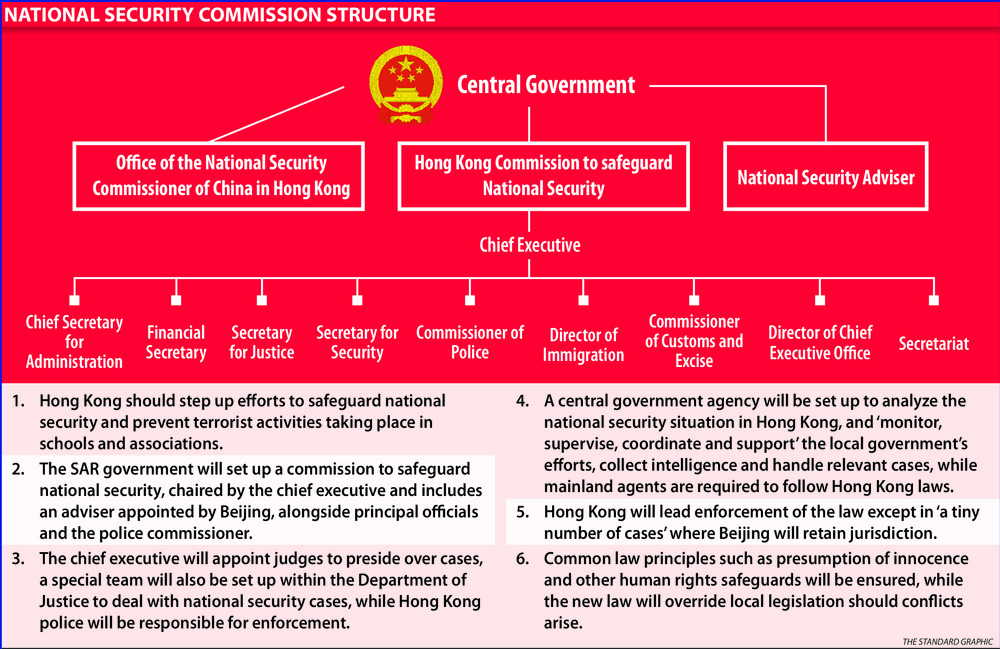
Xinhua earlier published an illustration regarding the draft of the law, which stated that the SAR government should step up efforts combating threats to national security and terrorism behavior.
The SAR government should also set up a commission to safeguard national security, while the central government will also set up an agency in Hong Kong to analyze the national security situation.
Judges that preside over national security cases will be appointed by the chief executive and special branches in the Department of Justice and the police force will deal with those cases.
The new law will override local legislation should conflicts arise and Beijing will retain jurisdiction in "a tiny number" of cases.
Meanwhile, director of the Hong Kong and Macau Affairs Office Xia Baolong met Legislative Council President Andrew Leung Kwan-yuen in Shenzhen last night. Both sides have not revealed what has been discussed.
michael.shum@singtaonewscorp.com
Editorial: We'll soon be able to judge new law