Read More



Defying the demographic cliff: restoring hope
06-10-2026 04:56 HKT

Transport chief takes a back seat on fining transit nuisance behavior
14-10-2026 18:09 HKT
When People's Daily released a video designed to promote the different faces of China to the international community, the state-run media may have been unaware it was wading into a long-standing debate on the question of learning English as a foreign language in the mainland.
It is not immediately known what the international community thinks about the video, titled This is Me, the People's Republic of China, that juxtaposes images of ancient China with those of the country today.
But it is likely that the video, narrated in English, may help revive the debate that first saw Beijing's municipal education authority declaring, soon after President Xi Jinping came to power, that it would cut by a third the weighting accorded to the English language in the exam.
Although the plan was later abandoned, the issue has remained.
During the two sessions that concluded last week, the subject was brought up again.
National People's Congress deputy Tuo Qingming was among a handful in the political elite that questioned the need for English.
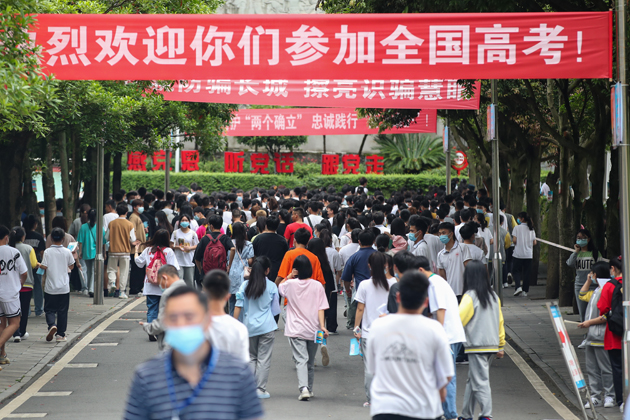
Tuo said it was a time-consuming subject and called for the weighting of the English language in the College Entrance Exam - or gaokao as it is known in the mainland - to be drastically reduced to ease the burden on students and narrow the gap between rural and urban schools.
Tuo went on to say that learning English had limited practical value for many mainlanders.
Chinese People's Political Consultative Conference member Chen Zhiwei was more radical, with a proposal for the English language to be removed as a core subject in both primary and secondary schools.
It is essential for students to learn a foreign language - English in this case - from a young age if they are expected to acquire proficiency.
Any suggestion that the subject should cease to form part of the core studies at primary and secondary levels does not make sense.
Nonetheless, as Chen's counterpart Tuo spoke about lowering the weighting for English in gaokao, there was a grain of truth in his observation.
This is not that the weighting should be cut as proposed but, rather, the factual observation that there exists a gap between rural and urban schools in their levels.
The gap is due to an imbalance in resources allocation which, ironically, cannot be resolved by lowering the standards of learning but only through greater efficiency in the use of resources.
As People's Daily chose to narrate the video production in English and not Putonghua, does it already follow that the state has also made up its mind on the matter?
Otherwise, would it have followed others and narrated the promotional video in Putonghua, the language spoken by over a billion people in the mainland?
Before us is a question of common sense.
Were Putonghua to be used instead of English, would the audience be able to understand This is Me, the People's Republic of China?
Greater efforts should be made to learn the language well rather than trying to inappropriately solve a problem by eliminating an essential.