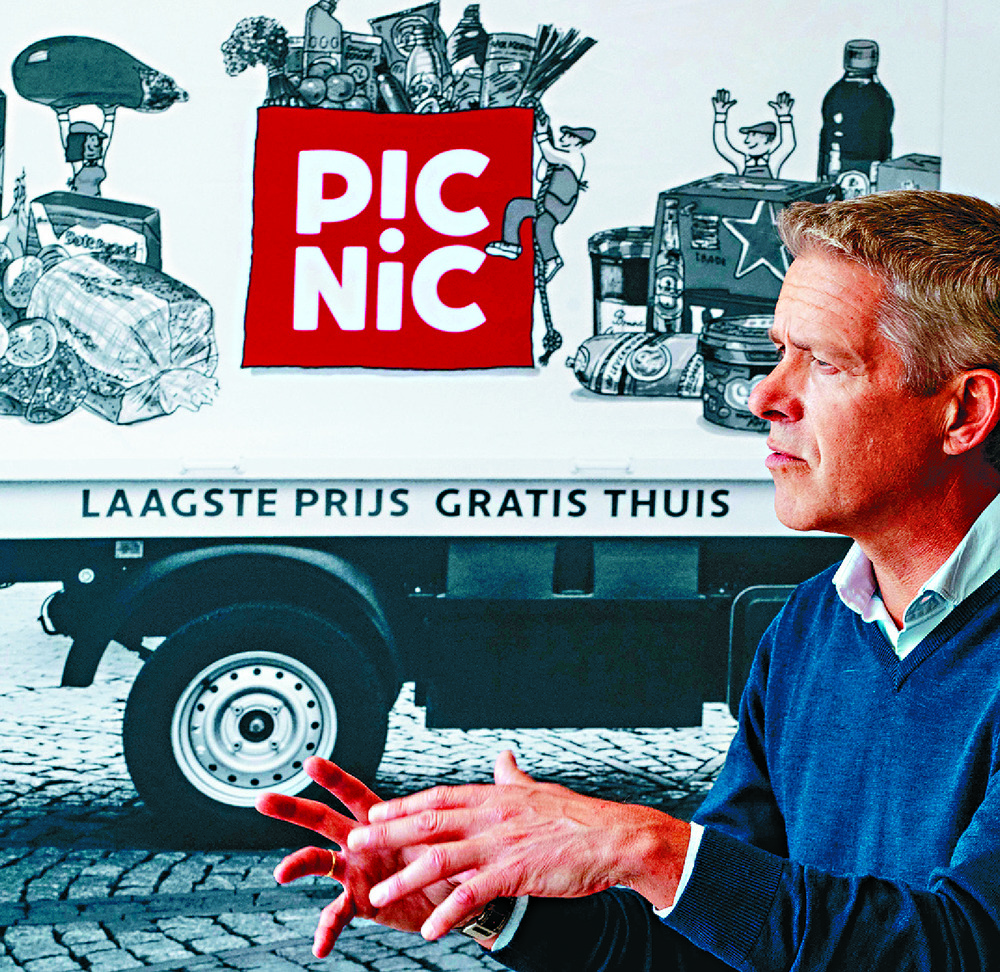
Advances in artificial intelligence are poised to drive a "massive" boom in online grocery deliveries, according to the head of Picnic, a Dutch app-only supermarket rapidly expanding into Germany and France.
Picnic has disrupted its home supermarket landscape with an offer of free delivery in a time window of 20 minutes - made possible by squeezing efficiencies out of huge amounts of data.
The firm already uses AI for a vast range of operations, said CEO Michiel Muller, 59, at its 43,000-square-meter distribution hub in Utrecht, central Netherlands.
"For instance, predicting how many bananas we will sell in three weeks. Or what happens when the weather is good or bad. Or doing our whole route planning," he said.
As the tech improves and datasets grow, predictions will become more accurate, further reducing food waste and offering even more precise time slots, he said.
"Don't forget supermarkets weren't here 60 years ago. You only had smaller stores. So there's always a movement around new tech and new ways of delivering goods."
"The supermarket will remain. That's for sure. Stores will remain. But the online part will grow massively," he said.
Picnic has developed its own software to fine-tune every element of the delivery process, from processing and packing stock at the warehouse to the famously complex "last mile" of dropping off the goods.
Delivery times are calculated with extraordinary precision, with reams of information crunched by 300 analysts and 300 software engineers at headquarters.
"We know how long it takes to walk around a vehicle and when it's dark, we add six seconds to delivery times," said Muller.
Unlike a regular supermarket, every order comes through on the app, so the firm knows exactly what it needs to order, deliver, and how long that should take.
It estimates this results in seven times less food waste than at supermarkets.
"There's not a single baguette that is ordered and not delivered," said Gregoire Borgoltz, head of operations in France.
Its drivers in ubiquitous white Picnic vans receive a rating after every trip based on their driving, even assessing whether they have sped too fast around corners.
The huge investments required in bespoke software, plus its distribution hubs with 14 kilometers of conveyor belts, means profits have been hard to come by.
Sales have risen from 10 million euros (HK$83.77 million) in 2016 to 1.25 billion in 2023, with staff levels soaring from 100 to 17,000 over the same period.
Muller said losses hit "around 200 million euros" last year due to expanding in Germany - opening slots in Berlin, Hamburg and Hannover.
For the first time since its 2015 founding, it finally turned in a gross profit this year in its home market. "It took eight years to be profitable in the Netherlands," he said.
This year, it raised 355 million euros to fund its push into Germany and France, notably from the Bill and Melinda Gates Foundation and German retail giant Edeka.
When it comes to profits, it's again all down to technology, said Muller.
"Basically, the level of automation determines our profitability level," he said.
"Today, we have about 30 percent automated in Holland. We will grow to 100 percent in a couple of years' time," with Germany and France following soon.
So far, Picnic is mainly operating in the northern French city of Lille and the greater Paris suburbs. Central Paris is a "big opportunity but also has some of the worst traffic jams," said Borgoltz.
Muller has ambitions to spread further. "Well, there are 183 countries in the world," he jokes.
AGENCE FRANCE-PRESSE
A Picnic employee checks orders in baskets before the groceries are delivered. Below: Michiel Muller. aFP