The battle for consumer attention in China's electric car market is being fought over touches of "tech luxury" that car buyers in other markets have never seen.
China's upstart electric brands, and even its state-owned, legacy automakers, are racing to pack technology and features once considered premium into EVs as cheap as US$20,000 (HK$156,000) - less than half the cost of an average new car in the United States, now more than US$48,000.
That represents a deepening challenge to foreign brands in China, including Tesla and Volkswagen, and others, analysts say.
Last year, BYD shocked the sector by releasing Seagull EV, now priced under US$10,000 and China's fourth-best seller.
But other Chinese automakers, including state-run companies that were later entrants to the EV race, have closed the gap on sub-US$10,000 EVs at last week's Beijing auto show.
The market is also crowded with electric and plug-in vehicles starting near US$20,000 that still splash on once-expensive interior features and technology.
Chinese, especially younger ones, rank "tech luxury" as an important consideration, and the country's automakers are taking the lead on such features, said Bain & Co partner Raymond Tsang in Shanghai.
"This is different from many Western markets where traditionally buyers are still weighting quite heavily on build quality, reliability, ride and handling," he said.
In a race to stand out, some Chinese brands are offering features intended to be fun, if not frivolous.
The Baojun Yep, a mini-EV by SAIC-GM-Wuling joint venture that starts around US$11,000, has a screen on the tailgate where drivers can flash messages such as "thank you," or a heart emoji, to acknowledge the kindness of another road user.
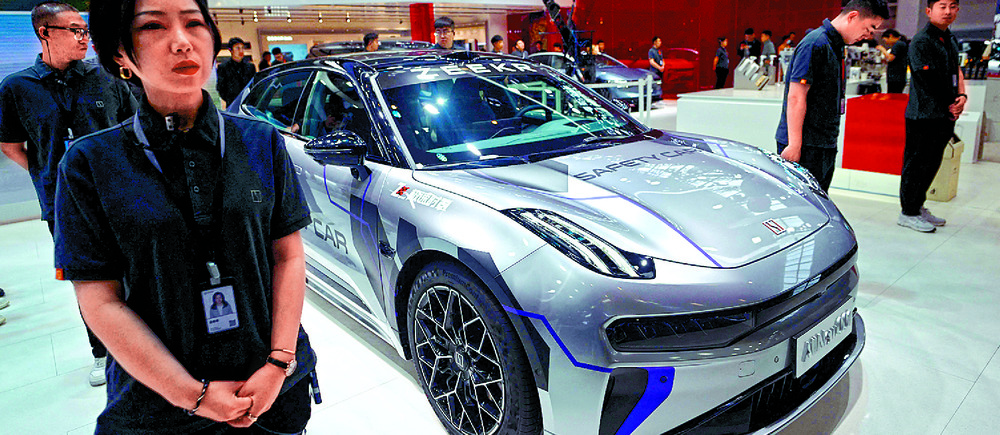
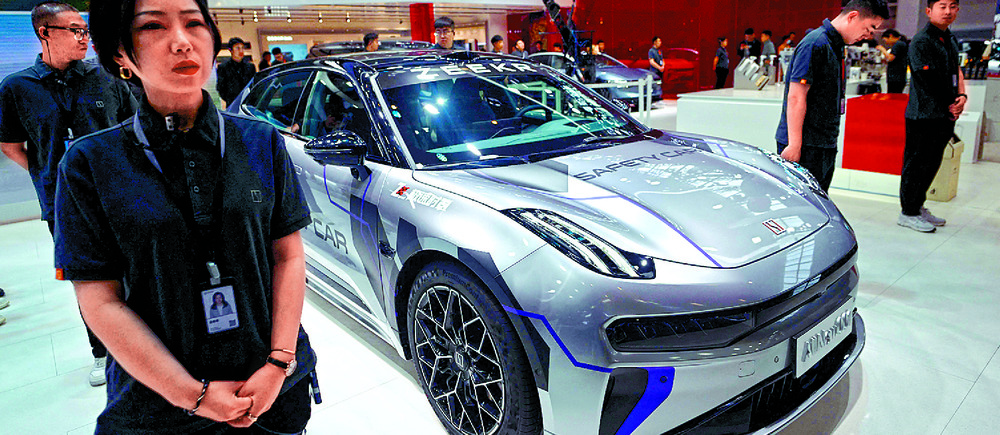
The Zeekr 001 electric sedan, a premium offering that starts around US$37,000, has a front grille that can play music at a stop while giving pedestrians a bouncing string of thumbs-up emojis.
SAIC Motor brand Roewe's just-released D5X DMH plug-in hybrid SUV, which starts around US$16,500, allows drivers to enter up to 10 different commands into a navigation system, such as a series of different destinations, all at once.
XPeng and Nio, EV-focused firms that launched as startups, are rolling out mass-market brands. Xpeng expects its Mona-branded EV to be the first in China priced below US$21,000 to have high-level self-driving features.
"Even one or two years ago, I didn't think we could achieve that," XPeng co-president Brian Gu said last week.
In China, the price of specialized components - including sensors needed for self-driving features and screens for on-board entertainment - has tumbled and competition has intensified in the world's largest auto market, analysts say.
State-owned Dongfeng showed off the Nammi in Beijing, an EV with a 300-kilometer range that sells for US$9,600. It features flush door handles that pop out on command, an aerodynamic feature popularized by Tesla. Owners can start the car and open doors remotely with a phone.
Historically, US and European brands have been considered more luxurious and higher quality than Chinese brands. That's changing fast, analysts say.
"The halo of foreign brands has almost disappeared," McKinsey analysts said in March. "Foreign, high-end traditional car owners are being transformed into Chinese high-end, new energy brand owners in an almost one-way flow."
German carmakers are not standing still.
Volkswagen, China's leading foreign brand, plans to deliver the "Chinese wow effects" tech-savvy consumers there expect, China chief Ralf Brandstaetter said.
Mercedes-Benz CEO Ola Kaellenius said his Chinese digital tech team was dedicated to catering to the tastes of younger and more tech-oriented consumers in China.
"In the new E-Class, you can sing karaoke. Maybe you don't have that feature in Germany. Maybe you should. But here customers love it," he said.
Both executives said their cars had the capability to add new features with "China speed" through over-the-air updates.
At Chinese tech giant Huawei's flagship store in central Beijing, Jack Xu was shopping not for a phone but for his first EV last week. The one that caught his eye was a Huawei-backed SUV under the Aito brand, an EV made in partnership with Seres.
"For EVs, we are already leading the world," the 36-year-old education worker said, looking at the display screen spanning the width of the front row. "Why would I choose a foreign car?"
REUTERS
Zeekr 001